19 Aug, 2026
Older Americans leaving workforce poses challenges for AI plans

By Brian Scheid
Flush with record stock market gains, baby boomers are leaving their jobs in droves, upending a 25-year trend in the US labor market and triggering a workplace experience gap that could complicate how effectively businesses can implement new AI tools.
"The premium on experience is going to go up," Joseph Fuller, a professor of management practice at Harvard Business School, said in an interview.
The labor force participation rate for Americans aged 55 and older dropped to 36.9% in July, down 120 basis points from a year earlier and marking the lowest rate for this group since March 2005, according to the US Bureau of Labor Statistics. Historically, the participation rate — a measure of the share of a group either working or actively looking for work — has steadily risen for this age group since the early 1990s, as more older Americans have remained in the workforce.
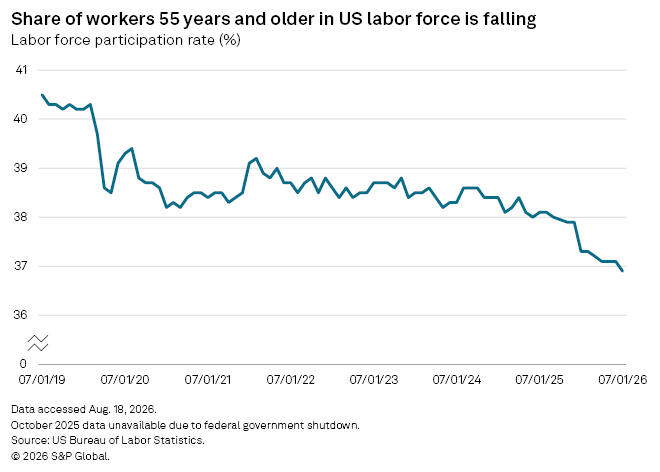
With the share of older Americans in the workforce declining, experience and skills in the labor market are eroding, and a generational shift in work appears to be intensifying, said Thomas Simons, chief US economist with Jefferies.
"Mid-career workers are enjoying increasing leverage in seeking higher wages, while [Generation Z workers] are left in the cold, out of focus for employers and unable to learn from boomer co-workers," Simons wrote in an Aug. 7 note. "The experience recession is intensifying and unlikely to improve any time soon."
As of July, the participation rate for Americans aged 65 and older was 230 basis points lower than its pre-pandemic level. Meanwhile, the number of people in this age group grew by more than 11 million between 2019 and 2025, according to World Bank data.
Americans aged 55 and older account for approximately 23% of the overall workforce, up from less than 14% 25 years ago and about the same as a year ago, according to data from the Bureau of Labor Statistics. However, the overall number of workers in this age group has declined by about 350,000 over the past year. As of July 2026, roughly 37.7 million Americans 55 and older were in the US labor force.
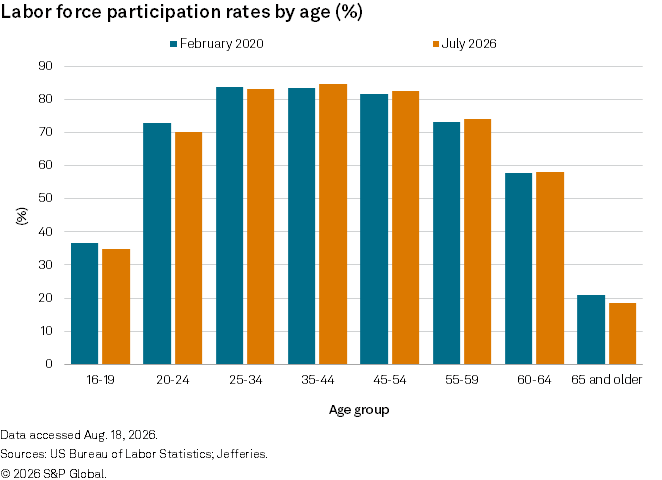
Simons, who referred to this change as the "Boomer Brain Drain," wrote that the aging workforce over the past 25 years boosted cumulative skill and experience in the labor force. Nevertheless, this trend has ended, creating new challenges for American businesses.
"While businesses may immediately recognize some benefit from having fewer highly paid older workers on their books, they will feel the negative impact of the loss of access to their skills and the interruption of their ability to pass skills on to younger co-workers over time," Simons wrote.
Wealth effect
Record highs in the stock market, equity gains in housing and the rising value within workers' 401(k) accounts are encouraging more older workers to leave the workforce, pushing them toward retirement earlier than expected.
"We are in peak for baby boomers aging into retirement," Diane Swonk, chief economist at KPMG US, told S&P Global Market Intelligence. "And equity gains are most concentrated in baby boomers — more than previous generations — which likely helped accelerate those retirements."
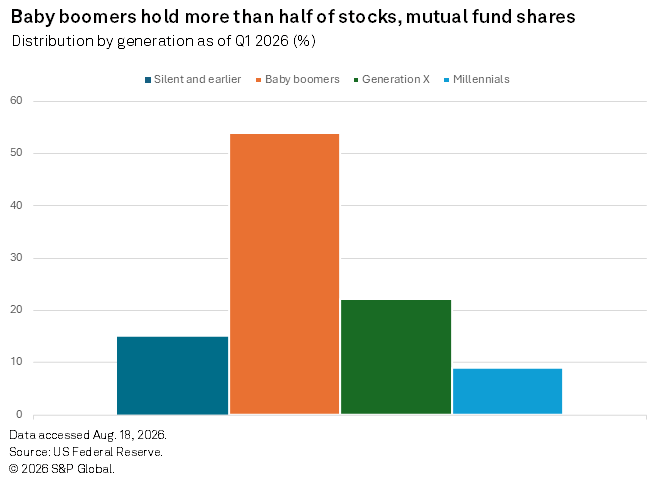
This trend is contributing to worsening labor supply shortages across the economy, according to Aditya Bhave, a US economist with Bank of America Securities.
Bhave noted that this should put downward pressure on the unemployment rate, which is arguably already happening, and upward pressure on wage inflation, which is not yet taking place.
Contextual intelligence
The overall trend of an aging workforce, coupled with early retirements and the substantial decline in immigration, has contributed to an erosion of what Fuller of Harvard Business School calls "contextual intelligence" in the labor force.
"A business might have people that went to great schools or ... [are] more technologically literate than the 58-year-old, but it doesn't matter if you don't understand the context," Fuller said.
This context, which comes from years of experience, customer relationships and knowledge in a given field, is declining as workers with long-tenured knowledge are leaving the office for the golf course and extensive overseas vacations, Fuller said.
Fuller noted that this loss will be increasingly felt as more businesses push for AI to take on new workplace responsibilities and workflows.
"Contextual intelligence is going to be really, really valuable in the age of AI," Fuller said. "Someone with contextual intelligence can look at an output from AI and say, 'That just doesn't make sense to me,' or 'Huh, I've never thought of that, but that's very interesting.'"
This shift has been one of the unique outcomes of the ongoing AI breakthrough, according to Tatiana Bailey, founder and executive director of Data-Driven Economic Strategies.
While previous technological revolutions, such as the proliferation of personal computers and the widespread use of the internet, have typically favored younger workers, that has not been the case with AI so far.
"In this technological breakthrough, older workers are valued more," Bailey said in an interview. "They have the experience, they have better critical thinking, and you need that context for AI prompts and verifying things."