03 Aug, 2026
Next-generation geothermal developers seek broader market appeal

By Nushin Huq
As projected power demand continues to rise in the US, companies are turning to new technologies to provide around-the-clock carbon-free power, including next-generation geothermal energy.
Utilities, hyperscalers and other buyers are signing long-term geothermal power contracts, anticipating that advances in technology can turn underground heat into clean baseload power. Next-generation geothermal developers believe that they can compete with natural gas and nuclear, harnessing hydraulic fracturing and other approaches to expand their opportunities beyond geographically limited traditional hydrothermal resources.
But challenges such as costs and geology persist, and the coming years will be critical for developers to make their cases to the market.
"We're quickly moving down the cost curve," David Ulrey, CFO of Fervo Energy Co., told Platts, part of S&P Global Energy.
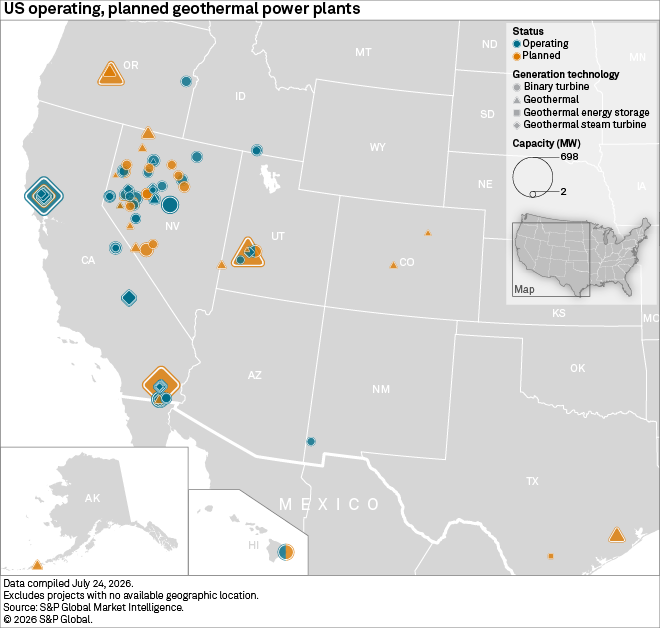
Fervo's flagship Cape Station project under construction in Beaver County, Utah, will be the first commercial deployment of next-generation geothermal, showcasing the company's adoption of horizontal drilling techniques pioneered by the oil and gas industry.
During Fervo's first-quarter earnings call in June, the company's first since going public, executives reaffirmed their plan to start generating power at Cape Station in the fourth quarter of 2026
For that first phase, the capital expenditure is $7,000/kilowatt, Ulrey said, falling to $5,500/kW for the 400-MW second phase of Cape Station.
"The important thing that we always point out here is that $5,500 per kilowatt is obviously higher than what you hear about for natural gas, but we don't have feedstock that eats into our [operations and maintenance] costs in the same way," Ulrey said in an interview. "We don't have that kind of volatility exposure. And we also have the benefit of a tax credit, where natural gas doesn't. And so we think those two things combined actually make us pretty competitive with natural gas today."
The company has 658 MW of binding purchase power agreements (PPAs), collectively worth $7.2 billion in future revenue, company executives said during the earnings call.
Cape Station is underpinned by PPAs with several load-serving entities in California, including Edison International utility Southern California Edison Co., several community choice aggregators and Shell Energy North America (US) LP, an affiliate of the UK oil major.
"Early on, quite a bit of our contracting was really driven by a California Public Utilities Commission requirement for energy that has attributes similar to geothermal," Ulrey said.
In addition, Fervo is working on a third phase of Cape Station, and it has a signed a 115-MW PPA deal with Google LLC for the output from the Corsac Station project it is developing in Nevada.
Fervo has identified a broader 40-gigawatt pipeline of development opportunities, according to the CFO.
"When we talk about 40 gigawatts, it's not kind of the pie in the sky," Ulrey said, pointing to the quality of Fervo's leases and compelling cost structure. "These are 40 gigawatts that we have pretty high conviction we can translate into projects in the future."
'Our moment to win'
Fervo is among a host of geothermal companies that believe they can capture more contracts by building on advantages such as around-the-clock clean power, scalability and supply chain stability.
"Our supply chain still has quite a good bit of capacity in the near term, where what we hear is natural gas is challenged on that front," Ulrey said.
The regulatory requirements to procure both firm and clean power also help geothermal developers.
"When you overlay that Venn diagram, the resource that's really available and ready to meet that requirement is geothermal," Lucy Darago, chief commercial officer of XGS Energy Inc., told Platts.
XGS last year announced a deal with Meta Platforms Inc. for a 150-MW project in New Mexico.
"Our agreement with Meta is really founded on our ability to deliver those attributes," Darago said.
Geothermal's scale is another key competitive advantage, Darago said. Most developers will be building 25- or 50-MW units, which offer more operational flexibility than natural gas facilities.
"If you have the same capacity, 500 megawatts, say, but split into 10, 50-megawatt blocks, you're able to get a very different reliability and resilience profile because you can cycle maintenance across that fleet of operators," Darago said.
New nuclear power development faces greater uncertainty, in Darago's view.
"We feel it's really our moment to win in this critical next five-year timeline while the regulatory and technology landscape for nuclear is still being shaped," she said.
PPA terms, prices
Geothermal contracts are typically are set at firm, fixed prices for a term of 15 to 25 years.
For Fervo, Ulrey said the 15-year PPA is the "pretty good sweet spot for us in terms of financeability."
The prices are in the range of $100 to $130 per megawatt-hour, Ulrey said.
For XGS, the market, including utilities and industrial customers, is valuing geothermal in the western US at over $100/MWh for 10- to 20-year fixed-price contracts, Darago said.
"We see that matched with hyperscaler industrial customers that are looking to procure for their own needs," Darago said.
The objective of the industry is to serve those high-value pockets first and bring down the cost curve. At XGS, the goal is to be competitive with natural gas by 2032-2035, Darago said.
"We want to feel really confident that we're driving costs down to a circa $50/MWh level as we scale," she said.
In the meantime, Darago said current valuation of geothermal does not reflect overpaying for the technology.
"It's folks equally valuing what the attributes bring into the market from really distinctive vantages," Darago said. "A hyperscaler is thinking about speed and scale in their value stack, and a utility is really thinking about reliability and affordability across a diversified energy portfolio."
Overcoming challenges
Geothermal developers also face challenges related to geology and procuring clean power for production sites.
Geothermal uses some electricity in its process, which can affect its energy attribute certificate process, according to Benjamin Gerber, president and CEO of CleanCounts, a nonprofit environmental attribute tracking system.
"Whether you're using new or existing fracking wells, you're going to need to figure out where those electrons that you used to pump the water came from," Gerber told Platts.
If that electricity does not come from a clean resource, companies will need to purchase existing renewable energy credits to validly claim that the production is 100% renewable, Gerber said.
CleanCounts is working with a group of stakeholders to create an environmental attribute certificate standard for geothermal.
While new technologies make geothermal more flexible than it used to be, location still plays an important role.
"If you remove the constraint of limited willingness to pay, we could do it anywhere you want," Ulrey said. "But for the market today, [geology] does still matter."