26 Aug, 2026
Increasing alternative asset allocations drive pension fund headcount growth
By Dylan Thomas and Shambhavi Gupta
The larger investment teams required to manage expanding portfolios of alternative assets are boosting headcount at pension funds across the globe.
Government, union and corporate pension fund headcount totaled 60,308 globally as of June 1, up 30% from the same date in 2020, according to S&P Global Market Intelligence data. While Asia-Pacific and Europe recorded the fastest rates of growth, every region saw gains. Headcount totals for global pension funds increased each year in the analysis.
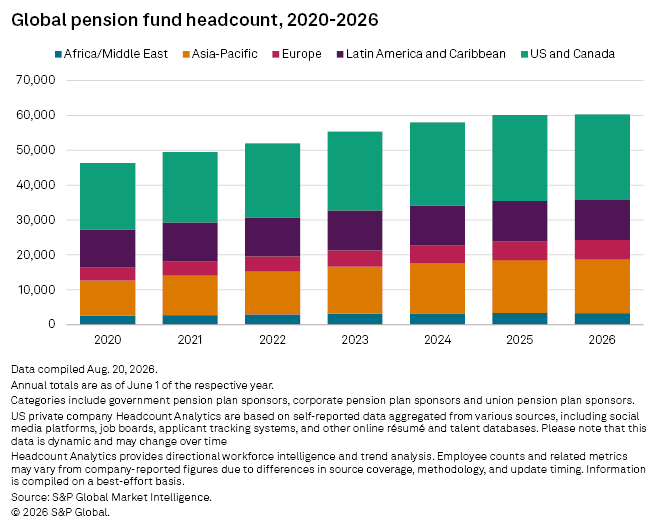
Within the US, large public pension funds are expanding investment teams to handle complex deals like private equity coinvestments, said Steve Voss of investment consultancy Meketa. These teams are also building out allocations to newer asset classes like infrastructure or private credit. Voss, who advises US state and municipal pensions, said the trend is most apparent among the "mega-market" funds with $20 billion or more in assets under management.
"You are seeing notable growth in the mega-market category in terms of staffing," Voss said. "It comes from increasing exposures to alternative investments."
Diversification into alternatives
A quarter-century's worth of allocation data collected by the National Association of State Retirement Administrators, a non-profit trade association for state and local public retirement systems in the US, traces a significant shift toward alternative assets in investment portfolios.
Keith Brainard, research director at NASRA, said that about 90% of public pension fund investments were in stocks and bonds around the turn of the 21st century. "Now, that's down to about two-thirds, with the other one-third in alternatives," he said.
Allocation to alternative asset classes stood at 31.8% of investment portfolios as of the first quarter of 2025, up from 24.5% five years earlier, according to a survey of 149 pensions published in the 2026 edition of the National Conference on Public Employee Retirement Systems' Public Retirement Systems Study.
Brainard expects the diversification trend to continue to play a role in growing headcount.
"If you're running an S&P 500 pot, you don’t really need any or many staff. But if you've got a portfolio of private credit, for example, you might want to have one or two people on board," he said.
California Public Employees' Retirement System's headcount rose by more than 5% between 2020 and 2026, a period that coincided with the buildout of a sustainable investment team and adding private debt to its portfolio, James Scullary, a CalPERS spokesperson, said in emailed comments. CalPERS is the largest defined-benefit pension fund in the US, with $658 billion in assets under management.
 |
- Read about institutional investors cutting private equity allocation targets. - Catch up on the Q2 performance of private equity's Big Four. - Download a file of raw data used in this story. |
Size matters
The diversity of pension funds makes it difficult to credit one factor alone in the industry's larger headcount, said Brainard. Pension funds vary not just by size and strategies of the portfolios overseen by investment teams, but also by the scope of their administrative missions.
NASRA research manager Alex Brown said there is a link between scaling pension AUM and larger investment teams. Pensions with larger investment portfolios are more likely to build teams that can manage those portfolios in-house, rather than working with an outside adviser.
"They have a higher percentage of investment staff for every $1 billion in assets," Brown said.
Voss said funds with growing investment teams also add administrative and legal staff in support positions. "So, there is a trickle-down effect," he said.
Outlook
Public pension funds in the US are beginning to experiment with artificial intelligence to improve productivity, but AI is not having an impact on headcount yet, NCPERS spokesperson Lizzy Lees wrote in emailed comments. Survey responses indicate AI is being used "primarily for administrative efficiency rather than investment decision-making," Lees said.
“While individual funds may be finding efficiencies through technology, we have not yet seen evidence that AI is driving widespread reductions in staffing across public pension plans," she added.