13 Aug, 2026
CredAg bid for BPM comes into play after French bank lays Italian cards on table
By Cathal McElroy and Marissa Ramos
Crédit Agricole SA recent intervention in merger talks between Banco BPM SpA and Banca Monte dei Paschi di Siena SpA could herald its launch of a takeover bid for BPM in the coming weeks.
The French banking giant, which is BPM's largest shareholder, declared its preference for a merger between its Italian business and BPM over a BPM-BMPS tie-up during its second-quarter earnings call on July 31. The comments from its executives preceded a statement from BPM later that day announcing that its board of directors had voted to end the negotiations with BMPS.
Crédit Agricole's clarification of its intentions in Italy, which it describes as its "second domestic market," along with reports that BMPS is considering a takeover bid for BPM, raises the prospect of the French bank mounting its own takeover offer for BPM.
"An outright takeover would make even more sense than a merger," Johann Scholtz, bank equity analyst at Morningstar DBRS, told S&P Global Market Intelligence. If Crédit Agricole opts for a merger over a takeover, "dealing with other shareholders would complicate capturing the full benefits and holding a large stake indefinitely without those benefits tying up capital with little purpose," he said.
A combination of Crédit Agricole Italia and Banco BPM would create Italy's third-largest lender, with total assets of around €300 billion, S&P Global Market Intelligence data shows. It would bring parent company Crédit Agricole SA's total assets to €2.673 trillion.
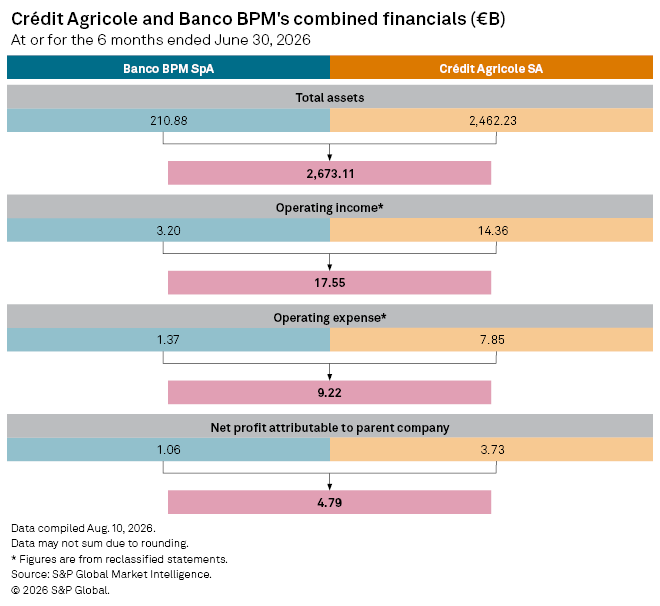
While much smaller in scale, an acquisition of BPM would offer a welcome boost to the French bank's comparatively sluggish profitability and efficiency metrics.
In the first half of 2026, BPM posted a return on average equity (ROAE) of 13.86% and a cost-to-income ratio of 42.81%, Market Intelligence data shows. Crédit Agricole SA delivered an ROAE of 9.70% and a cost-to-income ratio of 54.68% during the same period.
BPM's business profile is another attraction for Crédit Agricole, Sonja Forster, vice president, financial institutions at Morningstar DBRS, told Market Intelligence. "BPM has a strong franchise in corporate and SME banking, while Crédit Agricole is strong in retail banking," she said. "From a strategic perspective, a combination appears to make sense."
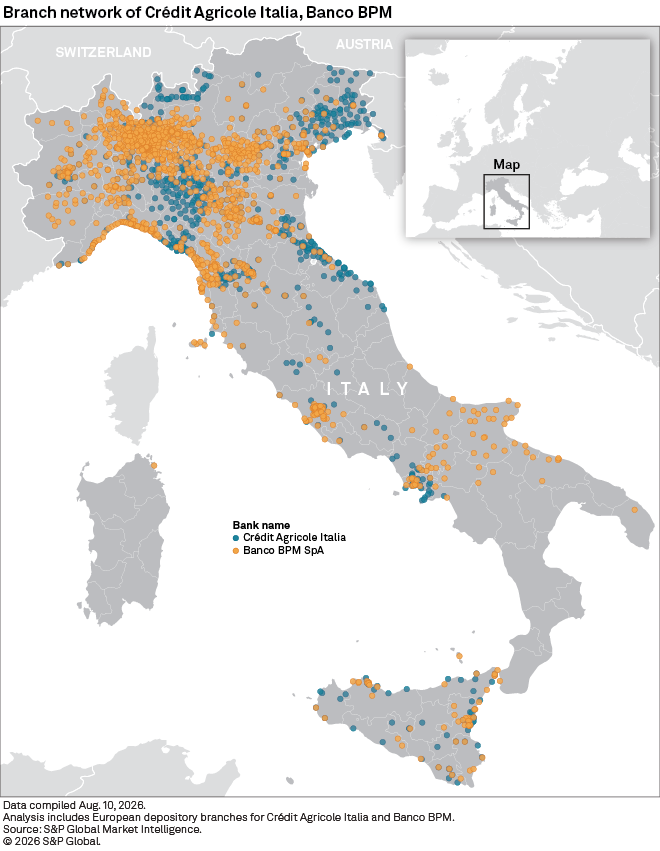
BPM's lighter focus on retail banking compared to Crédit Agricole allows it to operate a similar number of branches to the French bank's Italian unit, despite holding twice the assets, Market Intelligence shows. The overlap in both banks' branch networks — both are mostly focused on northern Italy, Market Intelligence branch data shows — also offers opportunities for cost synergies, said Forster.
The emerging prospect of a hostile takeover bid for BPM from BMPS following the collapse of merger talks, reported by the Financial Times on Aug. 2, could force Crédit Agricole to make a competing offer. A successful offer for BPM from BMPS may help the latter fend off advances from Intesa Sanpaolo SpA, which has launched a €30.6 billion takeover bid for BMPS.
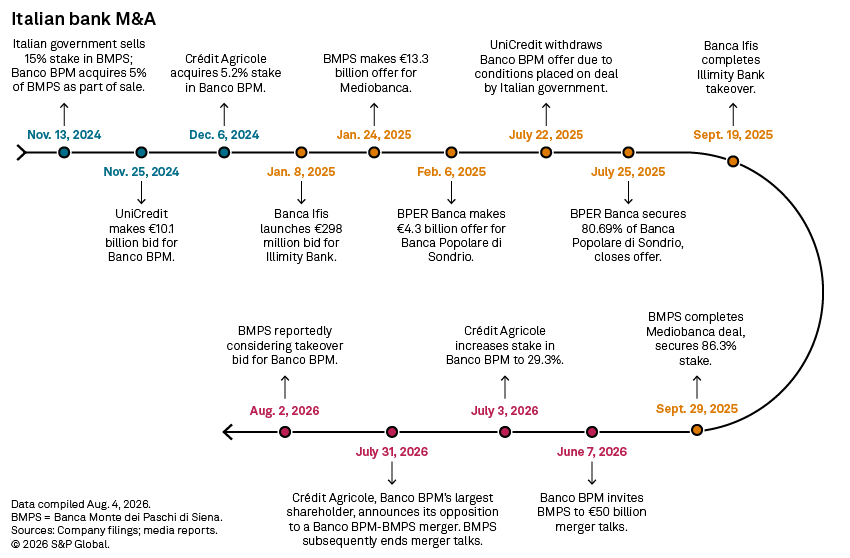
BMPS is continuing to assess its strategic options to defend against Intesa's takeover, CEO Luigi Lovaglio said during his bank's second-quarter earnings call on Aug. 7. Investors should not consider the BPM "chapter being closed or open," he added.
Closing the call, Lovaglio said he could be speaking to analysts and investors much sooner than the bank's third-quarter earnings call in November, implying the possibility of a significant announcement.
Another potential obstacle to a Crédit Agricole deal for BPM would be the position of the Italian government, which is seen by some as being opposed to a large foreign bank gaining significant influence in the country's banking sector.
The Italian government's Golden Power legislation allows it to block any deal involving the acquisition by foreign investors of Italian businesses considered strategically important to the country.
Crédit Agricole acknowledged the Italian government's sensitivities around its ownership of BPM during its recent earnings call.
"Whether Italian policymakers would permit such a transaction remains an open question," Filippo Alloatti, head of financials, credit, at Federated Hermes, told Market Intelligence.
Crédit Agricole entered the Italian retail banking market in 2006 with its purchase of local lenders Cariparma, Friuladria and more than 200 Banca Intesa branches. Further acquisitions followed in 2011 and 2017, with the group rebranding as Crédit Agricole Italia in 2016.
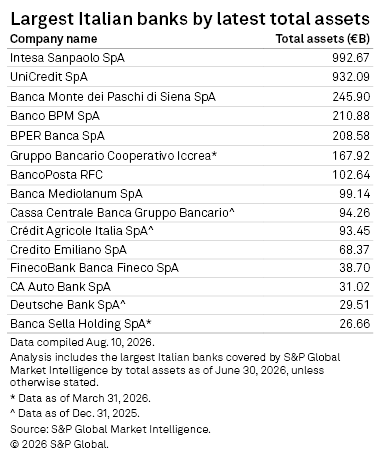
Any move for Banco BPM by Crédit Agricole would dwarf the French giant's previous deals in the country, however.
The current desire for deals of such scale in Italy is justified, Marco Troiano, head of financial institution group ratings at Scope Ratings, told Market Intelligence.
The current M&A rush "reflects the attractiveness of the market," he said.
"After so many years of zero interest rates and high cost of risk, the Italian market is now extremely profitable, thanks to the low level of NPLs and high deposit margins."
– View Crédit Agricole's branch map.
– Access detailed M&A market statistics on S&P Capital IQ Pro.