09 Aug, 2026
Boosted by chipmaker, Samsung-affiliated insurers post strong returns
By RJ Dumaual and Unzilla Shaikh
Through July, shares of Samsung Life Insurance Co. Ltd. have posted the highest return this year among the 20 largest Asia-Pacific insurers by market capitalization, according to an S&P Global Market Intelligence analysis.
Samsung Life's stock nearly doubled in the first seven months of 2026, with a total return of 97.7%. Analysts attributed the surge to potential special dividends from chip-making giant Samsung Electronics Co. Ltd., in which it holds a significant stake.
Samsung Life's dividend income could spike in 2027, Hana Securities analyst Y.J. Ahn said, as it owns more than an 8% stake in the chipmaker, and dividends from the holding are a major source of investment income. Samsung Electronics has pledged to use 50% of its free cash flow for shareholder returns, including regular and special dividends, Ahn added.
Samsung Fire & Marine Insurance Co. Ltd., which holds a smaller position in Samsung Electronics, also generated significant returns for shareholders, with its stock rising 32.6% through July 31.
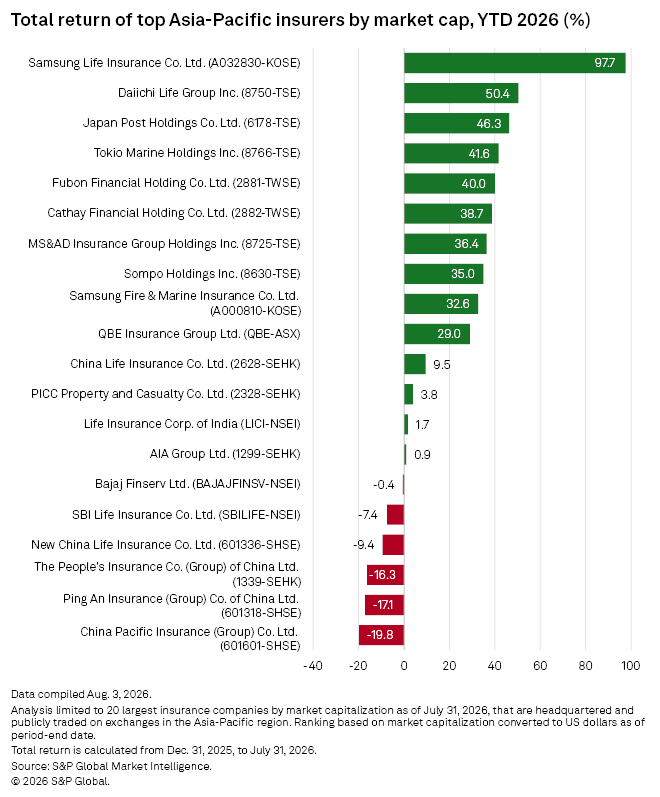
Tokio Marine Holdings Inc. was also among the sector's top performers, with a total return of 41.6% as of July 31. Its shares surged after entering into a strategic partnership with US conglomerate Berkshire Hathaway Inc. Berkshire, through unit National Indemnity Co., will initially acquire an approximately 2.5% ownership stake in Tokio Marine by acquiring 48,207,200 common shares at ¥5,962 apiece, or about ¥287.41 billion, by way of a third-party allotment.
Negative returns
China Pacific Insurance (Group) Co. Ltd., Ping An Insurance (Group) Co. of China Ltd. and The People's Insurance Co. (Group) of China Ltd. were among the sector's worst performers, recording negative returns of 19.8%, 17.1% and 16.3%, respectively, through July.
Investment market volatility appears to be a key theme among Chinese insurers.
Ping An Insurance reported a 7.4% drop in first-quarter net income, attributing the decline to short-term investment volatility from geopolitical conflicts. China Pacific said in its first-quarter earnings report that while China's economy got off to a good start in 2026, rising geopolitical risks have caused capital markets to experience corrections.
"We continued to strengthen market analysis and risk control, maintained consistency in strategic asset allocation, and adjusted tactical asset allocation strategies in a disciplined yet flexible manner," the company said.
Chinese insurers could be vulnerable to further investment market volatility.
"Low interest rates are prompting Chinese insurers to increase exposure to high-risk assets, heightening sensitivity to capital market volatility," S&P Global Ratings analyst WenWen Chen wrote in a report.
"Life insurers face the most pressure because declining reinvestment yields are compressing investment spreads and increasing asset-liability management challenges," Chen said. "[Property and casualty] insurers are not immune to these risks, as their earnings profiles remain heavily reliant on investment income to supplement underwriting results."
Asia's biggest insurers
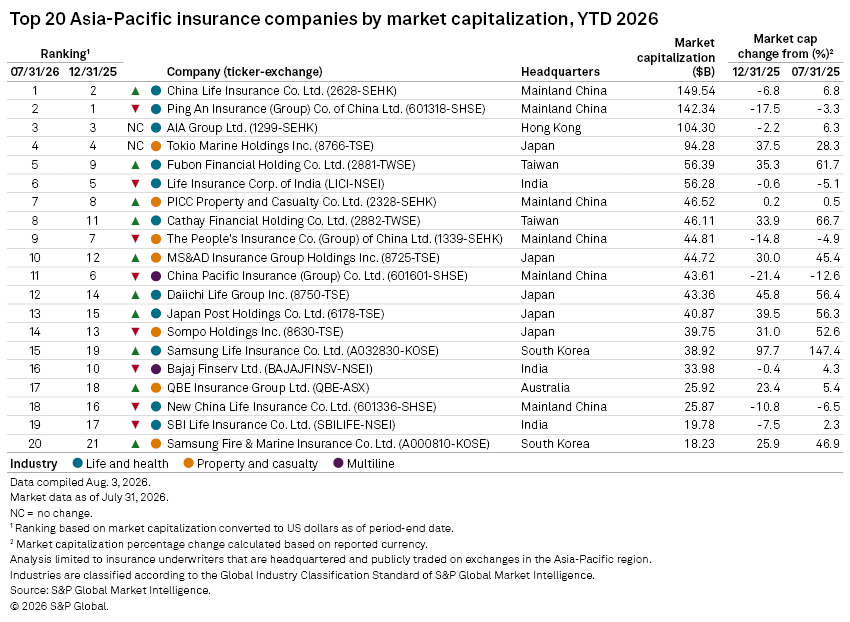
Ping An's equity struggles allowed China Life Insurance Co. Ltd. to become the largest Asia-Pacific insurer by market capitalization at $149.54 billion, surpassing Ping An's $142.34 billion.
AIA Group Ltd., Tokio Marine and Fubon Financial Holding Co. Ltd. rounded out the top five with market caps of $104.30 billion, $94.28 billion and $56.39 billion, respectively.