06 Aug, 2026
A year after $7B solar grant program was halted, funding gap persists
By Kirsten Errick and Karin Rives
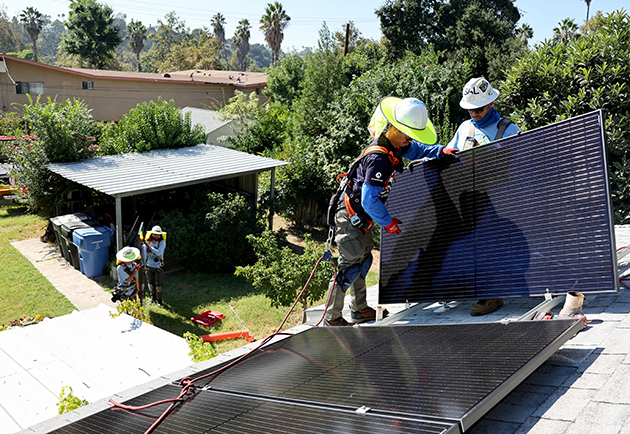
| Some states turned to nonprofits to fill the gap from lost Solar for All funding, although those organizations also experienced grant terminations. Grid Alternatives, its workers seen here in a 2023 photo, lost $330 million earmarked for solar energy projects on Native American reservations and elsewhere. Source: Mario Tama/Getty Images News via Getty Images. |
A year after the Trump administration canceled the $7 billion Solar for All program, grant recipients have either shelved their programs or struggled to find alternative funding sources.
The US Environmental Protection Agency's August 2025 decision to eliminate the grant program affected red and blue states, Native American tribes and communities nationwide. All planned to use the funding to help low-income households access clean electricity.
South Carolina was awarded $124 million to expand residential community solar, install solar and storage at apartment buildings, train workers and reduce energy costs. Planning was underway when the grant was withdrawn.
The South Carolina Office of Resilience "has not obtained other funding to continue the program," Kevin O'Dell, a spokesperson for the office, said in an email.
Oregon, awarded $87 million to serve 8,000 households, and Colorado, awarded $156 million to serve 20,000 households, paused their programs because of the funding cut.
"Without the Solar for All funding, Oregon has limited capacity to support solar installations on Oregon homes," Jennifer Kalez, a spokesperson for the Oregon Department of Energy, said in an email.
Similarly, Louisiana's program was canceled before it rolled out, a spokesperson for the Louisiana Department of Conservation and Environment said. The state's "Solar for Y'All Program" had expected $156 million to help hurricane-prone communities install solar, aiming to reduce lengthy power restoration times.
Grantees received 1% of funds
EPA Administrator Lee Zeldin ended the $7 billion Solar for All grant program on Aug. 7, 2025, citing congressional funding cuts that no longer authorized the agency to "keep this boondoggle alive."
Established under the 2022 Inflation Reduction Act, the program awarded grants in April 2024 intended to serve disadvantaged communities in 49 states as well as six Native American tribes.
When the grants were canceled, the recipients had used approximately $71 million, or 1%, of the obligated funds for project planning and implementation, according to an EPA Office of Inspector General (OIG) report released in January. Another $15.3 million was spent on administrative matters and $2.5 million on technical assistance, the OIG found.
When asked to comment on its termination of the Solar for All program, the EPA's press office pointed to the OIG report's finding that the program lacked sufficient quality assurance plans for projects. In August 2025, more than a year after the awards were made, the agency had yet to approve such quality assurance plans for 83% of the grant recipients — a delay that EPA staff told the auditor was exacerbated by deep agency staff cuts and the Trump administration's changing policies.
"EPA provides separate support for states and tribes and that continues, including almost $300 million for tribes in EPA's FY 2026 base budget for direct funding, technical assistance, and training under our permanent statutory authorities," an agency spokesman said. "EPA will keep working with states, tribes and communities on projects that advance our core mission of protecting human health and the environment."
That level of investment does not match what Solar for All would have provided. Some states have been better positioned to adapt to the funding loss than others.
Supportive legislators, green banks to the rescue
In Virginia, lawmakers stepped in to help offset the state's canceled $156 million grant set to serve 15,000 households. A law enacted in 2026 establishes an eight-year, $300 million program requiring Dominion Energy Inc. and Appalachian Power Co. to create utility-funded solar, storage and efficiency upgrades for certain customers.
"We remain extremely supportive of distributed energy in general and see it as a big priority for the state," Louise White, Virginia's deputy energy officer, said in an interview. "We're working to get more both solar and home storage and those types of solutions into more Virginia households."
The Maryland Clean Energy Center, serving as the state's official green bank, had leveraged $240 million by the end of 2025, generating a 10-to-1 return on publicly used funds, Kathy Magruder, the center's executive director, said in an interview.
The green bank was expecting to serve 10,000 households when its $62 million Solar for All grant was pulled. To offset some of the loss, the state awarded the bank a $10 million grant to help finance solar for multifamily housing.
Had the federal grant remained, "we would have moved the ball up the field faster," Magruder said. "We're inching forward from the green bank's perspective."
Hawaii's $62 million grant was for loans for rooftop solar and community solar projects. The initiative also provided technical assistance and process automation, making it easier for Native Hawaiians who need an additional permitting step to get installations approved.
"All of those in addition to the ... loan funds have been stalled," Gwen Yamamoto Lau, executive director of the Hawaii Green Infrastructure Authority, said in an interview. "But as a green bank, we continue to do what we do because we have alternative sources of funding."
Hawaii funded a handful of household loans, but the rest were moved to other existing programs. Because of the pulled funding, the loan amount is now higher for applicants who chose to continue projects. All but one of the state's community solar projects funded by Solar for All were discontinued.
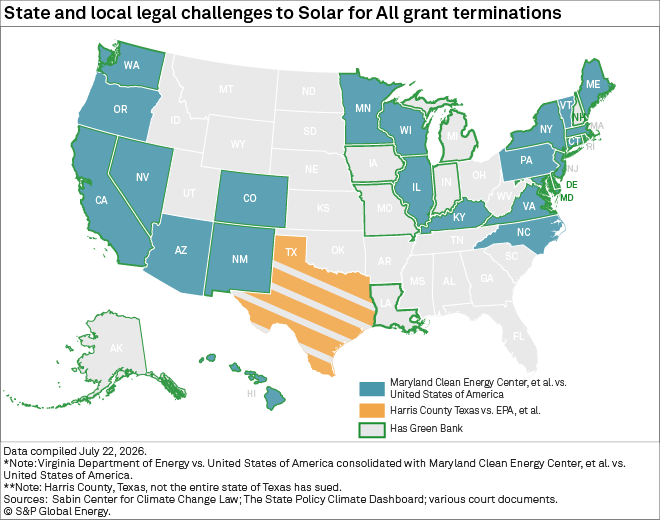
Like other states, Hawaii is monitoring lawsuits challenging the termination of Solar for All grants in federal courts. The state's high electricity costs had generated considerable interest in the program, and if it returns, Yamamoto Lau said Hawaii could offer "that holistic help that we're not able to provide right now."
Cost increases, uncertainties
While California moves forward with community solar programs, the cost of such projects increased after the state's $249 million grant was pulled, said Terrie Prosper, a spokesperson for the California Public Utilities Commission (CPUC). Storage projects also got more expensive.
The funding loss created staffing uncertainties and delayed major regulatory changes to CPUC programs premised on the agreed-upon grant award, Prosper said.
"The termination and uncertainty about funding have also harmed multiple CPUC programs by wasting valuable state and stakeholder time and resources that were spent to prepare to implement the grant," Prosper said.
While the ending of Solar for All funding removed a dedicated federal resource intended to bring low-cost clean energy to low- and moderate-income households, New York's NY-Sun program and the state's community solar model continue to prioritize access, a spokesperson for the New York State Energy Research And Development Authority (NYSERDA) said.
"All ratepayers continue to benefit from the cost declines and grid savings distributed solar is driving statewide," the NYSERDA spokesperson said in an email.
California and New York are among states challenging the cancellation of Solar for All in federal court.
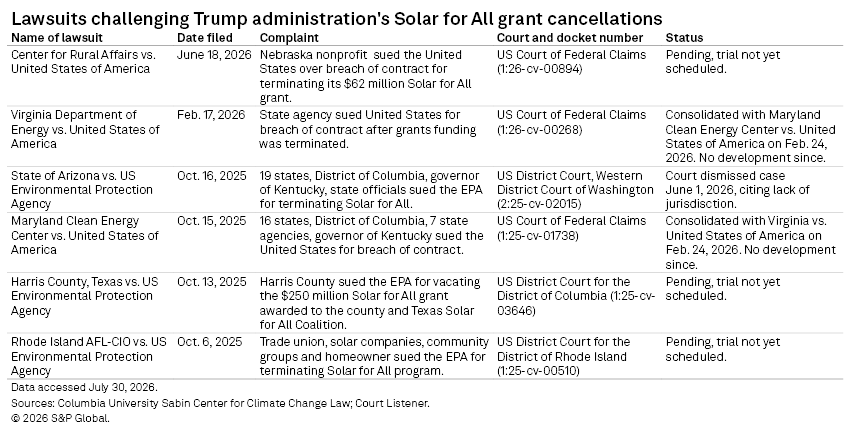
Six lawsuits representing more than 20 states, nonprofits, public officials, community groups, a labor union, and Texas' most populous county have been filed since October 2025 over the canceled solar grants.
For the Hopi Tribe in Arizona, another plaintiff, the $25 million Solar for All grant was slated to bring electricity to people who had none.
Over the past year, the tribe was awarded a $250,000 foundation grant to deploy "a handful" of grid-connected residential solar systems, said Fletcher Wilkinson, energy manager at Hopi Utilities Corp. Another $10 million federal electrification grant for off-grid solar and battery storage has escaped cuts.
"Unfortunately, these grants do not fill the gap left from the [Solar for All] termination," Wilkinson said in an email. "There will still be hundreds of Hopi households left without electricity."