21 Jul, 2026
Washington, DC, defends all-electric construction law in high-stakes appeal
By Parker Leipzig and Tom DiChristopher
The attorney general for the District of Columbia urged a US appeals court to affirm a lower court ruling that upheld a Washington, DC, ordinance requiring all-electric construction of commercial buildings.
The district's opening brief in the US Court of Appeals for the District of Columbia Circuit argued that the federal Energy Policy and Conservation Act (EPCA) does not preempt the district's 2022 building decarbonization law, the Clean Buildings Act. (No. 26-7050) Plaintiffs Washington Gas Light Co., industry groups and unions have asked the court to declare the law void and permanently block the district from enforcing it.
The District of Columbia's filing as the appellee in National Association of Home Builders of the United States, et al. v. District of Columbia came just weeks after a three-judge panel for the 2nd Circuit ruled in a separate case that New York City and state gas bans do not conflict with EPCA. The ruling created a rift with a 2023 decision in the 9th Circuit, which held that EPCA preempted Berkeley, California's first-in-the-nation gas ban.
The DC case is moving in tandem with a challenge to Montgomery County, Maryland's building electrification mandate in the 4th Circuit. The outcomes of the cases could influence whether US appeals courts resolve the circuit split — or whether the US Supreme Court ultimately wades into the legal debate over gas bans.
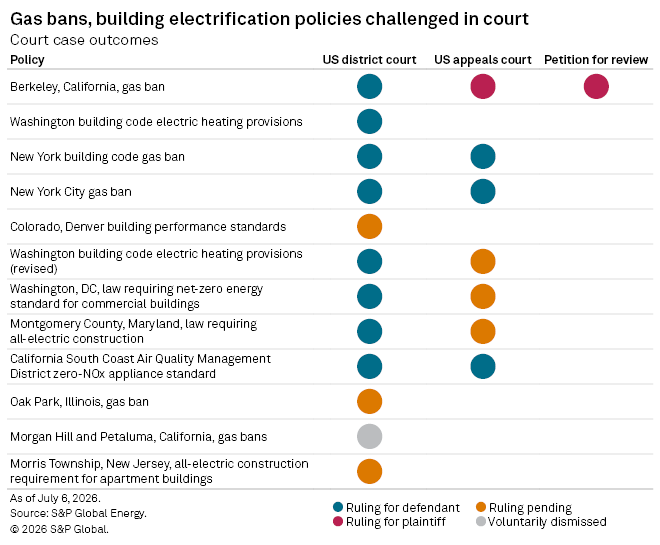
The district's Clean Buildings Act would require new construction or improvements of commercial buildings, including apartment complexes, to achieve a net-zero energy standard by 2027. That means the building draws enough power from clean energy resources to offset its total annual energy consumption. The law barred on-site fossil fuel consumption for thermal energy in certain buildings.
In a 2024 lawsuit, Washington Gas and its allies argued that the act effectively caps energy use at zero for gas appliances. For that reason, they said, it runs afoul of EPCA, which preempts state and local energy conservation standards that conflict with efficiency rules set by the US Department of Energy.
The District of Columbia countered that the law's fossil fuel provision regulates only the type of energy used in certain buildings, not the quantity of energy consumed. Therefore, the law does not concern "the energy efficiency" or "energy use" of any covered product that would fall under EPCA's preemption provision.
The act does not function like an "energy conservation standard" because while it regulates the type of energy in certain buildings, it still allows manufacturers to "market and sell the same gas appliances in the district that they do now, and consumers can still buy such appliances and use them in many buildings throughout the district," the appellee said.
Broad versus narrow EPCA reading
On March 26, US District Judge Ana Reyes rejected the plaintiffs' EPCA-based legal challenge to the electrification policy. Reyes joined several other district court judges who have sided with a dissenting opinion in the 9th Circuit's denial of Berkeley's petition for rehearing. Those judges have rejected the 9th Circuit's broad reading of EPCA preemption.
Washington Gas and trade groups said Reyes applied an "unreasonably narrow view" of EPCA preemption. The plaintiffs argued that EPCA preempts any state law "related to" gas appliance use, even if the relation is indirect.
In disputing that claim, the District of Columbia heavily cited the panel opinion in the 2nd Circuit case that upheld the New York policies. The appellee said Congress specifically used the term "concerning" in EPCA's preemption provision, a word with a narrower connotation than "related to." That choice must be respected, the appellee said.
Additionally, plaintiffs' reliance on the Berkeley opinion is invalid in this case, the appellee said. The 9th Circuit panel erred by ignoring EPCA's definition of "energy use" and overlooking the technical meaning of the term "point of use," instead applying everyday meanings to the terms to support a broad interpretation of EPCA preemption, the appellees said.
"This conclusion is supported by nearly every judicial decision to address similar EPCA claims," the appellee said. "Plaintiffs resist this straightforward conclusion by trying to rewrite EPCA's text, rearrange its structure, and revise its context, history, and purpose."
Debate over law's validity
The District of Columbia also argued that plaintiffs failed to show that EPCA facially preempts the Clean Buildings Act, citing a recent 9th Circuit opinion on EPCA preemption, which upheld a Southern California air pollution regulation that would bar some gas appliance sales.
In bringing a facial challenge, the plaintiffs needed to demonstrate that "no set of circumstances exists under which the law would be valid," the district said. Since the Clean Buildings Act would prevent the use of fossil fuel-powered appliances not covered by EPCA, such as coal-burning stoves and decorative gas fireplaces, the facial challenge fails, the appellee said.
"They must instead show that the act is preempted by EPCA 'in every application' and plaintiffs admittedly cannot do so," the district said.
If the appeals court rules that the plaintiffs were correct on the merits of their argument, the District of Columbia said, the court should remand the case to the district court to decide remedial issues.
Oral arguments for the case are scheduled for Sept. 8.