31 Jul, 2026
US managed care stocks down following mixed, cost-heavy Q2 results

By Tyler Hammel
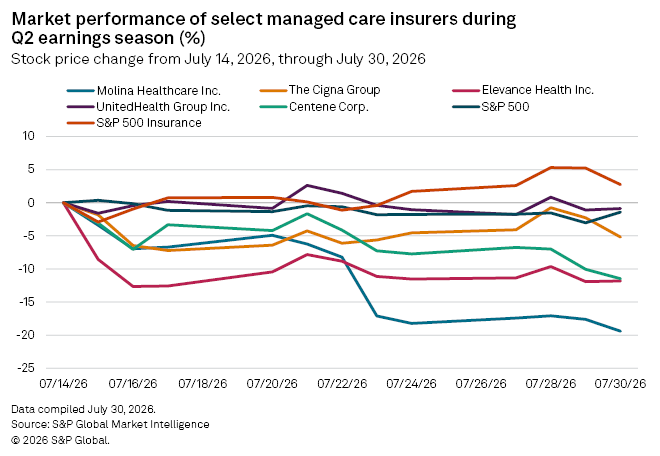
Shares of all major US managed care insurers have traded lower since the start of the second-quarter earnings season, marked by rising costs and mixed results.
Since July 14, the day before Elevance Health Inc. kicked off second-quarter earnings season, all eight major, publicly traded managed care insurers stock prices have declined.
Molina Healthcare, Inc. declined the most, dropping 19.4%, followed by Alignment Healthcare Inc., which fell 13.7%. Elevance dropped 11.8%. Humana Inc. and Centene Corp. fell 9.9% and 11.5%, respectively, while The Cigna Group dropped 5.2%. UnitedHealth Group Inc. showed the most resilience, declining by 0.9%.
The declines contrast with both the S&P 500, wich fell 1.4%, and the S&P Insurance Index, which rose 2.74%.
The US managed sector has been dealing with cost concerns since 2025, especially related to federal programs.
Medicaid drags
Molina's second quarter was marred by a drop in net income year-over-year, as CEO Joseph Zubretsky highlighted high medical cost ratios among key lines.
The insurer's cost ratio hit 92.7% during the second quarter, in line with expectations but still an area of concern due to Medicaid cost escalation, according to Zubretsky.
"The imbalance between Medicaid rates and medical cost trend appears to have stabilized and is well positioned to be corrected with future rate increases," Zubretsky said. "This reinforces our belief that 2026 is the trough year for Medicaid pretax margins."
Molina only works if Medicaid margins recover, according to a research note from J.P. Morgan analyst John Stansel.
"With Marketplace now materially smaller and Medicare already closing in on target margins, we believe that improvement beyond [adjusted earnings per share] of $10.00–$11.00 in 2027+ will come disproportionately from Medicaid," Stansel wrote.
Even as rates are rising, cost pressures at the state level pose an ongoing issue for margin recovery, Stansel wrote.
"With state budget pressures likely to persist (if not worsen) in coming years, and absent further rate upside in [the second half of 2026], the focus may pivot to care management, cost containment, and trend normalization as a vector for margin recovery in Medicaid," Stansel wrote.
Elevance raised its earnings outlook, due to disciplined and "prudent" approaches to many of its lines, including Medicaid, CEO Gail Boudreaux said during a July 15 earnings call.
J.P. Morgan analyst Lisa Gill said in a July 15 note that she is focused on the managed care provider's "continued core improvement in performance."
"It is understandable that the bar is high after the stock performance of the entire [managed care] group over the past few months; however, we continue to see Elevance executing against its targets and managing expectations," Gill wrote.
Cigna avoids exposure
The most recent of the major managed care insurers to report results, Cigna has far less exposure to many of the areas of cost pressures. The insurer does not offer Medicaid and Medicare Advantage plans, having exited the Medicare Advantage market in 2025, and it plans to exit the Affordable Care Act marketplace by the end of 2026.
Brian Evanko, who became Cigna's CEO at the start of July, described the insurer's second-quarter performance as "strong" and "durable" during an earnings call on July 30.
As Cigna leaves the Affordable Care Act and individual marketplace and frees up capital, it expects to invest in its existing portfolio, Evanko said, and not to try to serve all different end markets where Cigna does not have the specialization or the expertise.
"Overall, we really like our positioning in the Cigna Healthcare business and do not feel any compelling need to enter different end markets at this juncture," Evanko said.
Cigna's second-quarter earnings were favorable, wrote Gill, with performance ahead of expectations in both its Evernorth and Cigna Healthcare segments.
"Cigna is starting to move past several factors that have weighed on the stock in recent years, and we remain constructive on the story, particularly given the company's [less than ten times forward projected earnings]," Gill wrote.