20 Jul, 2026
Indian private-sector lenders' Q1 margins squeezed by prior rate cuts

By Yuvraj Singh
Net interest margins at India's biggest private-sector lenders came under increasing pressure in the April-to-June quarter as the central bank's earlier rate cuts took effect.
Three of the four largest private-sector banks reported yearly and quarterly declines in net interest margins (NIMs) from April to June. Only ICICI Bank Ltd. bucked the trend, posting narrow increases in its NIM of 2 basis points year over year and 4 bps quarter over quarter, reaching 4.36%.
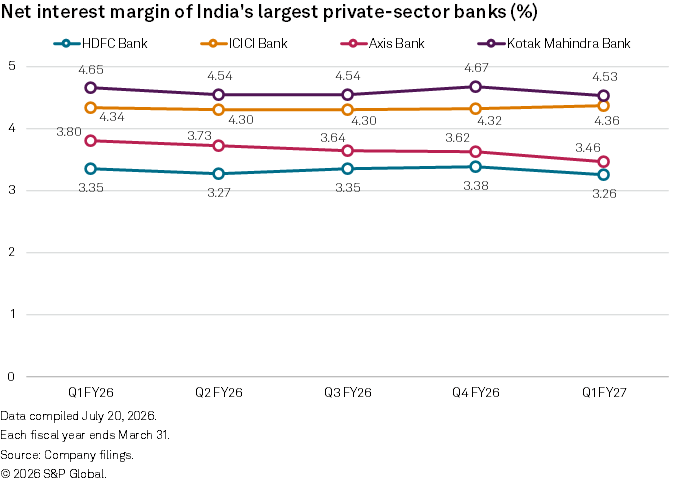
The Reserve Bank of India's monetary easing has ramped up pressure on the lenders' NIMs. The central bank reduced its benchmark repurchase rate by a cumulative 125 bps to 5.25% in 2025, compressing the spread between the interest lenders earn on loans and what they pay on deposits. Lending rates usually move quickly after policy rates are changed, while deposits take longer to reprice. The central bank has held steady so far in 2026 amid the inflationary effects of the war in the Middle East.
HDFC Bank Ltd., the country's biggest private-sector lender, posted a 9 bps year-over-year decline in NIM to 3.26% in the fiscal first quarter, the bank reported July 18. Kotak Mahindra Bank Ltd. reported a 12 bps compression, though it still had the highest NIM among the four big lenders at 4.53%.
Axis Bank Ltd.'s NIM fell sharply in the fiscal first quarter, dropping to 3.46% from 3.80% a year ago. The bank attributed its margin loss to a combination of rate cuts and to a change in the mix of its loan book, CFO Puneet Sharma said during the July 18 earnings call.
"Pricing on loans has been competitive for us as well as the rest of the industry," Sharma said, adding that a large part of repricing has been driven by corporate loans, which are typically lower-yielding.
Banks lean on retail loans
The lenders have indicated that they want to increase their share of high-yielding, predominantly retail, loans and capitalize on the central bank's incentives on foreign currency deposits to reverse the downward trajectory of their NIMs.
"[A] mix of assets is an important contributor [to] longer-term margin," HDFC Bank CFO Srinivasan Vaidyanathan said during the July 18 call.
Retail loans account for about 52% of the bank's portfolio. "India's consumption component of GDP is about 60%, and that's where we want to be ... because that is when we mirror the economic growth and fortunes in the country," Vaidyanathan said.
Axis Bank said its retail disbursements have grown about 18% over the past three quarters. "That disbursement trend will eventually translate to book growth," said executive director Subrat Mohanty, adding that efforts to reverse the adverse mix change have been underway.
"As retail disbursements pick up, you will see some recalibration in NIMs," Axis Bank CFO Sharma said.
Foreign currency deposits opportunity
The lenders also see the central bank's recent measures to boost foreign currency deposits from non-resident Indians (NRIs) as a potential tailwind. The regulator announced in June that it would cover banks' hedging costs for NRIs' foreign currency deposits, and removed the interest rate cap on foreign currency deposits for Indians living abroad until September-end.
Kotak Mahindra Bank CEO Ashok Vaswani said the bank is seeing strong demand from NRIs for such deposits.
However, banks expect a lag before these benefits reflect in their liability books. HDFC Bank's Vaidyanathan said the initial phase involved documentation and approvals, with momentum likely to build over July to September.
ICICI Bank, however, indicated that such deposits could be cost-effective. CFO Anindya Banerjee said the deposits could be raised at about 6% and remain below wholesale lending rates even after hedging costs. "This provides a competitive source of funding and creates incremental loan growth opportunities as these funds are deployed," he said.
Earnings beat estimates
Even with the NIM pressures, all four banks reported year-over-year growth in net profit in the first quarter of the fiscal year that began in April, beating analyst estimates.
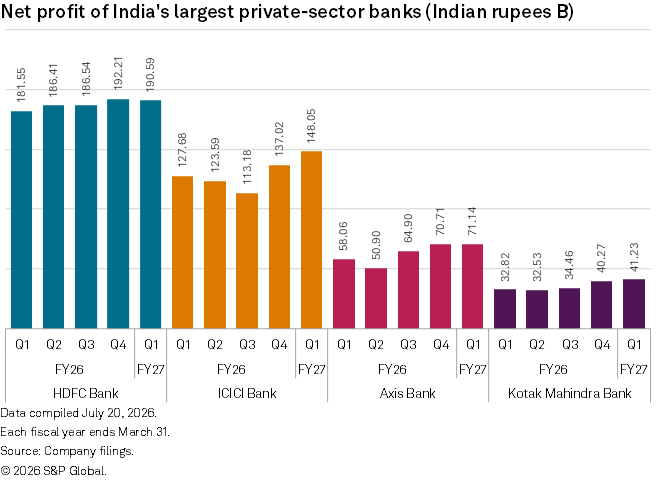
ICICI Bank posted a nearly 16% jump in net profit to 148.05 billion rupees from 127.68 billion rupees a year ago, above Visible Alpha's estimate of about 132 billion rupees. Visible Alpha is part of S&P Global Market Intelligence.
HDFC Bank recorded a 5% year-over-year increase in net profit to 190.59 billion rupees, while Kotak Mahindra Bank reported a 25.6% rise to 41.23 billion rupees. Axis Bank's net profit rose to 71.14 billion rupees.
Robust double-digit expansion in loans and deposits across the banks drove this growth. Kotak Mahindra's customer assets grew 16% year over year, while average deposits rose 14%. HDFC Bank's gross advances increased 13.4%, while average deposits rose 13.3%.