21 Jul, 2026
Eurozone banks set for unexpected lending gains amid higher rates
By Cathal McElroy and David Hayes
Banks in the eurozone are set to see a boost to their lending businesses as the European Central Bank hikes rates to tame inflation caused by the Middle East war.
The ECB raised its benchmark deposit facility rate 25 basis points to 2.25% on June 17, with the market expecting further increases before the end of the year. The central bank cited inflation pressures generated by the war, which caused a surge in energy prices in the first half of the year, as the reason for the hike.
The rise in eurozone rates prompted analysts to upgrade their forecasts for net interest margins (NIM) — the difference between what banks earn from lending and pay for funding as a percentage of their average interest-earning assets — for the bloc's largest lenders. Before the war started, the ECB was widely expected to hold its deposit facility rate at 2% in 2026, with some traders betting on a cut.
"It's been a bit of a black swan event, the war in the Middle East," Filippo Alloatti, head of financials, credit, at US investment manager Federated Hermes, said in an interview with S&P Global Market Intelligence. "If rates go higher, it would be, at least in the short term, positive for the banks."
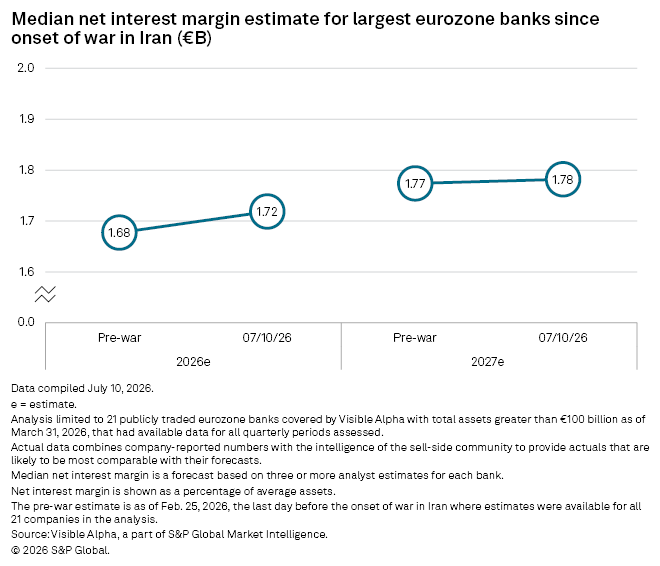
Median consensus estimates for 2026 full-year NIM at the largest eurozone banks for which data is available for all periods rose 4 basis points to 1.72% between the end of February when the war in the Middle East began and July 10, according to Visible Alpha data. Analysts, who had already forecast a 9-bps increase in lending margins for 2027 before the war, now estimate a further 1-bp increase in median NIM for the bloc's banks.
A particularly strong first quarter for net interest income (NII) — the difference between what banks earn from lending and pay for funding — among eurozone banks supports analysts' brighter outlook. Aggregate NII grew 3.4% quarter over quarter and 8.5% annually to a record €59.64 billion in the first three months of this year among a sample of 21 of the eurozone's largest lenders that had data available for the periods assessed, Market Intelligence data shows.
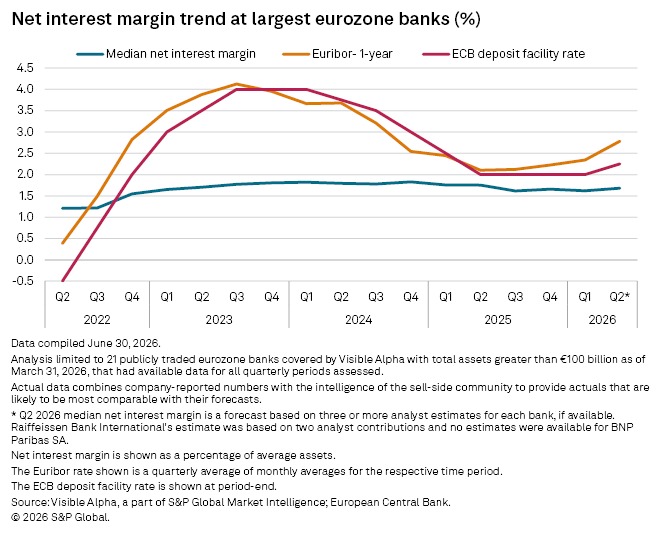
A surge in euro interbank offered rates, or Euribor — the benchmark average interest rate at which eurozone banks lend unsecured short-term funds to each other — after the outbreak of the war Feb. 28 contributed to the first-quarter result.
The 12-month Euribor rate — the standard reference rate used to set and annually reset the interest rate for variable-rate mortgages across the eurozone — jumped more than 70 basis points to 2.93% between the day before the start of the war and the end of the first quarter. The rate has remained elevated since, dipping no lower than 2.64% during that time.
The rise in Euribor rates reflects market expectations that the ECB, which is the only major European central bank to have raised rates in 2026, will raise interest rates further after its June hike. ECB executive board member Isabel Schnabel said June 25 that more rate rises will be necessary to bring inflation back to the central bank's 2% target.
"If I look at the forward curves, it's pretty much pricing in another 25-basis-point increase and then maybe like another 10 or 15 bps on top of that, which says there's some probability of another hike," Johann Scholtz, bank equity analyst at Morningstar DBRS, said in an interview.
The impact of higher eurozone rates will vary across markets and business models. Southern European banks were the biggest beneficiaries of the ECB's last monetary tightening cycle due to their largely variable-rate loan books and ample liquidity that kept deposit costs low. Nine of the top 10 banks that saw the largest increases in NII during the tightening cycle were from Italy, Spain, Portugal and Greece, Market Intelligence data shows.
Seven Southern European banks occupy a list of the top 10 lenders that saw the largest decrease in NII following the start of the ECB's last easing cycle, the data shows, suggesting that many of the banks in the region have retained a high degree of sensitivity to interest rate changes.
French banks, which experienced a fall in NII during the ECB's last tightening cycle due to specific features of the French market, should avoid similar problems this round. The expected extent of the ECB's tightening is more limited than the 450 bps of rate hikes delivered between July 2022 and September 2023, which sent French banks' deposit costs spiraling due to the country's regulated savings program.
"For French banks, overall, the outlook on NII is still positive," Sonja Förster, senior vice president for European financial institutions at Morningstar DBRS, said in an interview. "They still have longer-dated assets repricing at higher rates, and at the same time, they have loan growth."
No problems with nonperforming loans
The low probability of a more prolonged and severe tightening cycle should also keep eurozone banks provisioning for bad loans at reassuring levels, further supporting profitability, Scholtz said.
"This kind of hike on its own isn't really sufficient to push up [nonperforming loans] or anything like that," Scholtz said. "It's still manageable for households and corporates."
Eurozone banks could feel the benefits of the hike well into 2028, said Alessandro Boratti, analyst, financial institutions, at Scope Ratings.
"We see [NII] growing at middle-single digits in 2026 and then lower at around 3% in 2027 and 2028," Boratti said during a July 1 webinar on the midyear outlook for European banks. "The main driver behind it is the change in the interest rate environment."
– Access Visible Alpha estimates for BNP Paribas. (May require additional subscription.)
– Learn about Visible Alpha.
– Sign up for Earnings IQ Alerts to get results as soon as they're released.