24 Jul, 2026
Europe's new €100B Industrial Decarbonization Bank faces delivery test

|
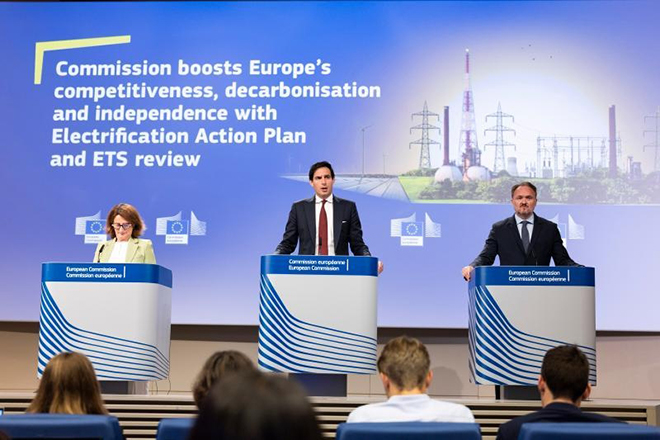
EU Commissioners Teresa Ribera, Wopke Hoekstra and Dan J |
As industry and policy observers assess the European Commission's review of the EU Emissions Trading System, attention is turning to a funding program aimed at supporting Europe's industrial survival in the transition to clean energy — and whether it can avoid the pitfalls of similar tools.
The proposed Industrial Decarbonization Bank (IDB), set to launch in 2028, will be an EU-level program designed to accelerate emissions reductions in industrial facilities covered by the Emissions Trading System (ETS), the bloc's carbon market. It aims to mobilize €100 billion in funding for industrial decarbonization.
But the bank faces early skepticism. Observers point to the slow start of similar incentive programs, such as the EU Innovation Fund, which has seen just 16 of 208 projects with grant agreements reach operation as of June 2025, according to the Clean Air Task Force (CATF) think tank.
The IDB must be designed to close that delivery gap, the group said.
"The litmus test for me is whether the IDB can support the development and growth of large industrial facilities," Ben McWilliams, an affiliate fellow focused on energy and climate policy at think tank Bruegel, told Platts, part of S&P Global Energy.
Investment Booster
The concept of the IDB emerged with the February 2025 publication of the Clean Industrial Deal.
In its first phase from 2028 until 2031, an "Investment Booster" will allocate 400 million carbon allowances as fixed premiums on a first-come, first-served basis to fast-track projects, with a dedicated portion reserved for lower-income member states in a bid to ensure fair distribution.
The European Commission expects this money to focus on promoting the scale-up of more mature industrial decarbonization projects.
Funding for first-of-a-kind innovations will be based on the EU Innovation Fund, which is also underpinned by the ETS.
The first phase of the IDB will inject an estimated €30 billion into low-carbon projects, assuming a carbon price of €75 per metric ton of CO2.
From 2031 onward, the IDB will transition to competitive bidding procedures, primarily offering carbon contracts for difference that provide long-term price certainty and reduce investment risks for decarbonization projects.
'Very little payoff'
The IDB includes safeguards such as completion bonds and strict deadlines to ensure projects are delivered on time, with payments tied to verified emissions reductions that can be made in carbon allowances.
"It is a step forward for industry to invest but looks bureaucratic," said Máximo Miccinilli, senior vice president and head of energy and climate at public relations agency FleishmanHillard in Brussels, adding that access will be linked to companies' ability to successfully apply.
"A larger budget won't matter unless the bidding process becomes simpler and more inclusive," Miccinilli told Platts. "Industry in crisis need survival tools for the short term, not investment promises deferred to 2035 or 2040."
Eligible use cases include industrial electrification, deployment of carbon capture and storage, grid connection and energy storage projects that enable decarbonization, flexibility solutions and even emissions reduction projects in waste incineration plants.
Industry vying for support under the new program may look warily at lessons learned from the "relatively disappointing" Innovation Fund, Miccinilli said, describing it as "marked by massive effort for applicants with very little payoff."
Success in delivery
While a €100 billion package is a serious commitment, Europe's largest energy-intensive industries will require far more than that over the next 15 years, according to CATF.
Closing the ongoing investment gap will require member state funding and private capital alongside the IDB, the think tank said.
"The Investment Booster is a welcome first step, but the IDB's real test will be deployment — turning Europe's pipeline of announced projects into facilities that are built and operating," Adriana Matić, associate for carbon management in Europe at CATF, said in a July 17 statement.
To achieve that, a coordinated system of development support, competitive carbon contracts for difference and dedicated infrastructure funding is needed, Matić said.
"Success must be measured by projects that reach operation, not by an expanding list of awards," the analyst added.
One of the programs supported by the Innovation Fund is the EU's Hydrogen Bank auctions. Launched in 2022, the auctions are designed to bridge the gap between production costs and market prices for renewable hydrogen, but are yet to see awards translate materially into final investment decisions.
Large-scale facilities key
A key test of success will be whether the program can deliver more than just pilot projects, another policy expert noted.
"I quite like the idea of 'commercialization contracts' as pointing to what the IDB needs to achieve," McWilliams of Bruegel said.
Europe has significant funds for supporting research and development, while the Innovation Fund and similar programs at national levels do a good job of building demonstration plants, McWilliams said.
"Where Europe has lacked so far is transforming research and pilot plants into large operating commercial facilities. The IDB cannot be the only tool to solve this problem," the analyst added.
The IDB proposal is now set for co-decision by the European Parliament and the European Council, with talks expected to run through 2026 and 2027, and implementation planned for 2028.
Different ideas for design can be discussed, for instance whether operational or capital expenditure is targeted, how funds are allocated across technologies, and how companies compete, McWilliams said.