22 Jul, 2026
Energy storage outlook jumps as hyperscalers, suppliers tighten ties

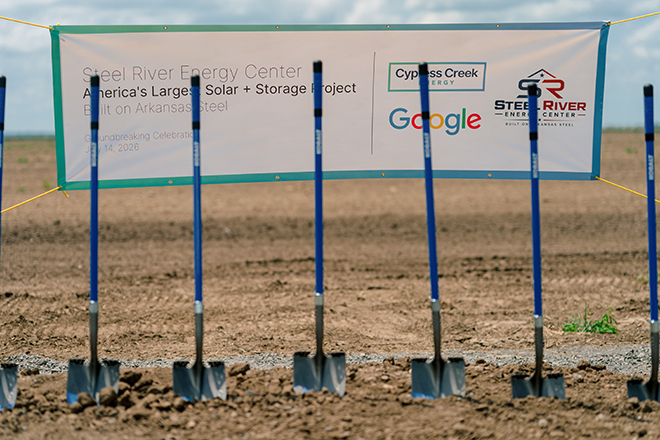
| Cypress Creek Energy recently started construction of the Steel River Energy Center in Wilson, Arkansas, which it says is the US' largest solar-plus-storage project. Google is buying the output. Source: Cypress Creek Energy. |
Hyperscale cloud computing giants and fellow technology titans are strengthening their ties with battery storage suppliers to power AI.
Companies including Amazon.com Inc., Google LLC, Meta Platforms Inc., Oracle Corp., NVIDIA Corp. and Tesla Inc. have launched far-reaching data center development and design initiatives this year that reflect a deeper integration of energy storage and digital infrastructure.
As a result, some industry observers and participants have become more bullish on batteries, citing storage as essential infrastructure at AI data centers and on power grids where projects are proliferating, often in combination with renewable energy and natural gas-fired resources.
"It's not just a 'nice to have' anymore," John Murray, principal analyst at S&P Global Energy Horizons, said in an interview. "It's become a 'need to have' for a lot of companies."
Analysts at Horizons in July elevated their outlook for US and global energy storage additions over the next decade, noting catalysts ranging from favorable economics and improving supply chains to surging data center power demand and the energy turmoil triggered by the Iran war.
The analysts expect annual global energy storage additions to rise nearly 40% in 2026 to about 165 gigawatts. Fueled by demand in China, Europe and the US, the industry's annual additions will exceed 210 GW by 2030, according to the latest Horizons outlook.
A year ago, Horizons analysts anticipated a market pullback in 2026, to about 95 GW, with annual additions still under 140 GW in 2030.
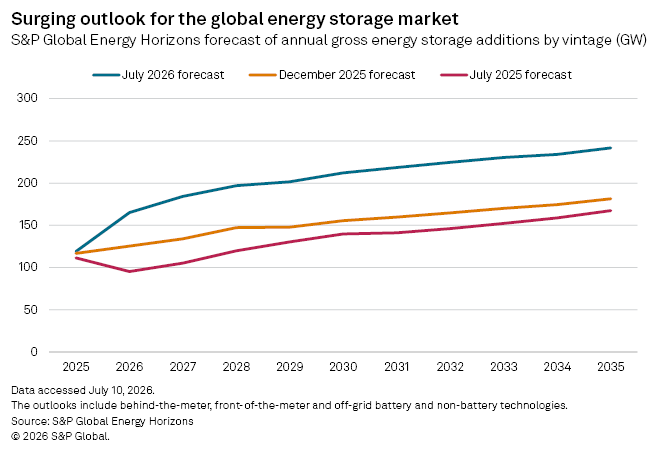
In the US, the updated forecast of 25 GW in 2026 would build on about 18 GW added in 2025. Analysts expect over 33 GW of new US energy storage resources to come online in 2027 and 2028 before tapering off.
"We were always worried that there's not going to be enough US-made or US-assembled batteries to be able to supply demand," Murray said. But the speed at which battery-makers are retooling production lines to serve demand for energy storage, rather than for electric vehicles, has been "incredible," he added, with some conversions requiring less than a year.
Project owners can claim tax credits for battery facilities that meet federal rules for domestic content, though deep-pocketed hyperscalers might also be willing to forgo tax incentives for faster deployments of certain foreign-made batteries.
"From what we've heard from them, if they can get a tax credit, of course they'll go for it," Murray said. "But what constrains them a lot of the time is time. They need things fast ... and with Chinese batteries, they can get them pretty quickly, reasonably cheap, and they're very, very good quality."
Batteries as 'Swiss Army Knife'
Behind-the-meter batteries at data centers, manufacturing sites and other large industrial facilities account for an outsize share of anticipated growth. US businesses and homeowners are poised to add almost 7 GW of on-site batteries in 2026 and another nearly 10 GW in 2027, according to the Horizons outlook, exceeding the size of the entire market a few years earlier.
Most of the on-site opportunity is in the industrial segment, including at data centers where batteries are becoming "the Swiss Army Knife" of energy options, said Tiffany Wang, a research analyst at Horizons.
"It's a technology that is proven, the costs are decreasing year after year, and you can basically use it for multiple use cases in a way that maybe you can't do for other technologies," Wang said.
On-site energy storage is emerging as a multifaceted tool that can enable operational flexibility, provide backup power, smooth volatile AI loads and optimize on-site generation, according to an April report that Wang co-authored.
The use of batteries to optimize gas turbines is generating the greatest interest among on-site applications, the analyst added.
"Gas-gen, you really use it for base generation, whereas behind-the-meter [batteries] would be more for that fast-response power, in case there's any rapid ramps where you need to do any peak shaving," Wang said. "They actually work really well in tandem."
Suppliers of residential batteries and other distributed energy resources are also pitching their aggregated behind-the-meter assets to hyperscalers.
Tesla in June teamed up with residential solar and storage company Sunrun Inc. and Google spinoff Renew Home LLC to offer over 16 GW of flexible capacity to data centers and utilities to help meet rising power demand by orchestrating millions of existing demand-side and energy-exporting devices into a distributed power plant.
'Smooth transaction'
Google, which has been among the most prolific corporate buyers of clean energy in recent years, is exploring batteries on both sides of the meter.
The Alphabet Inc. operating arm on July 14 unveiled its largest clean energy offtake deal to date with developer Cypress Creek Energy. Google agreed to purchase power from the first two phases of Cypress Creek's Steel River Energy Center in Wilson, Arkansas, which combines 1.6 GW direct current of solar capacity with 1.9 gigawatt-hours of battery storage.
"It was a smooth transaction," Cypress Creek CEO Kevin Smith said in an interview after announcing the project's groundbreaking with Google as the anchor customer.
Cypress Creek, which secured $3.5 billion in financing for the initial two phases of Steel River in June, plans to expand the complex to 2.5 GWdc of solar and 2.9 GWh of storage by 2029. The developer is owned by asset manager EQT AB (publ).
|
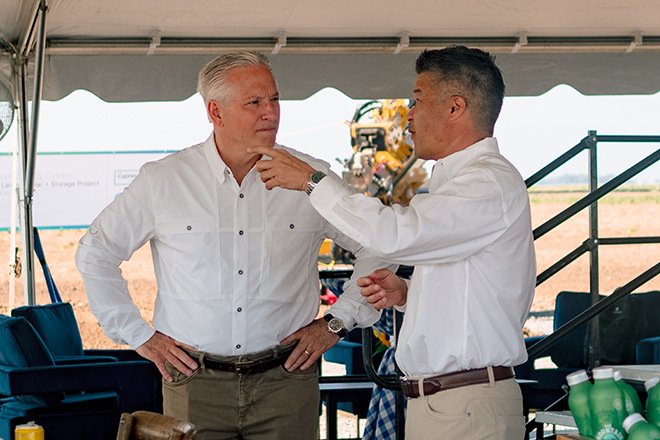
Cypress Creek Energy CEO Kevin Smith, left, speaks with PACO Steel & Engineering Managing Director David Paik at the Steel River Energy Center site on July 14. |
Once online, Steel River will connect to the regional grid about 30 miles north of where Google is building a $4 billion hyperscale data center in West Memphis, Arkansas.
Big tech buyers could ultimately account for one-third to half of Cypress Creek's 20-GW project pipeline, according to Smith.
"We're seeing unprecedented demand in the US that I haven't seen in my 40-year career," said the CEO.
While the US energy sector is facing an "all-of-the-above moment," battery storage and solar are the "most affordable and quickest to market," added Smith, who has worked across nuclear, natural gas, renewable and storage industries.
For Google, the Steel River deal is part of an expanding portfolio of renewable energy and battery projects associated with its data centers.
Google's recently acquired independent power producer Intersect Power LLC started operations in June at the Quantum Clean Energy Project in Haskell County, Texas, alongside a data center on which construction recently started. The project includes 640 megawatts of solar and a 1.3-GWh storage system.
Also in June, Google and Intersect said they plan to build another data center in Texas colocated with more than 1 GW of wind, solar and battery storage resources.
In addition, batteries will be used as backup power sources at the two Google data centers in Texas and the facility in West Memphis, according to spokespeople for Intersect and Google.
Exposed to risk
Despite their growing clean energy portfolios, tech giants continue to rely on diesel- and gas-fired generation for on-site power at data centers, and are seeing their total carbon footprints rise as their digital infrastructure and electricity use expand.
In the US, community concern over the energy, environmental and affordability impacts of data centers has boiled over into moratoriums at state and local levels, and lawsuits.
Such opposition to data centers is jeopardizing a large volume of associated clean energy capacity, according to Horizon's Murray. Community opposition to data center development in the US has become a significant threat to renewable energy and battery storage projects, Murray said in a report released in June.
The analyst estimated that 27 GW of behind-the-meter battery systems at data centers could be exposed to delays or cancellation, with most of the imperiled projects concentrated in Ohio, Nevada and Virginia. In addition, the report cited over 30 GW of at-risk capacity on the utility side of the meter, including 16 GW of large-scale solar, 9.5 GW of batteries and 6 GW of wind.
That potential impact could expand if discontent over data centers continues to spread.
"There's local opposition popping up everywhere across the country," Murray said.