22 Jul, 2026
Buyout funds attract bulk of $306.8B raised by PE managers through June 30
By Joyce Guevarra and Shambhavi Gupta
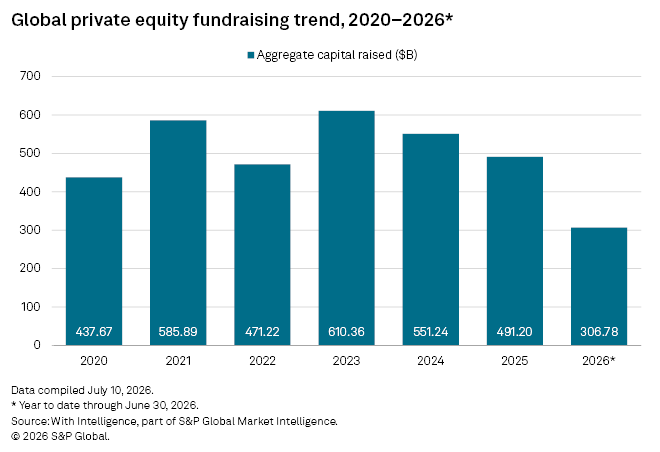
Global private equity fundraising is on track to reverse a two-year decline with $306.78 billion raised in the year to June 30, equivalent to 62% of the total for 2025, according to data from With Intelligence, a part of S&P Global Market Intelligence.
The fundraising total is an aggregate across 157 funds pursuing buyout, growth equity, secondaries, general partner stakes, co-investment and fund-of-funds strategies.
Buyout strategies accounted for 70% of total capital raised, while secondaries made up 15%. By investment region, North America-focused funds totaled $131.49 billion, or roughly 43% of the total, while multi-region funds raised 30% at $93.24 billion.
Flight to quality
Fundraising in total dollar terms is improving, but successful capital raising is skewed toward established managers with strong distributions to paid-in capital (DPI), said Kelly Phelan, partner at Asante Capital Group LLP. DPI is a measure of actual cash returned to investors relative to paid-in capital.
"Several years ago, limited partners were really focused on IRR (internal rate of return) as the gold standard. Today, DPI is absolutely king. Folks need capital back to reinvest into their relationships, and liquidity is tight in this market," Phelan said. "Those who can really show it are the ones who are clearing effectively."
Phelan said full exits are more persuasive to LPs than partial liquidity events.
"In a more benign exit environment, the GPs that are able to actually sell quality assets and prove that they have a durable strategy regardless of market conditions are really attracting a lot more capital these days."
Middle-market opportunity
Middle-market private equity managers are regaining traction with LPs as investors reassess portfolios dominated by larger platforms. While mega-funds continue to attract the largest commitments, smaller funds are benefiting from renewed demand for lower-middle-market exposure, where LPs believe alpha can be stronger, Phelan said.
For middle-market firms, LPs are focused on sourcing investment opportunities and differentiation, said Alan Goldfarb, founder and managing partner of Orangewood Partners LLC.
"Firms that can clearly demonstrate a repeatable investment process and operational expertise are continuing to attract capital because those qualities are increasingly difficult to replicate."
- Download a spreadsheet with data featured in this story.
- Read about trends in global venture capital rounds of funding.
- Explore more private market headlines.

Largest 2026 fund closes
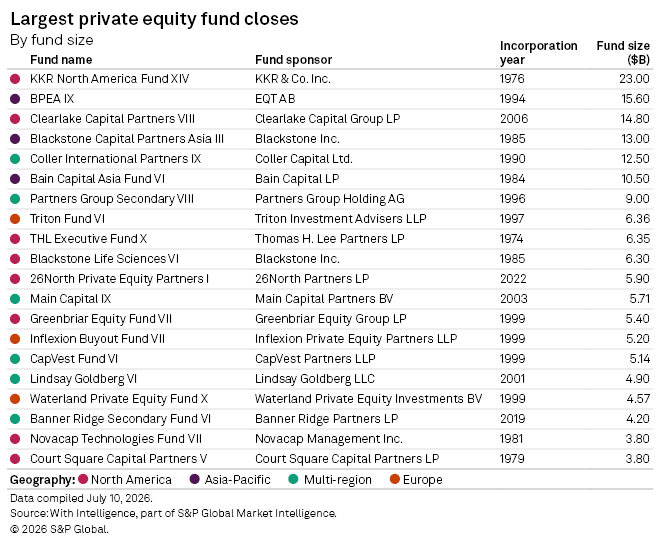
Most of the large private equity funds that closed in the first half of 2026 were raised by managers founded at least 20 years ago, With Intelligence data shows.
KKR & Co. Inc. closed the largest fund, KKR North America Fund XIV, at $23 billion. The buyout fund surpassed its $20 billion target. Minnesota State Board of Investment committed $400 million, while Oregon Investment Council and Maine Public Employees' Retirement System committed $350 million and $50 million, respectively. Cathay Life Insurance Co. Ltd. and Fubon Life Insurance Co. Ltd. are also limited partners in the fund, according to S&P Global Market Intelligence data.
Largest targets
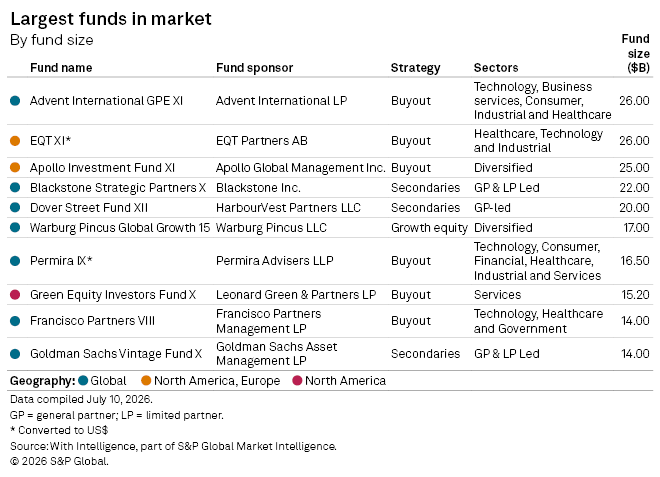
As of June 30, the 10 largest funds in market have a collective target of $195.70 billion. The two largest - Advent International LP's global buyout fund, Advent International GPE XI and EQT Partners AB's North America and Europe-focused buyout vehicle, EQT XI - each aim to raise $26 billion.
Closing timeline
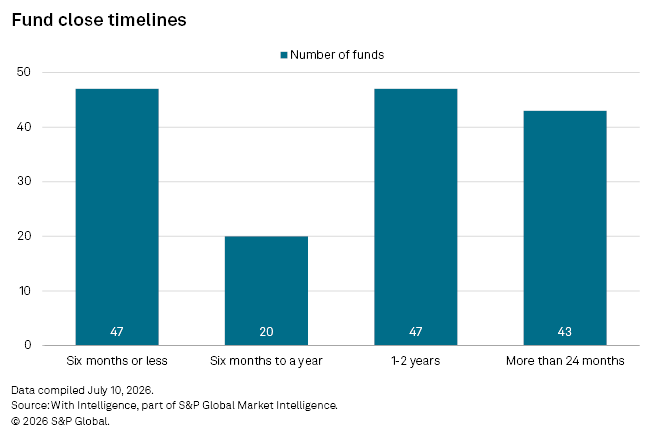
Of the funds closed in the first half, 30% reached a final close within six months. Another 30% took one to two years, while roughly 27% of the funds required more than 24 months to reach final close.
There is real flight to quality in the current fundraising environment, said Russ Roenick, co-founder and managing partner at Transom Capital Group LLC.
"There's the haves and there's the have-nots, and there's a lot more have-nots than there are to the contrary," Roenick said.