29 Jun, 2026
Swedish banks' net interest income outlook improves as rate hike becomes likely
By Adrian Jimenea and Cheska Lozano
Analysts have increased their estimates for Sweden's three largest banks' main source of revenue as a tightening of monetary policy in 2026 becomes increasingly likely.
The combined 2026 net interest income (NII) of Skandinaviska Enskilda Banken AB (publ) (SEB), Svenska Handelsbanken AB (publ) and Swedbank AB (publ) is expected to reach 128.78 billion kronor, according to Visible Alpha estimates as of June 23. This was up from the 127.91 billion kronor estimated before the banks published their first-quarter financial reports.
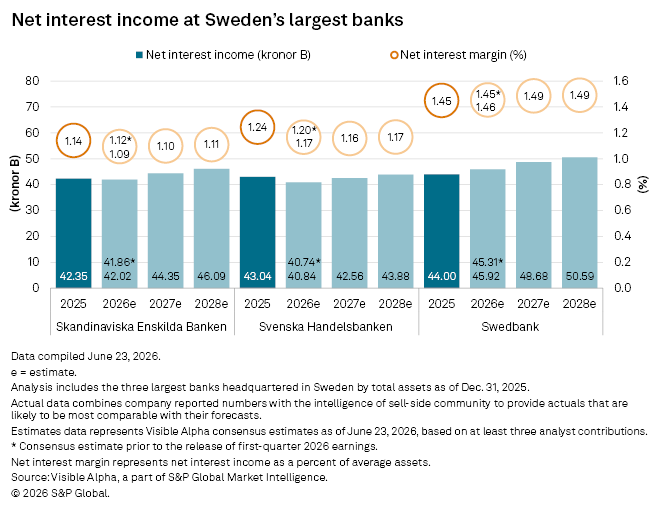
SEB's 2026 NII estimate has been raised to 42.02 billion kronor from a previous forecast of 42.86 billion kronor. It is the largest of the three banks by assets and its revenue is relatively less sensitive to interest rate movements given the size of its corporate loan portfolio, which is typically on fixed-rate terms.
Swedbank's NII estimate was hiked the most, to 45.92 billion kronor from 45.31 billion kronor. Swedbank is the largest mortgage lender in Sweden,
NII estimates for Handelsbanken have increased by a smaller degree. Analysts expect the bank to generate 40.84 billion kronor of NII, up from a previous forecast of 40.74 billion kronor.
Sweden's central bank, the Riksbank, has cut benchmark interest rates more aggressively than its European counterparts since 2023, pressuring banks' lending income. However, the war in the Middle East has heightened inflationary pressures, prompting central banks around the world to move toward tighter stances on monetary policy.
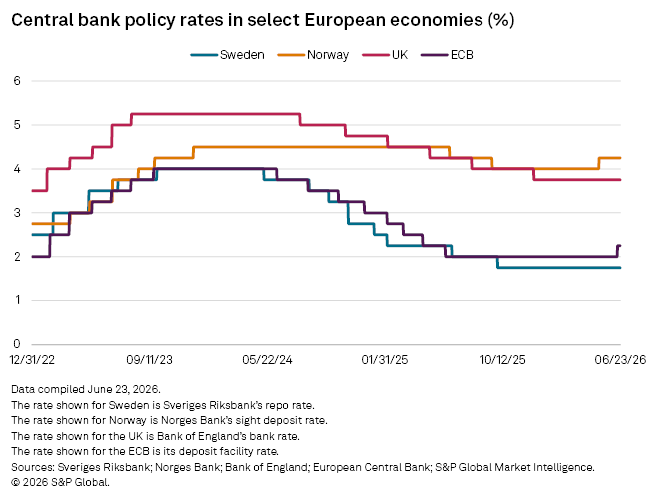
On June 17, the Riksbank maintained its policy rate at 1.75% but said the likelihood of a rate hike later in 2026 has increased since its March assessment. "The supply disruptions linked to the war in the Middle East have led to inflationary pressures rising and the risks of inflation becoming too high have increased," the Riksbank said.
The Riksbank further cut its 2026 GDP growth forecast to 2.2% from 2.5% in March.
Handelsbanken CEO Michael Green said in April that a faster and uninterrupted recovery for the Swedish economy is needed for the bank to see a significant pickup in lending in its home market. Sweden accounts for approximately 76% of the group's profits.
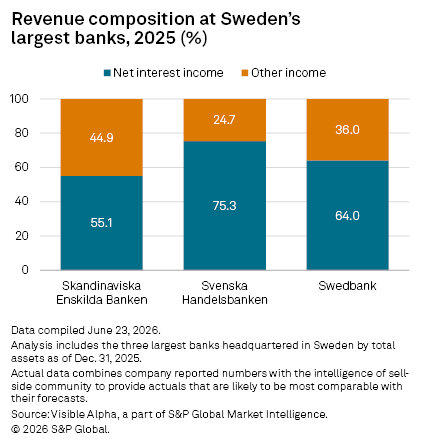
Of the three banks, Handelsbanken is the most dependent on NII, S&P Market Intelligence data shows. In 2025, NII accounted for 75.3% of its total group revenue. This compares with 64% at Swedbank and 55.1% at SEB.
Total domestic loans to non-monetary financial institutions in the country amounted to 8.897 trillion kronor in May, according to the government's official statistics agency. This was up from 8.877 trillion kronor in April and 8.634 trillion kronor in May 2025.
Lending to households grew 3.1% in May compared with 3% in April. Lending to non-financial corporations also improved to 3.3% in May from 3.1% in April.
As of June 26, US$1 was equivalent to 9.71 Swedish kronor.
Visible Alpha is a part of S&P Global Market Intelligence.