18 Jun, 2026
May US retail sales jump; Sleep Number, West Marine file for bankruptcy
By Umer Khan and Sean Longoria
US retail sales beat expectations in May thanks to broad increases in consumer spending.
Monthly sales jumped 0.9% to $763.71 billion, according to seasonally adjusted advance estimates released by the US Census Bureau, significantly better than the expected 0.5% from consensus estimates compiled by Econoday. April sales growth was revised to 0.4% from the advanced estimate of a 0.5% gain.
Inflation has heated up in recent months, with the consumer price index for all items up 4.2% annually in May, driven by rising energy prices. Despite the inflation uptick, May spending rose across nearly every retail category.
"Higher goods and energy prices are definitely boosting the sales gains, but consumers in aggregate continue to meet the challenge and grow their real inflation-adjusted spending," Scott Anderson, chief US economist for BMO, said in a note.
The Federal Reserve on June 17 released projections calling for higher inflation and a higher benchmark federal funds rate through 2028 than they forecasted in March.
"For now, households are still prepared to spend, largely funded through saving less and borrowing more," James Knightley, chief international economies for ING, said in a note. "High income households, boosted by significant wealth gains, are spending vigorously. Meanwhile, middle and lower income households, who are under more financial strain from high prices and weak income growth, are treading water."
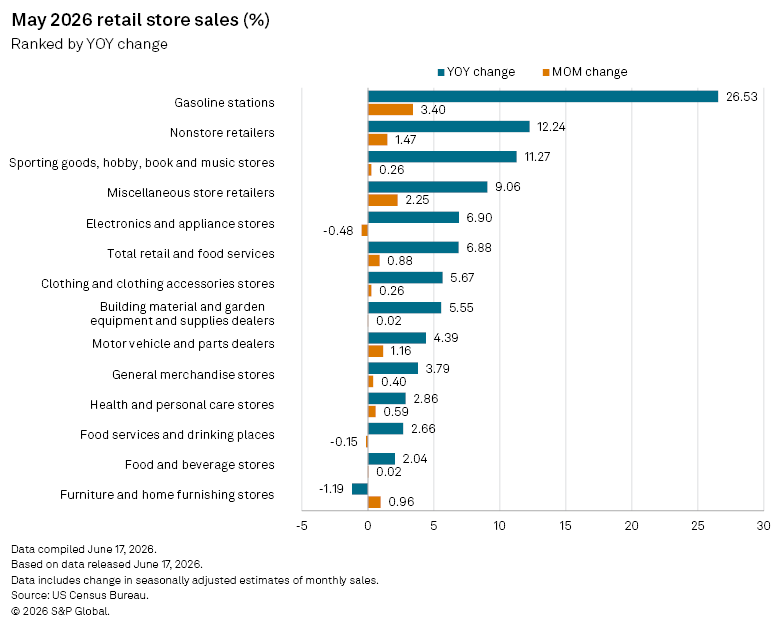
Retail sales climbed in 11 of 13 categories tracked by the Census Bureau.
Gasoline station sales rose the most, up 3.4%, as the price of fuel continued to climb. Gas prices in May climbed compared to April, with the national average over Memorial Day weekend more than 50 cents per gallon higher than the same point a month earlier, according to AAA. The run-up in gas prices also propelled a 26.5% jump in gasoline station sales in May compared to the same month in 2025.
Monthly sales fell in the electronics and appliances stories and food services and drinking places categories, dropping 0.5% and 0.1%, respectively.
 |
– Set – For more bankruptcy analysis, check out the monthly bankruptcy series. |
Bankruptcies
Two retailers, Sleep Number Corp. and West Marine, Inc., filed for bankruptcy protection in the month ending June 16. The median probability of default for publicly traded companies fell in mid-June from a month earlier.
Sleep Number, which sells mattresses and related products, is combining with Sleep Country Canada. It submitted a bankruptcy petition to facilitate the merger, according to a June 12 filing. Sleep Number executives expect the company to continue operating during the process.
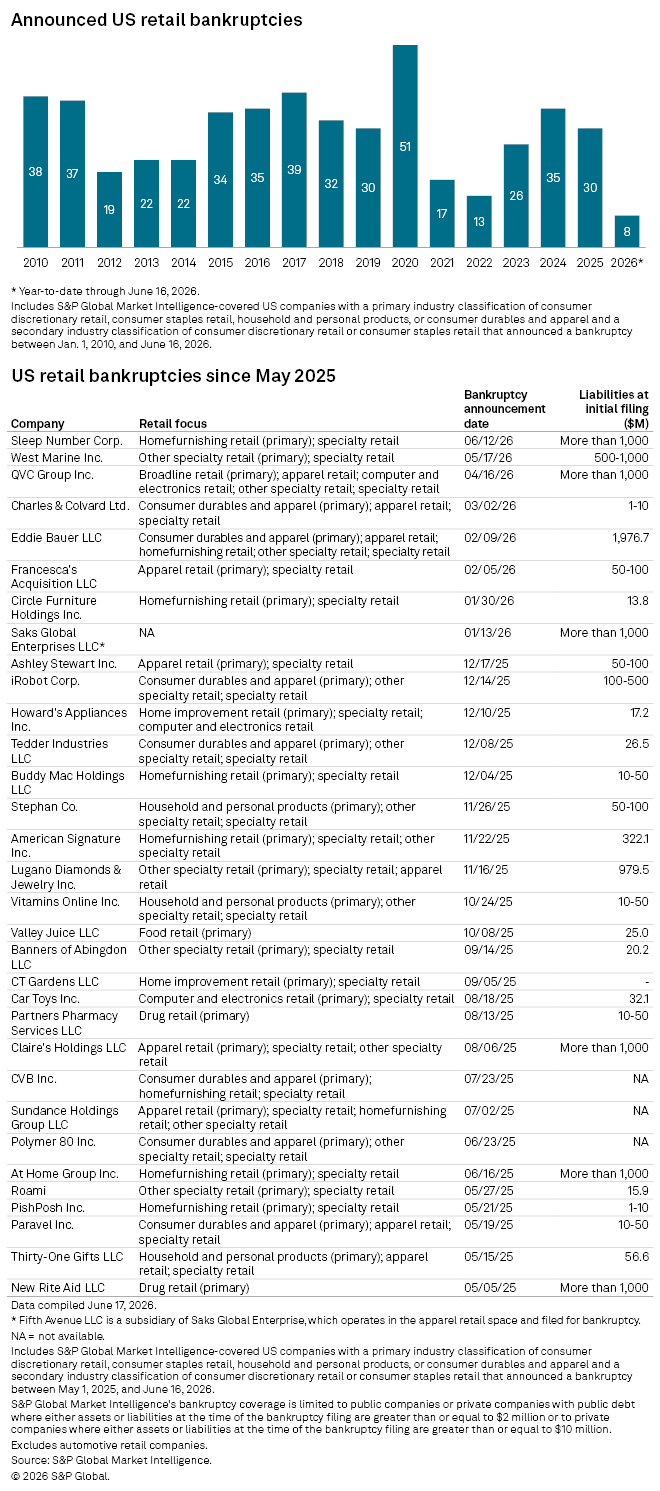
West Marine planned a similar reorganization through its bankruptcy process, according to a May 17 release. The boating and fishing parts and accessories retailer is continuing to operate via its more than 200 stories in the US.
The two filings bring the total retail bankruptcies tracked by Market Intelligence so far in 2026 to eight. The data covers companies with public debt and at least $2 million in assets or liabilities, and private companies with at least $10 million in assets or liabilities at the time of filing.
Default risk
Median probability of default scores fell in 9 of 15 retail industries tracked by Market Intelligence as of June 16 compared to scores from mid-May. Overall, the median 1-year probability of default among 198 publicly traded retailers dropped to 2.1% from 2.4% over the same time.
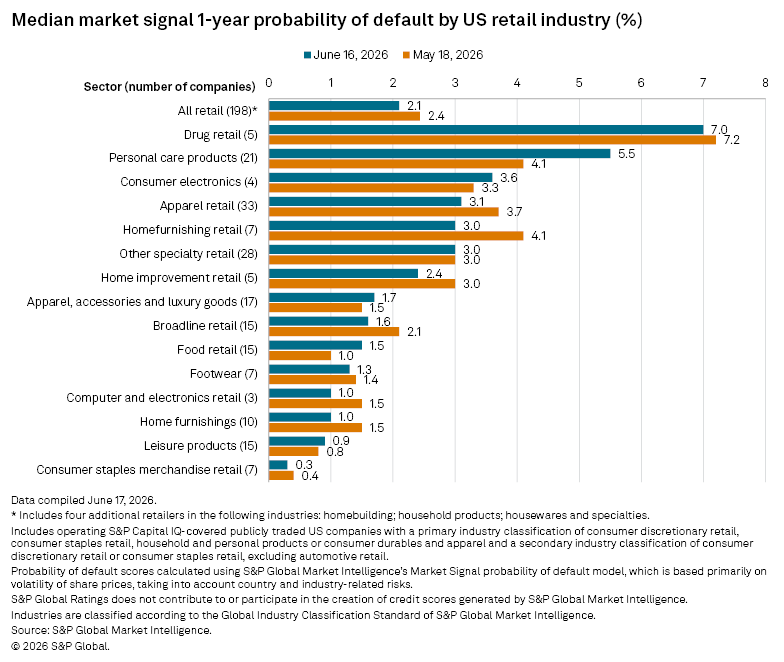
The percentages represent the median probability that a company will default on its debt within a year. They are based primarily on share price volatility for public companies on major US exchanges and account for country and industry risks, as well as other macroeconomic factors.
Median probability of default rose the most for personal care products companies, up 1.4 percentage points over the month. Homefurnishing retailers recorded the largest drop in default risk score to 3.0% as of mid-June from 4.1% a month earlier.