24 Jun, 2026
Federal coal plant subsidies spark debate over ratepayer costs, grid strategy
By Karin Rives and Susan Dlin
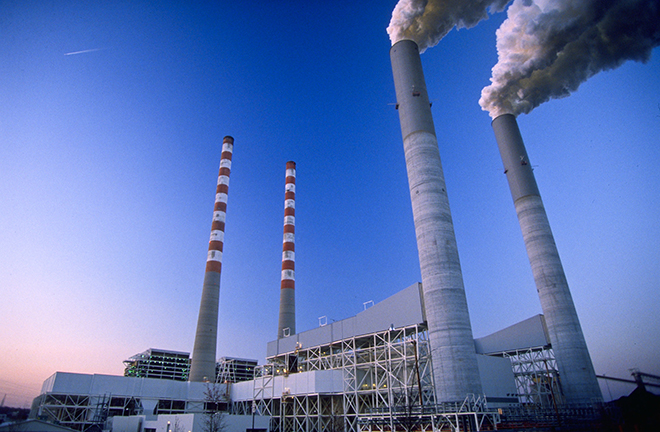
| The Tennessee Valley Authority is expected to receive a $46.3 Source: Tennessee Valley Authority. |
US electric utilities that were on track to retire dozens of aging coal-fired power plants have welcomed more than $1 billion in potential federal subsidies to help extend the life of those facilities. The funding has intensified debate over whether the subsidies represent a pragmatic response to electricity demand growth or a potentially costly bet on uncertain load projections that could saddle ratepayers with stranded assets.
Industry analysts and policy experts offered mixed views on the potential implications of the federal funding. Supporters said the grants provide a low-cost bridge to meet near-term reliability needs, while critics said the investments could lock utilities into aging infrastructure just as cheaper alternatives become available and data center demand proves less robust than projected.
The central tension revolves around whether anticipated electricity load growth from data centers and other industrial users will materialize at levels sufficient to justify keeping coal plants online for several more years, particularly in regulated markets where modernization costs flow directly to customer bills regardless of how often the facilities actually run.
Power companies in the fall of 2025 jumped at the US Energy Department's solicitations of grant proposals, part of the Trump administration's multipronged strategy to reverse the coal industry's decline.
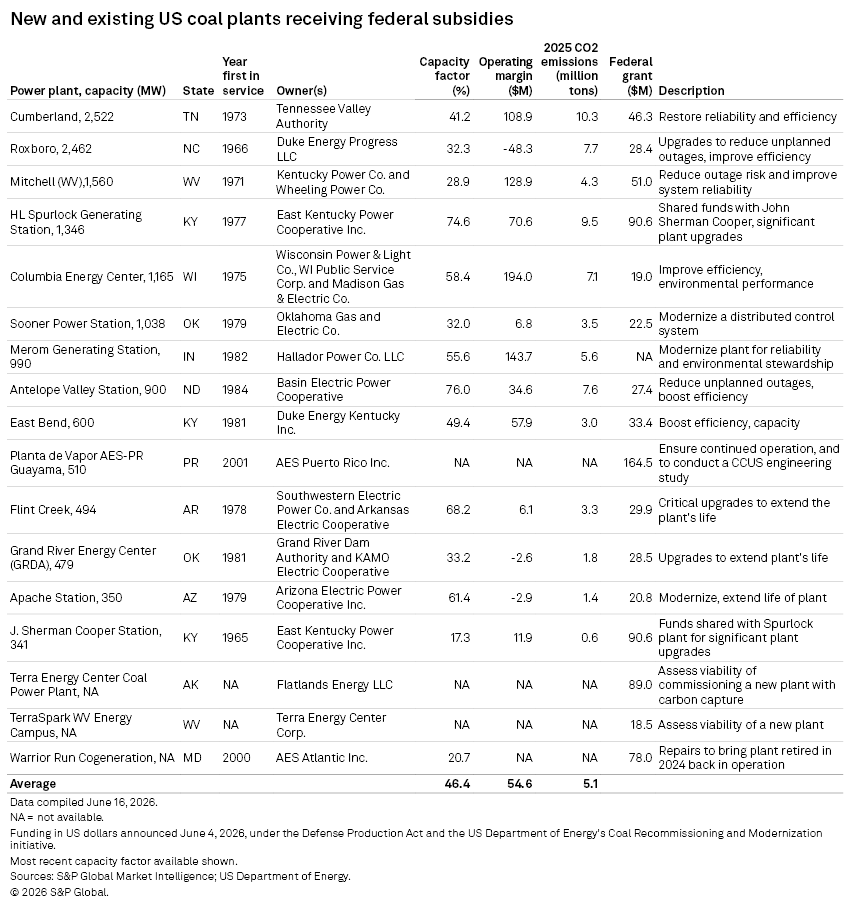
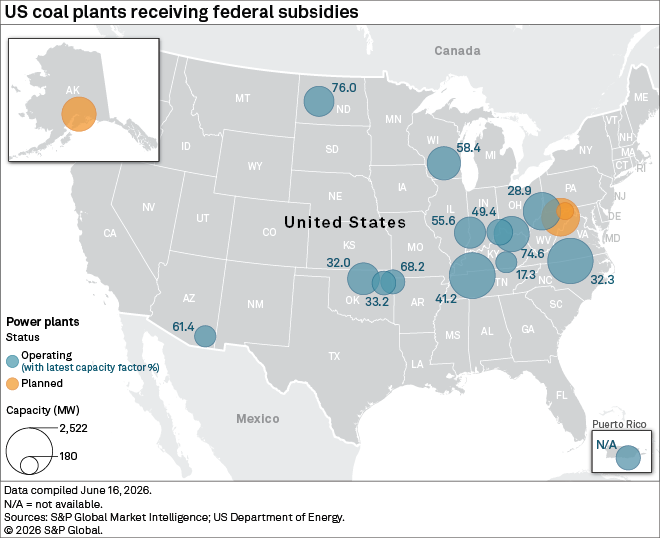
The first batch of grants to refurbish seven coal plants, worth $175 million, was announced in February. On June 4, the DOE said it had selected 13 more existing plants to receive nearly $590 million in grants, for a total of $850 million in coal-related funding announced that day. The plant owners are now negotiating final amounts with the agency.
"But what if, even with the best effort of utilities, lots of communities say, 'We don't want these data centers?' What if five or six hyperscalers become two or three?" said Stephen Arbogast, a finance professor at the University of North Carolina's Kenan-Flagler Business School. "There's at least one scenario where this stuff reverts to the mean, and some of the power demand goes away. And people can take a fresh look at what they're doing."
Ratepayer impacts
A 2025 study that consulting firm Grid Strategies conducted on behalf of several environmental groups estimated that the Trump administration's mandates to keep coal plants from retiring could cost ratepayers across the US at least $3.1 billion annually by the end of 2028. This does not include health costs from increased emissions of carbon dioxide and toxic pollutants.
Analysts have suggested that coal plant life extensions could be more expensive than alternatives, given that coal-fired power production was declining as cheaper and cleaner generation went online.
Travis Miller, a senior energy and utilities equity analyst with Morningstar, offered a contrasting view, saying that extending the operating life of existing coal plants could benefit ratepayers.
"Keeping an older coal plant operating with minimal investment can be a big benefit for customers' bills relative to building a new facility to maintain reliability," Miller said in an interview. "This ultimately all gets down to what's necessary for reliability and the trade-off in maintaining an existing coal plant that customers have already paid for."
The economics differ significantly between regulated and competitive electricity markets. With just a few exceptions, coal plants receiving federal subsidies are located in Midwestern or Southeastern states with regulated markets, where utilities earn returns on capital investments regardless of how often a plant runs. That regulatory structure creates incentives for plant modernization even if the facilities run infrequently, raising questions about whether the investments serve customer interests or utility earnings goals.
Strategic questions
Beyond immediate economics, analysts questioned whether coal plant life extensions address long-term grid transformation challenges or simply defer difficult decisions about decarbonization pathways and resource adequacy.
Keeping a coal plant running longer with modernized equipment may help some utilities trying to meet load growth and keep power rates under control — top priorities for the industry today, the University of North Carolina's Arbogast said.
"The question for the utilities is: Alright, you've got this front-end problem, but what are you going to do behind it?" Arbogast said in an interview. "What are you going to do to decarbonize the grid? Where are you on small modular nuclear and on carbon capture? These kinds of issues are kind of leaking off the page."
The grants arrive as utilities face competing pressures to maintain reliability, control costs and reduce emissions. The utilities must also navigate permitting bottlenecks that delay renewable energy deployment, as well as supply chain constraints and rising costs that slow natural gas-fired plant construction.
The Trump administration's rollback of a number of environmental regulations has given coal plants a new lifeline, although the plants could face regulatory risks should policies shift again.
Miller contended that all generation sources will be needed if US electricity demand grows at projected rates. The US is searching "for any electron possibly" to maintain reliability as the data center buildout continues, the Morningstar analyst said. "If electricity demand in the US grows at the rate we think it will, all generation sources are going to be needed to help serve that demand."
Mike O'Boyle, senior director of policy and strategy for think tank Energy Innovation, countered that Texas has shown that renewables and batteries can help meet growing electricity demand without extending coal plant operations, suggesting the federal subsidies may reflect outdated assumptions about baseload generation requirements.
"Real reliability challenges posed by demand growth don't happen 24/7, 365 days a year," O'Boyle said in an interview. "They're highly concentrated in a few hours over the year. So the firming you see from batteries actually provide a lot of the reliability that's needed. Texas is adding many gigawatts every year and allowing for a much more rapid transition."
'Saving customers money'
For coal producers, the federal grants represent a potential reprieve from years of declining demand as utilities retired coal-fired generation in favor of cheaper natural gas and renewable energy.
US coal deliveries to some power plants have increased since early 2025, suggesting the policy shift may be driving fuel demand in certain regions.
Mindful of rising customer bills, power companies stressed that the DOE grants will help offset the cost of plant investments needed to meet growing power demand.
"The support provided by the DOE will allow [Oklahoma Gas and Electric Co.] to complete this project at a much lower cost to customers," said Dustin Gabus, a spokesperson for the company, which was selected for a $29 million grant to help modernize the central automation system of its 1,038-MW Sooner plant.
The utility's 2,220-MW Belews Creek plant would use a $34 million federal grant to defray the cost of replacing parts of a boiler, turbine, control systems and other equipment. Those upgrades will reduce forced outages and keep the plant running smoothly "for several years to come," the company said.
"These grants help keep our units operating reliably and efficiently, while saving customers money by paying down the cost of these projects," Riley Cook, a Duke Energy spokesperson, said in an email.
Alliant Energy Corp. in 2021 proclaimed "the end of an era" by announcing it would close its last coal plant in Wisconsin by the end of 2024. But that date was pushed back as electricity demand grew in the Midcontinent Independent System Operator's power market. Today, Alliant refers to the plant as a "cornerstone in the American infrastructure."
The $19 million grant the company is negotiating with DOE would be matched with $29.5 million from Alliant Energy and the other owners to modernize the 51-year-old, 1,165-MW Columbia Energy Center.
"With rapid load growth across MISO, it is anticipated that the Columbia power plant will continue to run more like a baseload unit, as it has in near-term history, rather than as a peaker unit," Alliant spokesperson Cindy Tomlinson said in an email.
Whether that scenario plays out across the broader US coal fleet depends on variables including actual versus projected demand growth, the pace of alternative generation deployment, future policy directions and the economics of coal plant operations in an evolving electricity market.