06 May, 2026
Deposit growth trails lending at Japanese megabanks
By Yuzo Yamaguchi and Marissa Ramos
Deposits are growing at a slower pace than loans at Japanese megabanks, potentially crimping lenders' securities investments and even lending.
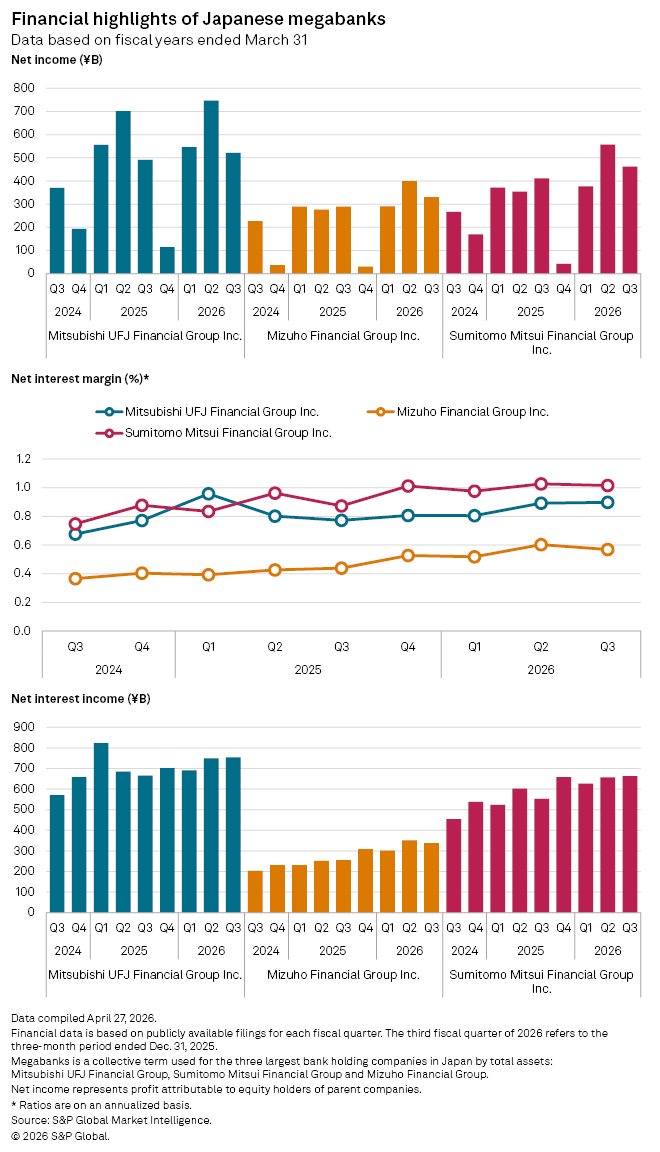
Mitsubishi UFJ Financial Group Inc. (MUFG), Sumitomo Mitsui Financial Group Inc. (SMFG) and Mizuho Financial Group Inc. all reported slower deposits in most quarterly periods since March 2024 when the Bank of Japan ended its negative interest rates policy, data from S&P Global Market Intelligence show.
"Loan-to-deposit ratios [at banks] are rising as Japan is in a world of rising interest rates," said Hideo Oshima, a senior economist at Japan Research Institute. "So they may have to take measures against this trend such as cutting back on their securities investments or even reducing their lending eventually."
As the central bank started raising its benchmark interest rate as part of a normalization cycle and to contain inflationary pressures, Japanese lenders are increasingly forced to compete for deposits, which ultimately get used to fund loans. The deposit battle has been intensified as consumers and companies diversify their asset management, including shifting money to higher‑yielding securities such as bonds and tax‑free equity investments.
Deposits lag
Deposits at MUFG grew 5.9% year over year as of March 31, 2024, compared with a 6.8% growth of loans, Market Intelligence data show. But the gap between the pace of deposits and lending has widened since. During the quarter ended Dec. 31, 2025, deposits grew 2.5%, while loans increased 5.1%.
Similarly, SMFG's deposits growth at 2.7% in the October-to-December quarter of 2025 was short of a 3.4% loan expansion as of Dec. 31, 2025, the data show.
"It's hard to think the gap between growth of deposits and loans will shrink," Oshima said.
Scaling back
Bank of Japan's data shows a similar trend across most Japanese banks, including major and regional lenders. Monthly year‑over‑year deposit growth for all banks was 1.8% in March, lagging loan growth 5.2% in March. The gap was even more stark for major banks, with deposits up 1.8%, compared with a 6.3% increase in loans in March, BOJ data show.
The central bank has scaled back on its purchases of Japanese government bonds as part of its quantitative tightening and rate‑hike policy.
The regulator, which holds nearly 48% of all Japanese government bonds, announced in June 2025 that it will scale back on its monthly outright purchases of JGBs. The central bank started by reducing its monthly purchases by ¥400 billion and moved to reducing monthly purchases by ¥200 billion per month from April.
The central bank plans to scale back its monthly government bond purchases "in a predictable manner, while allowing enough flexibility to support stability in the JGB markets" to cut its monthly purchases to ¥2 trillion by March 2027.
That puts pressure on companies and consumers to act as substitute buyers. Banks too are reluctant to allocate more cash to government securities as prices of government bonds will fall as rates rise, pushing yields lower. Bond prices move inversely to yields.
MUFG reduced its holdings in government bonds to ¥14.56 trillion as of Dec. 31, 2025, from ¥25.07 trillion in the fiscal year ended March 31, 2024. The bank posted a mark to market loss of ¥340 billion on its yen bond holdings in the December quarter. SMFG's JGB assets shrank to ¥8.95 trillion from ¥10.76 trillion over the same period. The lender posted an unrealized loss of ¥220 billion on its JGB holdings.
Capital hungry
Meanwhile, corporate demand for capital remains strong. M&A involving Japanese companies rose 8.8% to 5,115 deals in 2025, marking a second consecutive record high, according to Recof, a Japanese M&A advisory firm. Deal value increased 74.7% to ¥35.7 trillion, also a record. In the first three months of 2026, the number of M&A deals involving Japanese companies grew 9.6% year on year to 1,295, Recof said in a report.
"As capital demand will likely remain strong, banks are eager to lend," said Masahiro Ichikawa, chief market strategist at Sumitomo Mitsui DS Asset Management. "When it comes to deposits, consumers could keep shifting cash to more attractive investments such as tax-free NISA [Nippon Individual Savings Account]."
Banks are rushing to attract retail customers, with digital banking emerging as a key battle ground. MUFG launched the "emutt" brand in 2025 that consolidates financial services using an app. In the second half of this fiscal year that started April 1, the lender aims to set up a digital bank that could offer higher deposit rates than offered at the bank's branches. The move follows SMFG's launch of its platform, Olive, in 2023 that integrates back account, credit card payment, finance and securities on an app.
The BOJ left its policy rate steady at its two-day meeting that ended April 29 amid the prolonged war in the Middle East. But Kazuo Ueda, the BOJ governor, said at a press conference, "We'll continue to consider raising interest rates" after the central bank revised up its inflation forecast to 2.8% for the current fiscal year that started in April, compared with its previous predictions of 1.9%.
As of May 6, US$1 was equivalent to ¥157.20.