13 May, 2026
Accelerating recovery key to Calif. regulator's action against State Farm

By Tom Jacobs
|
A homeowner in Altadena, Calif., opens the door of the trailer he is living in on his property, next to the remains of his home, which was destroyed in the Eaton Fire, on March 30, 2025. |
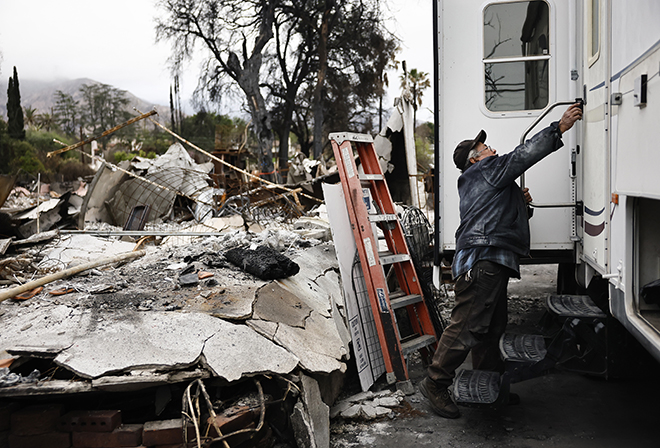
The penalties that California's insurance regulator is pursuing against State Farm General Insurance Co. for alleged improper claims handling are secondary to expediting the recovery process for homeowners impacted by the January 2025 wildfires that devastated Los Angeles.
An investigation by the state's Department of Insurance concluded that the State Farm Mutual Automobile Insurance Co. subsidiary committed widespread violations when handling claims from the January 2025 wildfires in Los Angeles. The state's market conduct examination found that State Farm "delayed, underpaid, and buried policyholders in red tape at the worst moment of their lives," said California Insurance Commissioner Ricardo Lara in a news release.
While the department's order to show cause includes severe potential remedies for the alleged violations, the immediate priority is resolving disputes for policyholders who have been left in limbo, said Deputy Commissioner Michael Soller.
"We're going to move quickly to get this in front of a judge because people have been waiting now 15, 16 months in some cases," Soller said in an interview. "Many people are still out of their homes and still having disputes with their insurers."
While no specific deadline was established for a formal response from State Farm General, Soller said the insurer has requested June 14 as its response date. The hearing before an administrative law judge is to take place within 30 days of the order being served.
Stiff penalties possible
The department's investigation involved a review of 220 out of the approximately 11,300 residential claims filed by State Farm General policyholders. That review concluded that State Farm General allegedly committed 398 violations in 114 of those claims, including delayed investigations, underpayment of claims, repeated reassignment of adjusters, improper handling of smoke damage claims, and poor communication.
Financial penalties, which would have to be authorized by the judge, could include a $5,000 fine for each violation or $10,000 for "willful violations." However, the regulator asked the judge to authorize no more than a one-year suspension of State Farm's certificate of authority, which allows it to do business in the Golden State.
The department said in the show-cause order that State Farm has not carried out its contracts in good faith," and that conduct "constitutes
grounds for the commissioner to suspend [State Farm's] certificate of authority" in accordance with the state insurance code.
"[The suspension and the fines] are the remedies that are available to the Department of Insurance, and when you look at past orders to show cause, we will frequently list those remedies because that's what a judge needs to consider based on the facts and based on the evidence," Soller said.
Any penalties, including the potential suspension, would only come after the action has been reviewed by an administrative law judge, Soller said.
State Farm said in a statement on its website that suspending its ability to serve its policyholders "over primarily administrative and procedural errors is a reckless, politically motivated attack that could ultimately cripple California's homeowners insurance market."
The Bloomington, Ill.-based insurer declined to provide further comment.
Legislative proposals
The fallout from the wildfires has led to a pair of bills, both sponsored by Lara, that would give the state insurance regulator additional authority concerning consumer protection measures.
Senate Bill 876, also known as The Disaster Recovery Act, would require insurers to maintain disaster recovery plans. It would also give the insurance commissioner the authority to double penalties during declared emergencies, mandate restitution to policyholders and address delays caused by multiple adjuster reassignments.
The Smoke Damage Recovery Act, Assembly Bill 1795, would establish the state's first enforceable public health and insurance standards for smoke-damaged homes. That would include science-based testing and restoration requirements.
Both bills are with their respective chamber's Committee on Appropriations, with the Senate bill scheduled for a May 14 hearing.