13 Apr, 2026
Venezuela's new mining law faces ESG, security challenges

The Venezuelan National Assembly approved
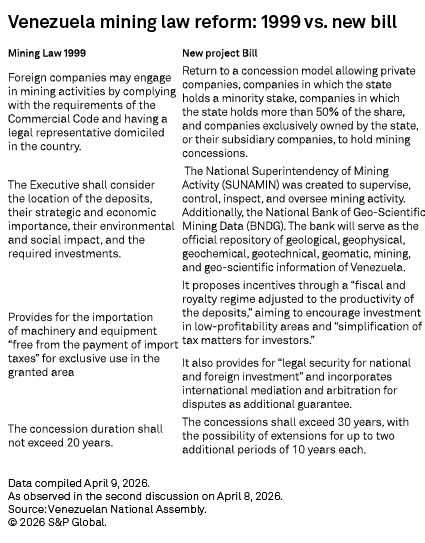
The new bill proposes repealing a 1999 mining law and 2016 regulations governing Venezuela's gold reserves, while extending the terms of mine concessions and granting access to international arbitration to settle disputes with the government.
Acting President Delcy Rodríguez, who has run the country since the US seized President Nicolás Maduro in early January, hopes to attract foreign companies to mine Venezuela's reserves of gold, silver, platinum, diamonds and other materials. Venezuela has struggled to secure international investment after former President Hugo Chávez nationalized the mining sector in 2011 and Maduro created the Orinoco Mining Arc in 2016 via executive decree.
Maduro created the Orinoco Mining Arc to generate new revenue by granting tax exemptions to companies mining a stretch of land that covers about 12% of the country. However, the initiative failed to draw outside investors or generate significant activity. Instead, the region, home to many Indigenous communities, has become a hub for illicit gold mining.
"As long as there is no management of the situation in the Orinoco Mining Arc and it hasn't been established what they are going to do there, the environmental aspect remains unclear," said Dolores Dobarro, a mining consultant who formerly served as the Venezuelan deputy mining minister and a legal adviser to the Ministry of Energy and Mines.
"The risk is very high for investors," Dobarro said.
Law offers concessions, arbitration
Among the most attractive changes for investors are the extension of mining concessions to 30 years and the inclusion of international arbitration mechanisms for dispute resolution. Miners will need reassurance that there will not be a repeat of Chavez's takeover of mines owned by Crystallex International Corp., Gold Reserve Ltd. and Rusoro Mining Ltd.
"This last measure [of arbitration mechanism] is essential for trying to build trust, especially considering the history of expropriations that affected companies like Crystallex and Rusoro in the past," said Pablo Nuñez, a mining consultant and treasurer of the European Federation of Geologists.
In its most recent session, Congress approved articles of the bill allowing concessions to be held by the state or by joint ventures with either majority or minority state participation, a departure from the hydrocarbons law, which requires the state to hold a majority stake. The bill also entitles the state to royalty payments of up to 13% on gross mineral production.
Also, the proposed law establishes new institutions, including the National Superintendency of Mining Activity as the regulatory entity, and creates a National Mining Fund intended to mitigate social impacts and guarantee labor protections for workers in the sector.
Environmental and security gaps
The proposed law does not mention any requirements for environmental permits, mine closure plans, or social programs for communities near the mines.
"[In these conditions,] the risk is very high because the miners are already aware that mining activities, including exploration and extraction, must be carried out carefully, always seeking a balance between the environment and the communities," Dobarro said.
Some analysts said the main risk for mining companies is related to environmental, social and governance factors. Mining companies, especially publicly listed ones, have been facing increasingly stringent compliance standards from investors and regulators in the countries where they operate or trade.
These ESG expectations are often stricter than local legal requirements, particularly when enforcement is weak. For example, in Venezuela, civil society and environmental groups have criticized the government for bypassing environmental impact assessment requirements, while artisanal mining has expanded into protected areas and fueled significant deforestation.
"Investing in southern Venezuela today carries significant reputational risk. Informal mining and the development of the Orinoco Mining Arc have caused extensive deforestation, mercury contamination and human rights violations affecting Indigenous communities," Nuñez said.
Geopolitics and resources
The new law is under discussion amid political tensions within the government over how it could guarantee security in the Orinoco Mining Arc, which has mostly been controlled by criminals and the military, according to a June 2025 State Department report to Congress.
The government must guarantee political certainty, whether Rodríguez continues as interim president or elections are held in 2027.
The precariousness of the Venezuelan government in recent months has left observers wondering how the state could fill gaps left by the law, said Emiliano Teran, a professor at the Central University of Venezuela.
US President Donald Trump's interventionist stance toward Venezuela, sometimes referred to as the "Donroe Doctrine", could be making prospective miners feel apprehensive.
"This should be understood not only in terms of drug trafficking, as President Trump has said, but also in relation to the protection of resources," Teran said.
The estimated market value of gold mined in Venezuela averaged $2.2 billion annually in 2020–2024, according to a 2025 US Department of State report to Congress.
Optimism and precautions
A first vote on the bill on March 10 signaled the government's intent to accelerate reforms and send a clear message to miners and financiers considering gold and strategic mineral projects, after a March 4 visit from US Secretary of the Interior Doug Burgum.
The bill traces the path of the country's energy policy. The Venezuelan National Assembly enacted an oil sector reform on Jan. 29, reversing the 2007 nationalization of oil.
Gold Reserve, which is primarily a mineral exploration and development company, said March 16 that it had confidentially submitted proposed comments for consideration during the legislative process. The company said it welcomed the initial approval of the draft mining law.
"We thank Venezuela for putting forward a progressive new mining law and we appreciate the willingness to receive comments on this draft legislation," Paul Rivett, vice chair of Gold Reserve, said in the statement. "Constructive consultation will help to ensure that the final legislation supports the long-term development of Venezuela's mineral resources."
Gold Reserve reported renewed engagement in Venezuela in a March 5 update, citing political changes in early 2026. The company met with a US mining delegation in Caracas, the capital, as part of its reentry efforts.
The company also said March 5 that the US Treasury Department's Office of Foreign Assets Control had granted a 30-day license allowing certain businesses, including Gold Reserve, to negotiate with Venezuela.
However, some companies are still involved in arbitration over the past expropriations. One example is Canada-based Rusoro Mining, which has "no mining assets in Venezuela anymore," a spokesperson told Platts via email. Platts is part of S&P Global Energy.
Rusoro filed lawsuits in the US and Canada in 2018, seeking enforcement of a $1.34 billion arbitration award arising from Venezuela's expropriation of the company's gold mining properties.
Gold Reserve initiated arbitration proceedings against Venezuela in 2009 in Washington, DC, claiming the country had expropriated its Siembra Minera gold project, previously known as Brisas. In 2014, the International Centre for the Settlement of Investment Disputes, part of the World Bank, ordered Venezuela to pay the company $740.3 million, which was amended to $1.03 billion in 2016.
The International Centre for the Settlement of Investment Disputes also ordered Venezuela to pay $1.39 billion in damages to Crystallex International in 2016, after the company claimed the government had expropriated its Las Cristinas gold project. The amount was based on Crystallex's project investments totaling $1.20 billion as of April 2008, when it was denied an environmental permit for the planned mine, plus interest.
The Venezuelan government should try to negotiate these debts directly, as it is doing with hydrocarbons, Dobarro said.