17 Apr, 2026
UK battery storage glut prompts review of queue protections

A glut of battery storage projects in the UK's reformed grid connection queue is prompting officials to consider stripping protections that gave batteries priority access, the Department for Energy Security and Net-Zero and energy regulator Ofgem said April 16.
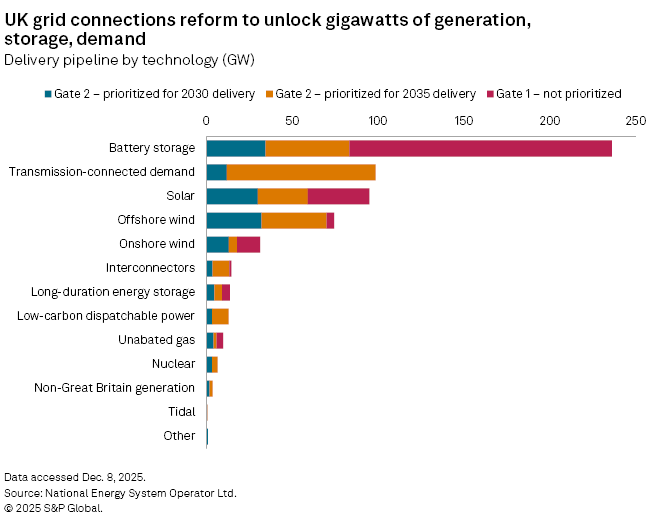
Some 14.8 gigawatts of battery capacity above the government's 2030 target range has "Gate 2" status in the queue, with surplus amounting to 61.7 GW beyond the 2035 system requirements.
The glut stems from protections built into the connections reform process that favored projects with planning consent or capacity market contracts, combined with batteries' faster planning approval timelines compared with other technologies, according to an open letter from UK Energy Minister Michael Shanks and Akshay Kaul, director-general for infrastructure at Ofgem.
The UK's National Energy System Operator Ltd. (NESO) in December 2025 prioritized 132 GW of clean energy generation and storage projects for 2030 as part of sweeping reforms to the grid queue, awarding them Gate 2 status to signify they are ready to connect and are aligned with clean power goals.
An additional 151 GW of Gate 2 projects were earmarked for connection by 2035, while some 221 GW have "Gate 1" status, indicating they do not yet meet the readiness criteria.
The government aims to reach between 23 GW and 27 GW of installed battery storage capacity by 2030, up from about 7 GW at the end of 2025.
Voluntary queue exits
In the letter, Shanks and Kaul said they are working closely with NESO and network companies "to understand the effects of the battery surplus," adding that they are considering options to safeguard the delivery of the connections process should significant risks be uncovered.
That includes the possibility to expand the use of "bay-sharing," allowing more than one user to connect at the same point.
The officials said that some batteries with Gate 2 status will likely withdraw from the queue voluntarily, pointing to an industry-proposed code modification that seeks to encourage such departures through additional financial measures.
"It will be important to ensure that non-viable projects leave the queue before the network companies have committed significant capital expenditure, both for their connection and for any wider network reinforcement, and in good time to allow their capacity to be reallocated at the next connections window," Shanks and Kaul said in the letter. "The later non‑viable projects leave the queue, the greater the risk of driving unnecessary network redesign, risking knock‑on impacts for other projects, and increasing costs for bill-payers."
The officials said NESO's annual methodology consultation raises the possibility of removing protections that allowed batteries to qualify for priority connections, potentially restricting future windows to projects that have secured revenue support.
The move would address the risk of further oversupply, with some 8 GW to 20 GW of battery capacity currently in Gate 1 potentially able to qualify for a Gate 2 offer, the officials said.
Colocation concerns
NESO's grid connections reforms have also created complications for developers planning hybrid renewables projects, with the prioritization effort in some cases leading to mismatched timelines between batteries and the solar or wind sites they are integrated into.
Low Carbon Investment Management Ltd., a UK-based developer backed by CVC DIF, has several large-scale solar projects in development with Gate 2 connection offers.
"The lowest cost option would be to facilitate [battery storage] on those sites so that it utilizes the same grid connection," Roy Bedlow, Low Carbon's founder and CEO, said in an emailed statement.
"Renewable developers who have spent years planning integrated sites have suddenly found that the battery element — the very asset that makes their project flexible, more valuable, and more useful to the grid — has been carved out of their projects altogether as part of the connections reform process," Bedlow said.
The executive added that colocated batteries can help reduce curtailment by capturing excess renewable energy at source and providing fast-responding flexibility, while also reducing infrastructure costs by enabling multiple technologies to connect behind a single transmission point.
In forming the connection queue, a NESO spokesperson said the vast majority of battery storage projects that were ready to connect before 2030 were stand-alone facilities. And it "would not be appropriate" to delay such projects in favor of prioritizing "less-ready" colocated sites with connection dates beyond 2030, they added.
"While colocation can reduce the amount of local network infrastructure required, these projects still have a significant impact on the wider national electricity system and market," the spokesperson said. "It is essential to assess a project based on its overall grid behavior and readiness, rather than its proximity to other generation or demand."
As part of NESO's consultation on the methodology for future application windows, the system operator is looking into whether colocated projects should receive prioritization in future capacity allocation or reallocation, the spokesperson added, acknowledging the benefits such projects can offer.
NESO noted that it already has more than three times the battery storage capacity needed for 2035, with a significant number being colocated projects.