24 Apr, 2026
States, federal regulators clash over prediction markets jurisdiction

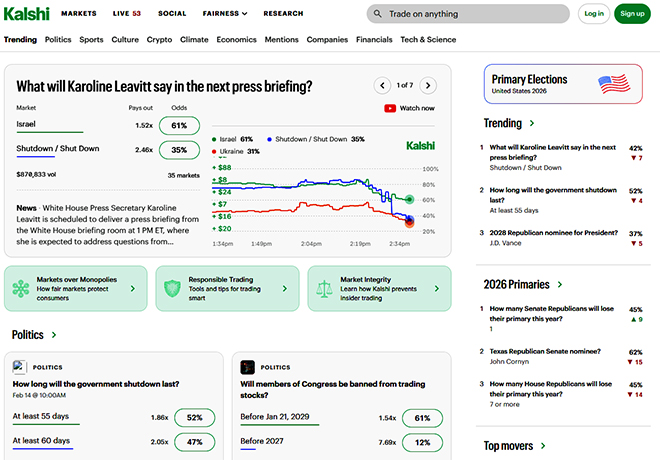
| A legal battle over Kalshi (pictured above) and other prediction markets platform is likely headed for the Supreme Court. Source: Kalshi Inc. |
A federal appeals court ruling on prediction markets is positioning the industry for a US Supreme Court fight that could determine whether billions of dollars in monthly trading falls under federal or state gambling regulations.
In March, Arizona became the first state to pursue criminal prosecution of a prediction market platform, where users bet real money on the outcomes of future events, from election results to corporate earnings and sports. The state argued that Kalshi Inc., a Commodity Futures Trading Commission-regulated prediction market platform, operates an illegal gambling business in Arizona without a license and engages in election wagering. While a federal judge blocked the case in April after the CFTC sued Arizona to stop it, Arizona is far from the only state escalating enforcement of these prediction markets. All told, at least 11 states have taken enforcement action against prediction market platforms, and 30 have signed onto amicus briefs in support of cracking down on the platforms.
Thus far, a number of courts have sided with the prediction markets and the CFTC. In addition to the Arizona case, the United States Court of Appeals for the Third Circuit ruled in April that Kalshi has a reasonable chance of proving federal commodity law preempts New Jersey state gambling statutes. However, a Maryland federal court ruled against platforms earlier this year, and a Massachusetts state court issued a preliminary injunction against Kalshi in January. Legal experts note that a potential Ninth Circuit ruling later this year could create the circuit split that forces the Supreme Court to resolve the question, though these experts remain sharply divided on the likely outcome. While some believe the federal preemption will prevail because the Commodity Exchange Act defines swaps and commodities broadly enough to cover prediction markets, others expect the Supreme Court to preserve state authority.
"To wipe out a foundational, historic state police power like the regulation of gambling would be extreme and out of line with Supreme Court precedent," Katherine Baker, chair of Nelson Mullins' gaming industry practice, told S&P Global Market Intelligence.
Jurisdiction battles
A major question in the cases centers on whether prediction markets should be treated like gambling — which is regulated at the state level — or like stocks and derivatives, which are regulated federally.
"Kalshi may brand itself as a 'prediction market,' but what it's actually doing is running an illegal gambling operation and taking bets on Arizona elections, both of which violate Arizona law," Arizona Attorney General Kris Mayes said in March. "No company gets to decide for itself which laws to follow."
The CFTC, meanwhile, has in recent years shifted its views of how prediction markets should be regulated. The agency initially questioned whether event contracts qualified as swaps under its jurisdiction but is now "all in," suing states to block enforcement, developing proposed rulemaking, and creating guidelines to prevent insider trading and market manipulation, according to Linda Goldstein, a technology attorney at CM Law who drafted the 2009 federal exemption for season-long fantasy sports.
The CFTC "has done kind of a 180 in the last several months," Goldstein said.
A CFTC spokesperson said in an emailed statement to Market Intelligence that the agency's position is that event contracts are swaps regulated under federal derivatives law, not state-regulated gambling like casino games or sportsbooks that involve a house setting odds.
The Commodity Exchange Act gives the CFTC discretion to evaluate whether contracts are contrary to the public interest, a spokesperson said, and the agency issued an advanced notice of proposed rulemaking in March seeking public comment.
"The CFTC has filed suits in Arizona, Connecticut and Illinois to defend our jurisdiction and continues to assess further participation in state litigation to ensure the federal regulatory framework is not undermined," the spokesperson said.
State revenue at stake
At stake for the states is not just their legal jurisdiction but also millions of dollars in tax revenue. The American Gaming Association estimates that states are losing $620 million in tax revenue to prediction markets.
"Contracts relating to sports are probably the highest revenue generator for prediction markets, more than anything else," Goldstein said. "That's really where the tension with the states really lies."
Tim Wagner, a partner at Nelson Mullins, said the state resistance is primarily about preserving regulatory authority over gambling rather than lost revenue, though he noted that licensing would establish nexus for corporate taxation of out-of-state platforms.
States are shifting enforcement strategies after federal courts blocked criminal and civil actions. Ohio's Casino Control Commission issued a $5 million notice of intent to fine Kalshi for alleged illegal sports gaming activity. The Commission did not respond to a request for comment.
"States are looking at their toolboxes and trying to figure out what works," said Braden Perry, a former CFTC senior trial attorney now with Kennyhertz Perry. "Monetary penalties may be an avenue that has less ability to fight than injunctive actions the CFTC could intervene in."
Sportsbook response
States are not the only players with revenue at stake. DraftKings Inc. and FanDuel Inc., the dominant leaders in the US online sports betting and daily fantasy sports market, both launched prediction market products in December 2025.
Goldstein said state-licensed operators view prediction markets as "competitors doing the same thing without the shackles of regulation and the costs of the taxes," but some have entered the space themselves to hedge whichever way the legal fight resolves.
Major sportsbook operators have reported slowdowns or declines in some states, though they publicly deny that prediction markets are cannibalizing their business.
"It's hard to believe prediction markets aren't at least partly responsible," said Daniel O'Boyle, senior analyst at InGame Intel.
Institutional capital signals confidence
Prediction market platforms are attracting significant institutional investment despite regulatory uncertainty. Intercontinental Exchange, operator of the New York Stock Exchange, invested $2 billion in Polymarket, while venture capital firms including Sequoia Capital Operations LLC, Andreessen Horowitz LLC and Paradigm have backed Kalshi and Polymarket, O'Boyle said.
Traditional market makers, including Susquehanna International Group LLP, Jump Trading LLC and DRW, have entered the space as liquidity providers. Jump Trading reportedly received small equity stakes in both Kalshi and Polymarket in return for providing liquidity, O'Boyle said.
"These prediction markets aren't going anywhere," Perry said. "The institutional investors are not afraid of the potential jurisdictional issues, and that signals they believe it will get resolved in favor of federal preemption."
Kalshi generated $144 million in fee revenue in March alone, while Polymarket's global site brings in an estimated $30 million to $50 million monthly, O'Boyle said. Kalshi controls more than 90% of the CFTC-regulated US market.
Kalshi did not respond to requests for comment on revenue figures, litigation strategy or the Ohio fine proposal. Polymarket did not respond to requests for comment on institutional investment or revenue figures.
Supreme Court schedule
As to how soon the Supreme Court may be called to take up the issue, Nelson Mullins' Baker said the Ninth Circuit is expected to rule by summer in consolidated cases involving Kalshi, Robinhood and Crypto.com against Nevada. Oral arguments in April suggested the court will rule against platforms, she said, which would create a circuit split with the Third Circuit.
Perry identified the Third Circuit case as the likely Supreme Court vehicle because it was the first appellate ruling on preemption. If a circuit split emerges, Baker said a cert petition could come by late 2026 or early 2027, with a Supreme Court decision during the 2027-2028 term.
The Nevada Attorney General's Office did not respond to a request for comment on the Ninth Circuit case.
Goldstein sees the most likely outcome as field preemption, where the CFTC retains exclusive jurisdiction over some prediction market contracts while states regulate others depending on contract type.
"I think it's unlikely the Supreme Court is going to rule that the CFTC has no jurisdiction," Goldstein said.
Regardless of which side prevails at the Supreme Court, both Perry and Goldstein agreed that a coherent regulatory framework is needed for the industry to grow. Perry suggested the CFTC could issue guidance similar to post-Dodd Frank derivatives regulation, followed by enforcement actions and eventually legislation.
"If everyone's playing on the same level field," Perry said, "it's a much more efficient process and a much more understood process for all stakeholders involved."