23 Apr, 2026
Project delays, erratic auctions risk Europe's offshore wind goal, execs warn

|
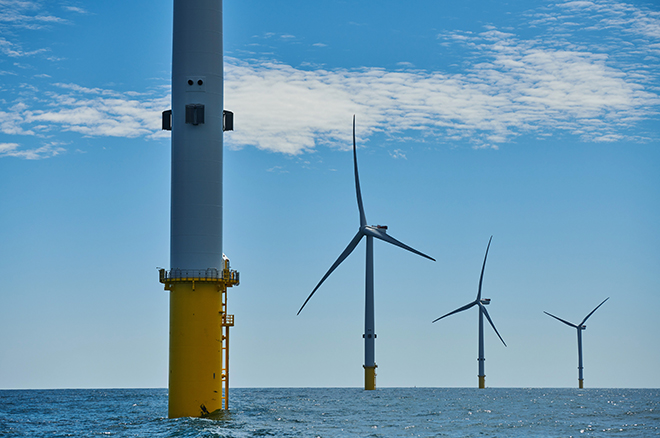
Three months after the North Sea Summit in Hamburg, Germany, offshore wind executives said implementation lags behind political ambitions. |
Three months after governments pledged to accelerate deployment in the North Sea, offshore wind industry leaders warned on April 23 that Europe risks squandering its energy security ambitions through bureaucratic delays and inconsistent policy implementation.
The North Sea Summit in Hamburg, Germany, in January included an agreement to develop 300 gigawatts of offshore wind capacity by 2050, alongside a joint investment pact aimed at enabling at least 15 GW of new offshore wind capacity annually in the 2030s.
But industry executives at lobby group WindEurope's annual conference in Madrid warned that those lofty targets are unlikely to be realized if governments fail to streamline permitting processes, stabilize auction schedules and accelerate grid connections.
"We are out of time," Henrik Andersen, CEO of Vestas Wind Systems A/S, said on a panel. "We're 55%-dependent on energy imports, and we goddamn sit here and discuss T's and C's that are so complex and complicated that it takes a longer time than just to sit down and manufacture, connect it and get the electricity available to society."
The unusually direct language from the chief executive of the Danish turbine-maker came as the European Commission revealed the EU had spent €24 billion in additional fossil fuel costs in the past six weeks alone due to the trade turmoil caused by the war in the Middle East.
"[That is] a huge amount of money that we could have dedicated to invest in our resilience, including offshore [wind]," Teresa Ribera, the commission's executive vice president for a clean, just and competitive transition, told delegates in Madrid. "It could have reduced the cost forever. Not for a while — forever."
Implementation a 'dark cloud'
While the Hamburg summit set clear targets, actual progress has been disappointing, Marc Becker, senior vice president for offshore wind at turbine-maker Siemens Gamesa Renewable Energy SA, said at the conference.
European offshore wind investments amounted to €22.5 billion in 2025, financing 5.4 GW of new capacity, according to WindEurope.
"The ambition is there, the action plan is on its way, but on the ground we are seeing things lagging behind, and that is a little bit of a dark cloud, because I need to fill the factories which also cost us hundreds of billions [of euros] of investment," Becker said.
The executive pointed to the long list of failed offshore wind auctions in Europe, adding that manufacturers need project pipelines to justify the massive capital investments required to scale up production.
Europe awarded nearly 7 GW of offshore wind capacity in auctions in 2025, including in France, Germany, Ireland and Poland, while a record 8.4 GW was successful in the UK's Allocation Round 7 auction in January 2026.
However, those successes are overshadowed by a large volume of failed bidding rounds in Denmark, France, Germany and the Netherlands.
The Danish, Dutch and German governments all plan to rework their offshore wind frameworks to incorporate two-sided contracts for difference (CFDs), mirroring the UK and France, where such mechanisms are already available to developers.
Sven Utermöhlen, CEO of offshore wind at Germany's RWE AG, said CFDs are essential to enable the estimated €1 trillion in investments required to reach the 300-GW target for 2050.
"That money needs to be attracted. That money needs to be unlocked. And that is where two-sided CFDs are so crucial, because two-sided CFDs provide the right derisking for the investors," Utermöhlen said.
Still, executives said it is also on governments to provide visibility and certainty. Erratic auction schedules remain a fundamental barrier to cost reduction and put the Hamburg target of 15 GW of annual additions at risk, according to Amanda Dasch, chief development officer at Danish wind developer Ørsted A/S.
"When you have very long lead times for projects, you're building major infrastructure, you have eight- to 12-year development cycle times, it's very difficult to figure out how to best manage your investment and keep the cost of capital down when you have a stop-start system," Dasch told delegates.
The volatility also makes it "incredibly challenging for the supply chain to make the investments that we require as developers to be able to create investable projects," Dasch added.
Vestas' Andersen urged policymakers to abandon attempts at comprehensive frameworks for the entire 100-GW Hamburg target and instead focus on delivering projects incrementally.
"Let's not try to build 100 GW and try to find excuses for not doing it," the CEO said, calling for the industry to celebrate each gigawatt added, rather than getting paralyzed by complexity.
"If we have ghost projects, if we fill up the project pipeline with things that are really not in there, that shouldn't be in there yet, that also disturbs the picture," Andersen said.