27 Apr, 2026
Private equity investment in EV ecosystem drops in 2025
Private equity and venture capital investment in the electric vehicle (EV) ecosystem dropped by 14% to $4.11 billion in 2025, according to S&P Global Market Intelligence data.
With only $110 million across eight deals in the first quarter of 2026, the sector is on track for a six-year low.
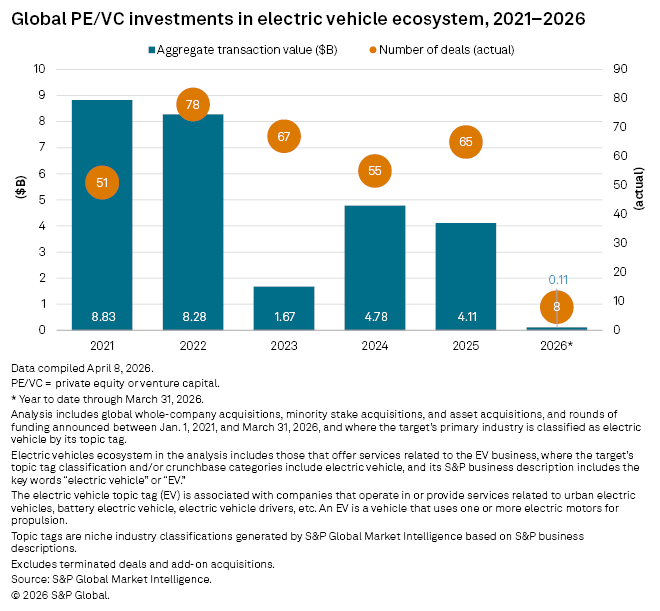
The electric vehicle ecosystem comprises companies that manufacture electric vehicles and its components, including battery systems. It also includes companies that offer EV-related services, such as charging infrastructure, operational software, autonomous driving technology, energy solutions and intelligent vehicle systems.
Developments in the US, including the removal of tax incentives for EV purchases, likely deterred investment in the EV ecosystem, said Mark Barrott, automotive and mobility practice leader at Plante & Moran PLLC.
Consumers are also reluctant to adopt pure EVs for several reasons, including the lack of a robust charging infrastructure and higher manufacturing costs compared with other markets, he said.
The EV ecosystem in the US will continue to see a slowdown in investments from private equity and venture capital firms, while the focus is increasingly shifting to Europe and Asia, added Ellen Clark, managing director at PMCF Investment Banking.
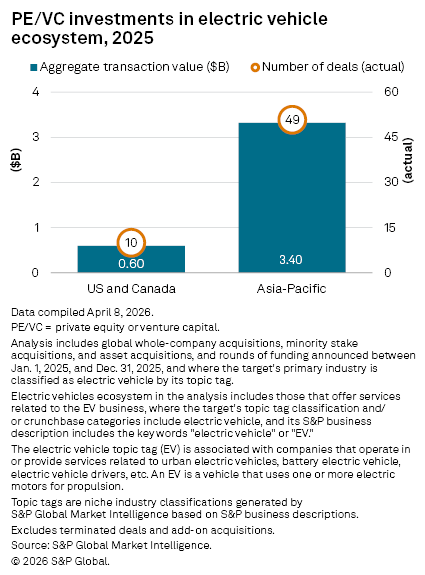
In 2025, Asia-Pacific attracted the most private equity investment in the EV ecosystem, accounting for 82.7% of total deal value of the year with $3.4 billion across 49 deals, according to Market Intelligence data.
The US and Canada recorded for 14.6% of the total deal value or $600 million.
Europe, despite it's strong push for EV adoption, only attracted $10 million in total deal value across five deals in 2025.
Companies active in the US are likely to invest in electrification technologies such as battery technology, which can be applied beyond automotive to areas like data centers, Clark added. Currently, the EV ecosystem is primarily driven by investments in ancillary technologies that support electrification systems, including software and sensors.
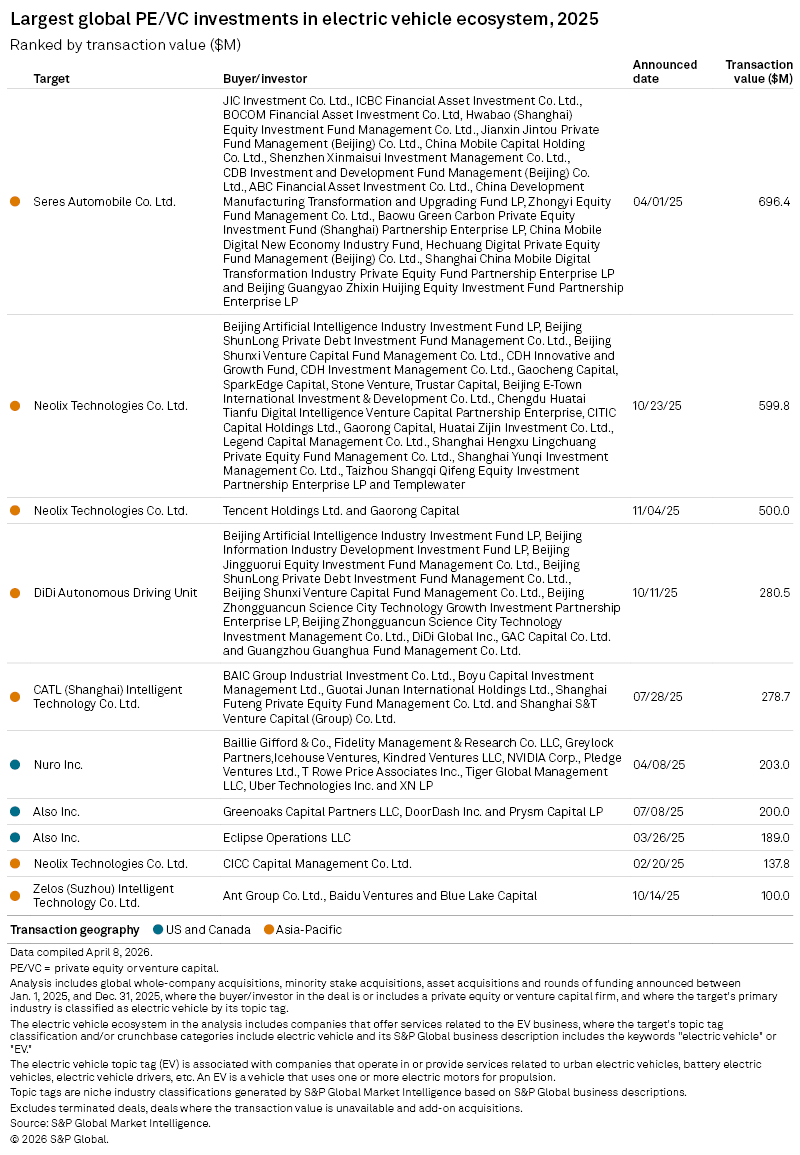
Mainland China, however, accounted for seven of the top ten deals in the sector in 2025.
The largest EV deal for the year was Chinese vehicle maker Seres Automobile Co. Ltd.'s $696.4 million funding round. The company also develops core components including electronic control systems like powertrains.
Beijing-based Neolix Technologies Co. Ltd., a manufacturer of self-driven unmanned logistics vehicles, had three separate funding rounds totaling $1.24 billion in the top 10 list.
-Download a spreadsheet with data featured in this story.
-Explore our report on how GPs and LPs are approaching deals, valuations and value creation.
-Stay up to date on the latest private equity headlines.

Conventional vehicle ecosystem
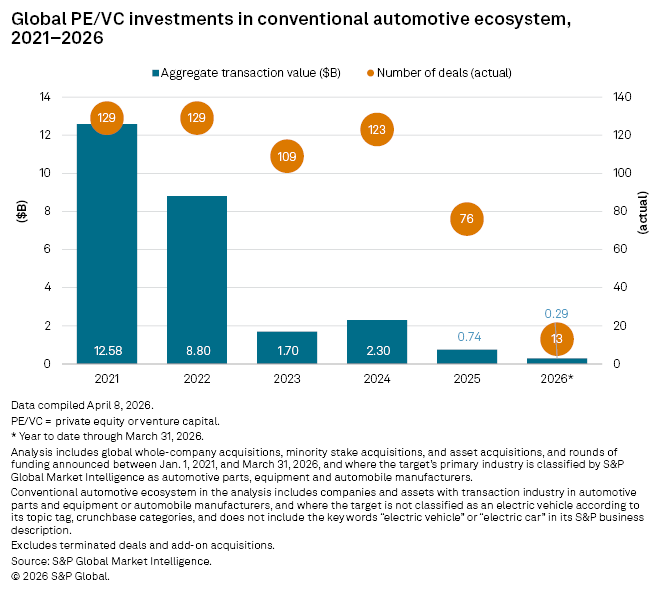
Private equity and venture capital investment in the conventional or gas-powered vehicle ecosystem declined, falling to $740 million in 2025 from $2.30 billion in 2024.
In 2023, the European Union approved a plan banning new combustion engine vehicles after 2035, which impacted investment in the conventional vehicle ecosystem, said Jan Philipp Feigen, partner for corporate and finance at law firm Hogan Lovells. With the plan's revision, however, Feigen sees some recovery in investments in 2026.
The largest deal in the combustion vehicle ecosystem was the $290 million series E round of 3D-printing assisted automotive parts Divergent Technologies Inc., led by Rochefort Management LLC. In April 2025, Divergent partnered with webAI to integrate distributed generative AI into its digital manufacturing platform, aiming to create AI-enabled industrial hardware systems for automotive applications, among others.
Feigen said the use of AI to automate vehicle production may also stir investments in the automotive industry as a whole.
Opportunities and risk
Whether investing in the electric or combustion vehicle ecosystem, private equity investors will face supply chain risks, especially given the unstable US tariff policy, said Luke Riela of Meketa Investment Group Inc.
Supply chain efficiency is central to controlling EV vehicle costs. Sourcing critical minerals, for example, is crucial as they account for 50% to 60% of battery costs.
Nonetheless, some areas of the automotive industry will continue to draw capital, including autonomous vehicles and battery technology, said Riela. Autonomous vehicle makers raised substantial capital last year, including Neolix Technologies and DiDi Autonomous Driving Unit, which raised $280.5 million.
Commercial vehicle electrification technologies that can be deployed across marine, rail and defense applications also present opportunities for investors, said Greg Urban, managing director at investment bank Greenwich Capital Group LLC.