20 Apr, 2026
Permitting obstacles impede renewables rush ahead of US tax credit deadlines

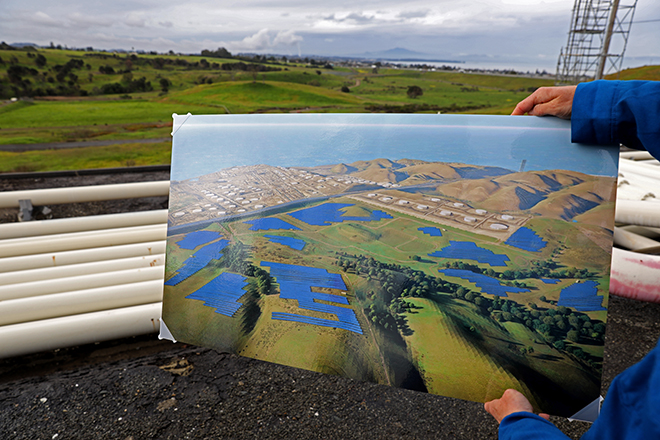
| A rendering of a planned solar plant next to a Phillips 66 refinery on the San Francisco Bay. |
US developers of solar and wind projects are racing to start construction ahead of a July 4 deadline in order to secure expiring federal tax credits, giving them a four-year window to complete their facilities.
Projects that fail to break ground in time, or were not grandfathered under previous safe-harbor rules, must come online in 2027.
But federal, state and local permitting obstacles are impeding many of their paths, fueling concerns about potential power supply shortages and adding urgency to long-standing calls for reforms.
"The reason permitting reform right now at the federal level and at the state level is so important is that we need to get all this stuff built fast," Ray Long, president and CEO of the American Council on Renewable Energy, told Platts, part of S&P Global Energy. "We need more power, and we need it now."
The Trump administration and Republican-controlled Congress have made renewable energy development more challenging through tax credit phaseouts and foreign supply chain restrictions under the July 2025 budget bill, coupled with federal regulatory actions that have halted some projects under construction or in advanced development.
An April 7 report from Crux Climate Inc. found that federal permitting delays held up roughly 11 gigawatts of US renewable energy capacity in the last 12 months. Based on a survey of 50 developers, that figure likely understates the broader impacts on the industry, which also include higher costs, according to Crux.
"We found that the federal permitting process overwhelmingly is slowing clean energy projects," Hasan Nazar, head of government affairs and public policy at Crux, told Platts. "It is resulting in less energy and higher costs in a moment where both are critical issues."
The report cited challenges ranging from unpredictable permitting timelines and onerous interagency coordination requirements to government non-response and strategic siting to avoid National Environmental Policy Act reviews.
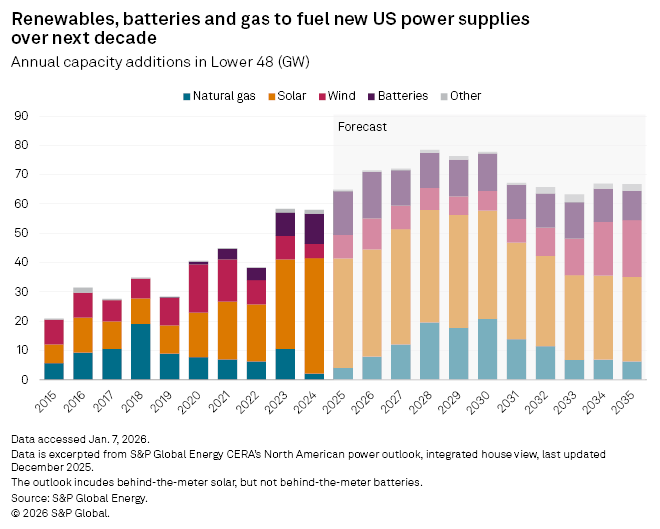
Despite such headwinds, solar, wind and battery storage — which retained long-term tax credits but is often built as part of renewables projects — accounted for over 90% of capacity additions in Trump's first year back in office. Market participants and observers widely expect power development to favor clean energy for years to come.
But permitting is one of the biggest risks to their forecasts.
"What we're seeing on the federal level is really just no transparency in how permits are being addressed," said David Carroll, chair of the board for the American Clean Power Association and CEO of ENGIE North America Inc.
'Converging pressures'
Although progress on Capitol Hill has been slow, momentum may be building.
"Utility-scale project permitting could accelerate over the coming months, driven by converging pressures that include rising energy prices, hyperscaler demands for immediate grid interconnection, and advocacy from Republican governors," Philip Shen, managing director and senior research analyst at Roth Capital Partners, said in a March 26 note.
Moreover, with the federal tax credit cliff approaching, states including California, Colorado, New Jersey, New York and Oregon have sought to fast-track renewables in recent months.
"The tax credits are federal, so there's limited abilities of the states to impact that," Carroll told Platts. "But you see certain states trying to move the permitting process forward as quickly as possible."
A bipartisan group of governors pushed for permitting reform in October 2025.
"This isn't a Republican or Democrat issue," Oklahoma Gov. Kevin Stitt (R) said at the time. "As the demand for energy rises as we bring new technologies and AI online, we need to complete energy infrastructure projects in a faster, more efficient way."
Considerations, concerns
Amid calls for action and anticipation of progress, developers are shifting into overdrive.
"Pivot, and everybody else in the industry, is working to make sure we commence construction by the different deadlines," Pivot Energy Inc. CEO Tom Hunt told Platts.
Permitting activities vary by technology and jurisdiction.
"You have more land use for solar," Hunt said. "Things like managing storm water and visual impact and grading and where it's located, jurisdictions will care about a lot more."
For battery storage, fire safety is crucial to obtain a permit. Incidents such as a major 2025 fire in California have raised awareness about the unique risks associated with lithium-ion battery systems.
"When you're permitting energy storage, the fire risk management becomes a much bigger issue," Hunt said.
Wind projects carry their own special considerations.
"There are environmental permits associated with wildlife, particularly birds, when it comes to wind that we have to work through," Carroll said.
The Federal Aviation Administration and the Defense Department must ensure there are no hazards to flight paths, training grounds or military radars, Carroll added.
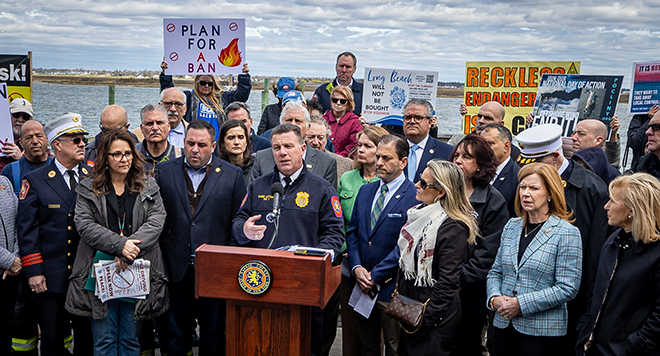
| New York's Nassau County Chief Fire Marshal Michael Uttaro speaks at a rally to stop nearby battery storage facilities and offshore wind projects from being built. |
| Source: J. Conrad Williams Jr./Newsday RM via Getty Images. |
'Bad for business'
"Across the states and the localities ... the biggest trend is the moratoriums," Carroll said. "Which I think is actually an incredibly troubling trend because now you're really impacting how private landowners utilize their land."
One "creative way" to block projects is with setback rules "that are just so onerous that you could not possibly make it work between property lines," Carroll added.
Such restrictions will "limit our ability to meet the rising demand," said Carroll. "It is hurting the ability to address the affordability crisis."
Lawmakers in Missouri this year proposed one measure, Senate Bill 849, that would impose a moratorium on solar development, and another, SB 879, that would add new requirements for siting, permitting and taxing utility-scale solar. Votes are pending in the final weeks of the session.
In Alabama, developers narrowly avoided a one-year moratorium on new solar power facilities after legislation — SB 354 and House Bill 617 — failed in the state Senate on a procedural matter.
"It's bad for business and for economic development in the state," Silicon Ranch Corp. CEO Reagan Farr said about the proposed moratorium. "We've let how we generate electrons become political."
Silicon Ranch plans to develop a 260-megawatt solar agrivoltaics project in Stockton, Alabama, to serve a Meta Platforms Inc. data center in Montgomery.
Complicating development, some counties lack zoning.
"The worst-case scenario, and what's playing out in one of our Alabama projects, is there was no zoning," Farr said. "We've worked on this project for years. We have a contract. It's a $350 million project. And they're like, 'Well, we want to enact zoning and apply it to your project.'"
For Farr, this raises questions about property owner rights.
Local restrictions are not uncommon. A June 2025 report from Columbia University's Sabin Center for Climate Change Law found 459 counties and municipalities with renewables and storage restrictions in 2024, a 16% increase from 2023.
"The projects in rural communities are often opposed on aesthetic grounds that these projects will change the rural landscape, affect the sort of rural character of the place," Romany Webb, deputy director of the Sabin Center, told Platts. "Sometimes we hear concerns about impacts on property values ... We often hear concerns about broader environmental impacts on species and the like."
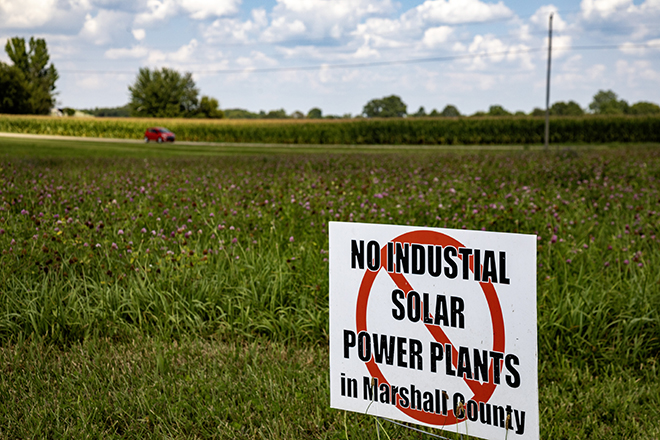
| A sign opposing solar in Marshall County, Indiana, highlights opposition across the US. |
| Source: Jim West/UCG/Universal Images Group via Getty Images. |
Community engagement
Some developers see opposition as part of the process.
"We're developing 700 projects across the country at any time," Hunt said. "So inevitably, some of those don't make sense for the community, or we need to adjust them."
Working with the community can help overcome hurdles. Pivot is developing a project in Illinois that was initially opposed because of potentially competing commercial development interests.
"The parcel was big enough where we could move the solar array back from the main road, build our solar array and then leave the front edge along the road available for future development," Hunt said.
Farr described how Silicon Ranch is engaging the community for its Alabama agrivoltaics project.
"In Alabama, we're buying more than two times the land we need," Farr said. "We're trying to give ourselves more room to create conservation areas and ... more buffer to be able to address some of these very site-specific community concerns."
Farr noted that concerns often center on large projects in rural areas, adding that more engagement can win over communities, as in one instance in Georgia.
"The most effective thing that we did was take community members and citizens to operating solar plants and just let them meet with those political leaders and our neighbors and just to see it firsthand and just dispel ... firmly held beliefs based on what they read online," Farr said. "We still have a lot of communities that are super excited to have us there and see this for the economic development opportunity it is."