02 Apr, 2026
Insurers, broader market feel the pinch as Middle East war continues
By Tom Jacobs and Jason Woleben
|
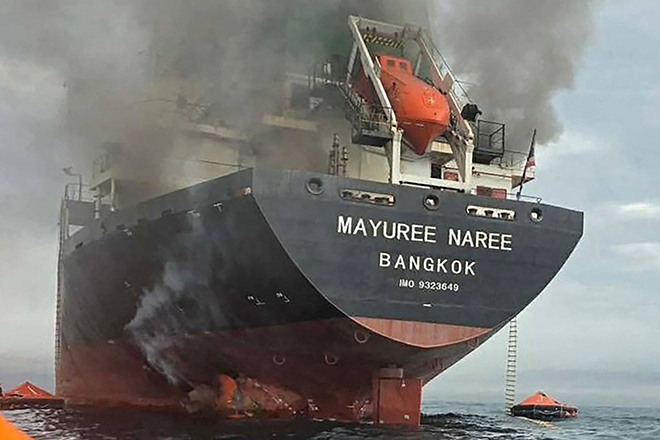
A handout photo taken on March 11 and released by the Royal Thai Navy shows smoke rising from the Thai bulk carrier Mayuree Naree near the Strait of Hormuz after an attack claimed by the Iranian Navy. |
The war with Iran has hurt US insurers' stocks and the broader market amid uncertainty about the conflict's progress and outcome.
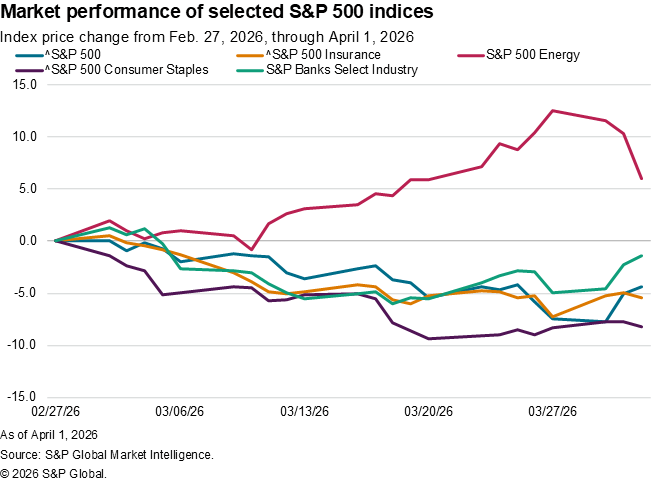
The S&P 500 Insurance Index fell 5.5% between April 1 and Feb. 27, the day before President Donald Trump signed an order to execute Operation Epic Fury against targets in Iran. The S&P 500 also lost ground, falling 4.4% over the same period.
The S&P 500 Banks Index and the S&P 500 Consumer Staples Index, which tracks large-cap producers of food, beverages, household goods, and personal products, fell 1.4% and 8.3%, respectively, while the S&P 500 Energy Index improved by 6.0%.
President Trump gave a 20-minute public address on April 1 from the White House, during which he outlined the reasons the US attacked Iran and said the military campaign would conclude "very shortly."
An anticipation of losses associated with the war is a key reason for the drop in the insurance index, said Keefe, Bruyette and Woods analyst Meyer Shields. There has not been "a whole lot of the potential upside" from rate increases in lines of business such as marine and energy, the analyst said, adding that when there has been a catastrophe or a large event, "things trade down in insurance before they trade out."
"I think we're following that pattern where, yes, there will almost certainly be some losses [that will] be very hard to quantify initially," Shields said in an interview. "But there's also some upside to the industry from rising rates in response to all of these losses and the elevated level of risk there."
Lines under pressure
Iran's decision to limit shipping through the Strait of Hormuz raises several red flags for insurers and reinsurers. Those warning signs include a change in the risk environment that could move beyond marine war coverage, which insures against losses caused by acts of war, terrorism, piracy, or politically motivated conflict.
The expansion of lines at risk includes energy, political violence, aviation, trade credit and "the wider macroeconomic environment," according to an analysis from Howden Reinsurance Brokers Ltd., which notes that the war is "a scenario with the potential to affect the broader sector, unfolding in real time and testing the resilience of the global risk transfer market."
"The most immediate impacts are currently evident in political violence/war, marine and energy risks, but the bigger issue for the industry may ultimately come through what we describe as the macro transmission channel," said David Flandro, Howden Re's head of Industry Analysis and Strategic Advisory, in a news release. "A sustained disruption in the energy supply would raise the risk of renewed inflationary pressure, higher interest rates and the potential for broader sector capital impairment."
Flandro said that the combination of factors "could affect insurance capacity more materially than insured losses from individual vessels or infrastructure claims."
Chubb chips in
One way insurers are trying to mitigate the risk of traveling in the Persian Gulf is through a maritime insurance facility partnership between Chubb Ltd. and the US government via the US International Development Finance Corporation (DFC).
Chubb has agreed to be the lead underwriter for the effort, which will, through the DFC, extend political risk insurance to secure maritime trade on its transit through the Gulf. Coverage includes marine war risk insurance for hull and liability as well as cargo, and war protection and indemnity (P&I), which will cover vessels' liability and hull and cargo protection.
Chubb will manage the facility, determine pricing and terms, assume risk, issue policies for eligible vessels and cargo and manage all claims.
"I think it's necessary for commerce, [and] I'm not sure it's going to make a difference for a company the size of Chubb," Shields said. "But from that perspective, I think it was certainly helpful to encourage commerce because, obviously, the world depends on that level of fuel transport."
Marine war coverage remains available on the private market, insurers and brokers say, though at a higher price than before the war.