11 Mar, 2026
Venture capital investment in defense tech surges while M&A activity slows

By Iuri Struta
Amid ongoing geopolitical volatility, venture capital funding for defense technology reached record highs in 2025, while M&A activity in the sector stalled.
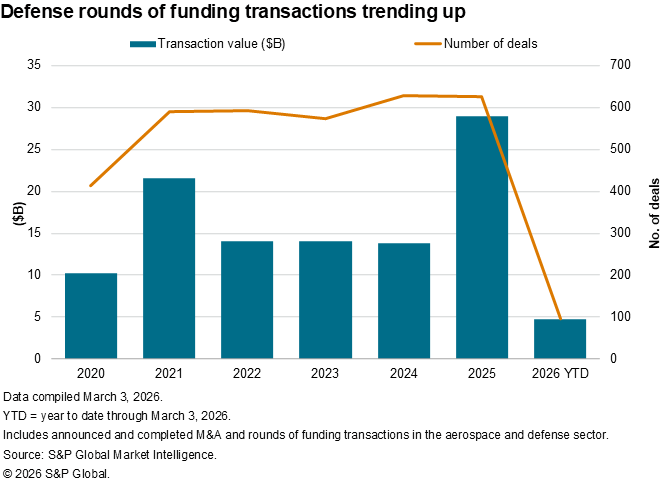
S&P Global Market Intelligence data shows that funding rounds for defense-focused startups rose sharply, with the number of VC transactions climbing to a peak of 629 in 2024 from 414 in 2020. Round values also expanded, reaching $29 billion in 2025, nearly triple the total recorded in 2020. The increase came as investors poured capital into startups aiming to challenge industry incumbents.
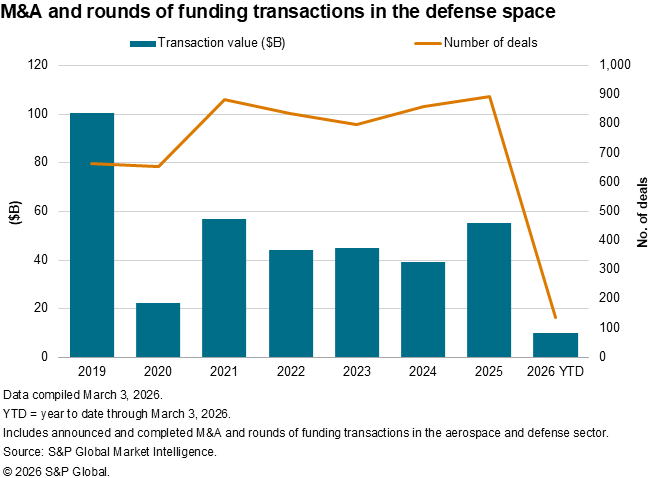
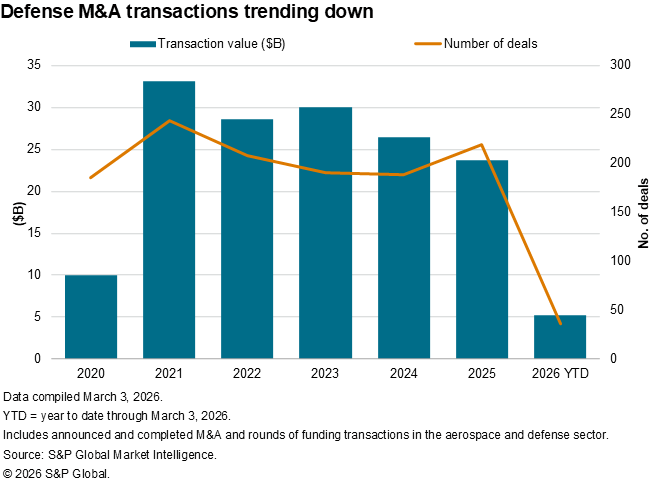
In stark contrast, M&A activity involving aerospace and defense targets declined, with deal counts and values falling in recent years after peaking in 2021. This moderation underscores how most large strategic combinations among legacy defense suppliers have run their course, leaving fewer transformational targets available.
Over the past five years, rising geopolitical volatility and war in Europe has prompted technology talent in the US and Europe to become more engaged in the defense sector.
This surge of innovation has supported a proliferation of defense technology startups seeking to commercialize cutting-edge capabilities in areas such as autonomy, cybersecurity, space systems and AI-enabled sensors.
Companies such as Anduril Industries Inc., Shield AI Inc. and Stoke Space Technologies Inc. secured some of the largest funding rounds in the sector, with 2025 deals reaching valuations from hundreds of millions to multiple billions of dollars.
Major funding rounds are expected to continue in 2026, especially for Anduril, which specializes in advanced autonomous systems. In early 2025 and 2026, Anduril consolidated its position as a leading defense technology provider by securing major contracts, including taking over the US Army’s $22 billion Integrated Visual Augmentation System (IVAS) program, developing a $100 million Next Generation Command and Control (NGC2) system and winning a $23.9 million contract for 600+ Bolt-M loitering munitions for the US Marine Corps. Overseas, the company previously secured a £30 million contract with the British government to supply drones to Ukraine.
Earlier this month, reports indicated that Thrive Capital Management LLC and Andreessen Horowitz LLC are co-leading a $4 billion investment in Anduril that would double the company's valuation to $60 billion.
The rise in funding for defense startups reflects a broader strategic shift. Silicon Valley has been deepening its involvement with the defense industry. Palantir Technologies Inc. provided the blueprint for this two decades ago, establishing itself as a key contractor by penetrating a closed ecosystem traditionally dominated by incumbent defense giants and their deep-rooted government ties.
Looking ahead, VC investment in defense will likely remain a significant growth area. A key tailwind is the sustained increase in defense spending in the US and Europe, where governments are prioritizing next-generation capabilities, replenishing equipment and modernizing industrial bases amid ongoing conflicts worldwide. The war in the Middle East entered its second week, while the Russia-Ukraine war marked its fourth anniversary in February.
Meanwhile, strengthened stock prices for traditional defense players could fuel a new wave of deals in the defense sector. Incumbents may target promising startups to quickly boost their technological capabilities.
This year has already seen notable deals, including the planned combination of Aureus Greenway Holdings Inc. (AGH) and Autonomous Power Corp., doing business as Powerus Inc. Powerus was co-founded by former US Army Special Operations veterans and builds autonomous drone systems for military and commercial use in high-risk environments.
While announcing their combination on March 9, the drone company said that Eric Trump and Donald Trump Jr., the sons of US President Donald Trump, are "notable investors" in the new entity.
"The need for and uses of autonomous technologies, such as those produced by Powerus, are front page news given developments in the Middle East and elsewhere," Matthew Saker, interim CEO of AGH, said in a news release. "This business combination is not just a compelling opportunity for AGH stockholders, but one made even more relevant by current geopolitical uncertainties."