13 Mar, 2026
Risks rise for insurers as war pressures on Iran mount

By Ben Dyson
|
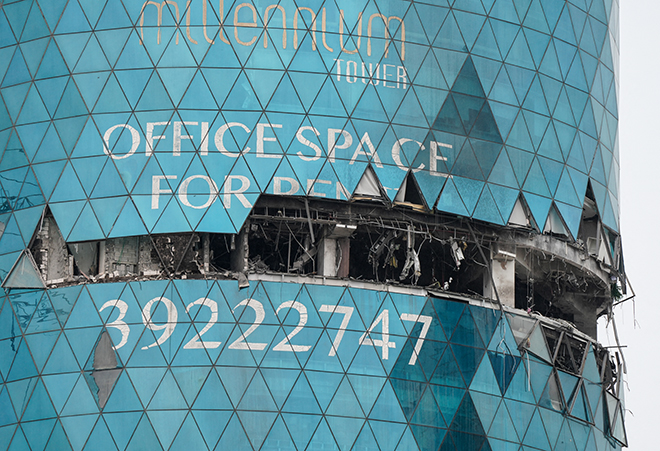
A damaged building in the aftermath of a drone strike in the Seef district of Manama, Bahrain on March 10, 2026. Source: AFP via Getty Images. |
Insurers providing war cover in Persian Gulf countries face higher risks as the US and Israel continue their air campaign against Iran.
Iran has hit a range of non-military targets in the Gulf in retaliation for the US-Israeli airstrikes, which began Feb. 28.
Attacks on critical infrastructure in Gulf states are likely to continue as the US and Israel degrade Iran's longer range attack capabilities, target critical Iranian infrastructure and the Islamic Revolutionary Guard Corps (IRGC) operate more autonomously, according to Jack Kennedy, head of Middle East and North Africa country risk at S&P Global Market Intelligence.
"With Iran's command chain progressively targeted, military units appear to be shifting to a doctrine of decentralized operations, increasing the likelihood of opportunistic strikes," Kennedy said in emailed comments March 9.
Range of risks
While Iran has targeted US military infrastructure in Gulf Cooperation Council (GCC) countries, it has also hit civilian property, including hotels, airports and energy facilities. Hotels in Dubai and Bahrain were attacked early in the conflict, while Abu Dhabi National Oil Co. was forced shut a refinery after suffering a fire caused by drone strikes. Bahrain's energy company, Bapco Energies B.S.C. Closed, declared force majeure on its group operations following an attack on its refinery complex.
A possible early example of the IRGC's autonomy was the attack on the Port of Duqm in Oman, for which the Iranian regime reportedly apologized, according to Bilal Bassiouni head of risk forecasting at risk advisory firm Pangea-Risk.
"We may see more similar situations where the IRGC or military leadership take on ad-hoc responsibilities [for choosing targets]," Bassiouni said in a March 3 interview. That heightens the risk for a wider variety of assets. The likelihood of Iranian strikes on energy facilities grows the more the US and Israeli air campaign intensifies and the more cornered the regime feels, Bassiouni said.
Property could also be damaged in attacks on Israel in response to its assaults on Iran itself and Iran-backed armed group Hezbollah. Israel has been hitting Hezbollah positions in Lebanon along with its strikes on Iran.

Property damaged in attacks would trigger claims under political violence and war-on-land policies for insurers and reinsurers. Moody's Ratings in a March 11 report said political violence and terrorism underwriters would start receiving loss reports "in the coming days." One of the first large claims notifications is likely to be from the attacks on refineries belonging to Bapco Energy, Moody's said.
The risks to property on land come on top of the threats to shipping in the Gulf, particularly vessels that try to pass through the Strait of Hormuz. The risks to shipping in the region have caused war insurance prices to surge. The UK Maritime Trade Operations Centre (UKMTO), which provides shipping security information, received 16 reports of attacks on vessels in and around the Persian Gulf, Gulf of Oman and the Strait of Hormuz between Feb. 28 and March 12.
Aviation claims are not out of the question either.
"Underwriters are paying closer attention to ground accumulations, particularly at major hubs, such as Dubai, and are asking more detailed questions around routing, airport selection and contingency planning for aircraft relocation," Phil Smaje, global industry specialty leader for transportation and logistics at insurance broker Aon PLC said in emailed comments.
Cyber and trade
Cyberattacks are also a possible risk for insurers. Medical equipment manufacturer Stryker said March 11 that it is suffering from a cyberattack affecting its internal Microsoft environment. Handala, a hacking group linked to Iran, has claimed responsibility for the attack, and said it was a response to the bombing of the Minab school in Iran, the Guardian reported.
There have been no public reports so far of large insured cyber losses directly attributable to the Middle East war, S&P Global Ratings said in a March 11 report. Larger, state-linked cyber attacks could "severely test underwriting models" and lead to legal disputes over coverage, the report said.
If the war puts significant pressure the global economy, insurers and reinsurers could face claims in lines such as trade credit insurance, which covers the risk of suppliers not getting paid for goods or services. Credit insurers are closely monitoring the implications of the war for global supply chains and trade flows, particularly if disruption becomes more prolonged, Oliver Henderson, chief broking officer for credit solutions at Aon, said in comments emailed to the press.
"What matters most from an underwriting perspective is how delays and interruptions translate into liquidity pressure over time," Henderson said. Underwriting appetite is still "broadly intact" with insurers taking a "more selective, scenario-based approach."
Should the conflict drag on and trigger supply chain disruptions and inflation, even insurers writing standard covers like personal motor in countries far beyond the war zone could face rising claims bills.
Claims uncertainty
Potential claims levels from the war remain highly uncertain. Insurance and reinsurance industry executives have been reluctant to make any estimates, though they expect some losses.
There is a chance that damage could be under-reported, Bassiouni said, as Gulf states seek to protect their reputations.
"This is a doomsday scenario for a lot of Gulf countries," he said, as some of their economic models are based on being secure and free from violence. "The views of drone strikes and ballistic missiles around skyscraper buildings in the Gulf is quite detrimental to that image."
The marine business has seen higher claims notifications, according to Jonathan Moss, managing partner of law firm DWF's London office. However, only a percentage of these will translate into actual claims. Coverage disputes between policyholders and marine insurers and their reinsurers are also likely, Moss said in an interview March 4.
If the war is short-lived, insurers should be able to cope with the claims bills as most property and casualty policies exclude war as standard.
Cloudy endgame
Moody's said in its March 11 report that its baseline scenario is that the conflict will last a matter of weeks and that passage of ships through the Strait of Hormuz will resume "at scale."
US President Donald Trump said March 2 that the war was projected to last four-to-five weeks, but could go on for longer. Trump then told CBS News in a March 9 interview that the war is "very complete, pretty much."
"De-escalation is unlikely in the near term," Market Intelligence's Kennedy said. "The US and Israeli campaign is expected to last weeks or longer unless pressured by financial markets, energy prices, or domestic political factors. Iran's leadership has rejected negotiations, and the IRGC is expanding its attacks."
A wind down would likely come from the US stopping its campaign after achieving specific military targets, Kennedy said. Iran might reduce its retaliation if attacks it alleges are being launched from Gulf Cooperation Council states stop, but the IRGC becoming de-centralized "makes consistent de-escalation difficult."