31 Mar, 2026
New Hong Kong marine war risk pool has room for growth

By RJ Dumaual
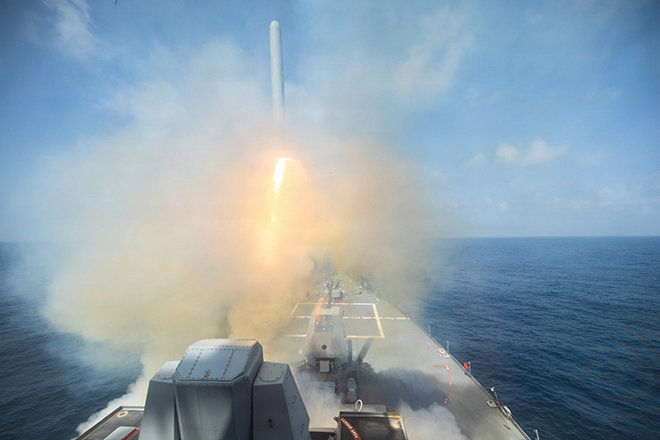
| Guided-missile destroyer USS Spruance fires a Tomahawk Land Attack Missile as part of Operation Epic Fury on Feb. 28, 2026. |
| Source: Wikimedia. |
The recently launched Hong Kong Marine War Risks Insurance Pool has the capacity to grow as the ongoing war in the Middle East limits shipping lanes in the Strait of Hormuz.
The pool, backed by five Hong Kong insurers, provides up to US$130 million in compensation for shipowners in Hong Kong and the mainland against war and emergency risks. It has already covered 10 mainland Chinese ships sailing in the Gulf and could become a more affordable alternative to the London market, Hong Kong Insurance Authority CEO Clement Cheung Wan-ching told the South China Morning Post. Tehran and Beijing have maintained close ties even as the war between the US, Israel and Iran has intensified.
Measures that support continuity of cover and provide wider options during extreme volatility are welcome and can help stabilize trade when aggregation of risk constrains traditional markets, Michael Walls, managing director for marine, cargo and logistics at Marsh, told S&P Global Market Intelligence in an email.
'Timely step'
The new marine risk pool also has room to expand.
The pool is a constructive and strategically important initiative, particularly for China, Marcos Alvarez, managing director of global financial institution ratings at Morningstar DBRS, told Market Intelligence in an email. However, its current scale with a HK$1 billion total underwriting capacity looks modest relative to the size of the risk it is trying to address, Alvarez added.
"The pool is a smart and timely step because it builds regional capacity and reduces reliance on Western markets, but at its current size it is more a useful supplement than a true substitute for global war-risk capacity," Alvarez wrote. "However, we believe we will see more traction on this initiative since Beijing is interested in transforming Hong Kong to an international insurance and risk management center under the current five-year plan."
The pool is a "great initiative," and there is a lot of capacity in Asia to support the risk sector, according to Steve Tunstall, general secretary of the Pan-Asia Risk and Insurance Management Association.
"Obviously things are in flux in the Middle East at the moment, so we're not sure how things are going to evolve, but there's one thing for certain, if corporations can't get insurance, they're not going to send ships," Tunstall said in an interview.
Tunstall described the size of the new pool as reasonable, though that depends on whether it covers the vessel, cargo or both. If it is just the vessel or cargo, then it is going to be "adequate," he said.
Hong Kong and Singapore
A large amount of global marine insurance is written in the London market, but there is a path for Asia to take on more marine risk.
Asia's high exposure to energy and trade flows through geopolitical chokepoints underscores the need to keep resilience solutions under review, Walls said, adding that any broader adoption would depend on risk‑sharing frameworks, reinsurance support and robust aggregation management. Growth for Asian insurers is likely to be incremental and selective.
Alvarez expects a gradual development rather than a rapid regional shift, saying that most Asian jurisdictions are still reacting to the present shock by tightening underwriting rather than by launching new public pools. Alvarez is not ruling out other Asian centers considering moves similar to Hong Kong's, adding that Singapore is the most obvious candidate to enhance existing mutual or market structures.
The Monetary Authority of Singapore referred Market Intelligence to the Singapore War Risks Mutual (SWRM), which did not respond to a request for comment. SWRM was established in 2015, in conjunction with the Singapore Shipping Association, to provide mutual war risks insurance to Asian shipowners and operators.
The Hong Kong Insurance Authority did not respond to a request for comment.