24 Feb, 2026
US insurance IPOs thin on the ground in 2025 as companies weigh sales instead
By Tyler Hammel and Umer Khan
Insurance initial public offerings remained thin on the ground last year as insurers weighed the benefits of an outright sale rather than going public.
Last year saw four insurance initial public offerings (IPO) with a total aggregate amount of $1.15 billion offered. This figure was up from 2024, which saw three IPOs with a total aggregate amount of $37 million, but still well below 2021's seven IPOs with a total aggregate amount of $4.35 billion.
2025 insurance IPOs were largely concentrated among a few sectors, including Florida-based property & casualty (P&C) companies, excess & surplus (E&S) companies and managing general agents (MGA), according to Tana Marcom, a senior director for Fitch Ratings.
"The MGA space is ripe for it, as well as anything having to do with specialty Florida personal lines following the reforms," Marcom said in an interview with S&P Global Market Intelligence. "In addition to the tort reform [Florida] did, there was lack of any sort of large hurricane activity last year and so some companies took advantage of that and more might prior to hurricane season this year."
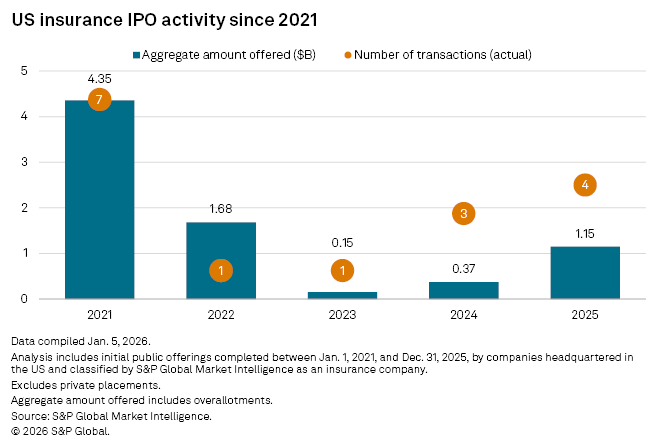
Technology and market condition improvements continued to be a driving factor behind IPOs even as a slate of IPO-ready insurers held off for potential 2026 launches, Marcom said, although this year's total will likely remain lower than 2021's record year.
"We do think that there's going to be a pickup broadly in M&A activity this year and I think, in turn, we could see an uptick in IPOs as well," Marcom said. "But it's obviously starting from a relatively low base to begin with, so there is not going to be a blockbuster record year."
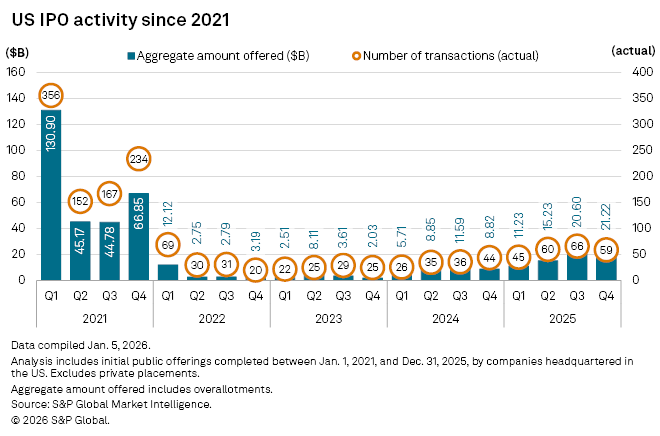
Insurance IPO trends matched the broader trend seen amongst all financial sectors. In 2025, there were 230 IPOs in the US across all financial sectors with a total aggregate amount of $68.28 billion. This figure was up from 2024, which saw 141 IPOs with a total aggregate amount of $34.97 billion, but still well below 2021's record of 909 IPOs with a total aggregate amount of $287.7 billion.
Underwriters vs brokers
When looking at insurance IPOs and M&A trends over the past couple of years, it is helpful to bifurcate insurance into underwriters and insurance brokers, said Mark Friedman, the US insurance deals leader at PwC.
On the underwriting side, launching an IPO carries financial risk and not all companies fare well on the public market, Friedman said.
"If you talk to any finance executive or any executive in a publicly traded insurance company, they will tell you like it is not easy being a public company when you've got the volatility inherent in underwriting," Friedman said. "What those causes are decisions that private companies wouldn't take, like doubling on reinsurance and giving up a lot of profitable business domain in order to avoid a miss on earnings."
This leads many underwriters to attempt a dual-track, Friedman said, whereby a company leverages a potential IPO to attract a buyer by showing viability on the public market.
Last year, analysts theorized this was a strategy undertaken by specialty insurer Aspen Insurance Holdings Ltd., which went public in May before being purchased by Sompo Holdings Inc. in August. Although the deal has not closed yet, Aspen's stock price has been steady since the acquisition was announced.
On the insurance broker side, there is less volatility within an IPO consideration and a handful of brokers have already raised capital valuations that are well beyond what any single private equity firm would be able to pay, according to Friedman.
"We're talking a handful of players that are potentially $30 billion plus in valuation, and we expect to see those companies trade just out of necessity," Friedman said. "Right now, there's five large public brokers, but it is likely that that number will double in the coming years."
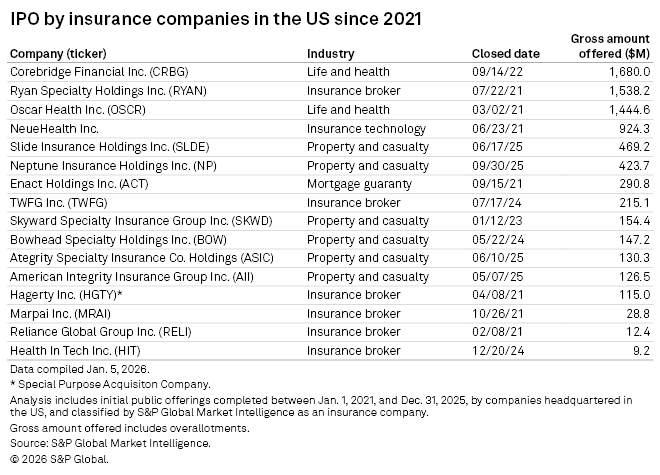
Since 2021, six of the 16 largest insurance IPOs have been insurance brokers, with the largest being Ryan Specialty Holdings Inc., which offered $1.54 billion in gross amount in July 2021.
2026 so far
The first notable insurance IPO of the year was the life insurance-focused insurtech Ethos Technologies Inc., which began trading Jan. 29, opening at $19 a share. The insurtech has failed to impress Wall Street so far and was trading at $11.71 as of 10 a.m. Feb. 23.
The San Francisco, CA based insurtech decided to go public after receiving positive support from investors, Ethos CFO Chris Capozzi said in an interview with S&P Global Market Intelligence.
"[Investors] love the durability of that demand in that, US consumers are purchasing life insurance through economic cycles, unswayed by the latest tariff announcement out of Washington, DC, etc.," Capozzi said. "I think they've viewed it as a very repeatable and durable source of demand and then also recognize that we have built the most efficient product to capture that demand."