09 Feb, 2026
Software sell-off may be overdone yet exposes deeper concerns

By Iuri Struta
A significant sell-off in software stocks has been triggered by investor concerns that powerful new AI coding tools from Anthropic PBC and OpenAI LLC could disrupt the industry.
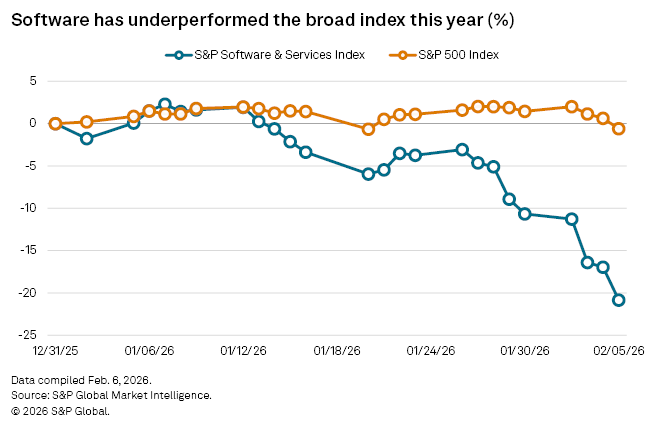
In the year through Feb. 6, the S&P North American Technology Software Index was down more than 20%. By contrast, the S&P 500 index was flat over the same period, according to data from S&P Global Market Intelligence.
However, investors and analysts contend that the sell-off may be an overreaction.
"We believe the market is baking in a doomsday scenario for software companies in the near term, which we believe is extremely overblown, as many customers won't be willing to put their data at risk to capitalize on AI implementation strategies until there is less risk with these migration projects," Dan Ives, an analyst at Wedbush Securities Inc., said in a recent note to investors.
Cowork sell-off
The market anxiety stems from recent product launches. Leading AI company Anthropic, for instance, recently released a new product, Claude Cowork, which it said was built largely with its own coding tools. The company subsequently released a series of AI plug-ins aimed at assisting legal professionals. Similarly, OpenAI has developed a coding tool and released an enterprise product, Frontier, designed to build and manage AI agents.
While these developments sent shivers through the software sector, some note that product launches do not equate to immediate adoption in the enterprise market.
"There isn't really any ... sign that, corporations have ditched large [software-as-a-service (SaaS)] vendors for in-house AI vibe-coded alternatives," Paul Wick, chief investment officer at Seligman Investments, told Market Intelligence, in an interview.
Revenue slowing, SBC growing
While the sell-off may be an overreaction, it is shining a spotlight on fundamental problems within the software sector that investors can no longer afford to ignore.
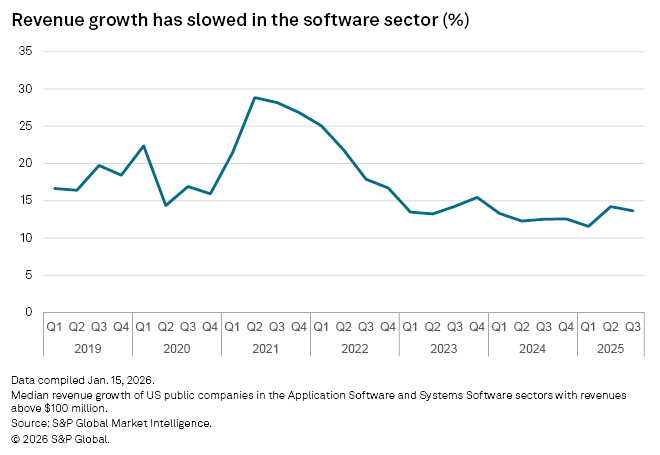
For one, the growth of SaaS companies has failed to recover from the swift decline that followed the 30% growth rates seen during the 2021–2022 pandemic era. Many incremental dollars from IT departments have been directed toward AI technologies rather than to the expansion of new software features. According to Market Intelligence data, falling growth rates bottomed out in the first quarter of 2025 before a slight recovery in the following quarter gave way to a plateau.
"A lot of SaaS software companies have naturally matured ... and their growth rates have ... slowed down, and now you have this additional headwind from head count cuts at large corporations," Seligman's Wick said, noting that layoffs affect SaaS' per-seat business model.
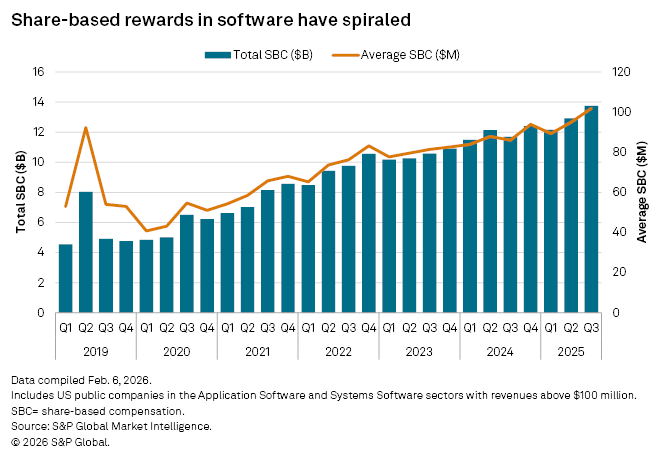
Furthermore, investors are scrutinizing runaway share-based compensation (SBC), another issue that can make software companies unattractive to private equity acquirers. While a noncash expense, SBC dilutes the value for existing shareholders. Thoma Bravo LP Managing Partner Orlando Bravo recently told the Financial Times that some software companies are "unbuyable" due to excessive SBC.
"The software industry has had a stock-based comp problem for a long time," Wick said. "So, if you look at a company like Salesforce Inc., they've been buying their own shares back aggressively for the last couple years. However ... their share count hasn't gone down very much."
According to data from Market Intelligence, total quarterly SBC has more than doubled since 2019, while average SBC also doubled.
Now, with growth slowing and AI risk looming, the perceived threat to the software business model has prompted investors to demand greater fiscal discipline.