24 Nov, 2026
Solar, storage suppliers double down on AI data center bets
By Garrett Hering and Kirsten Errick
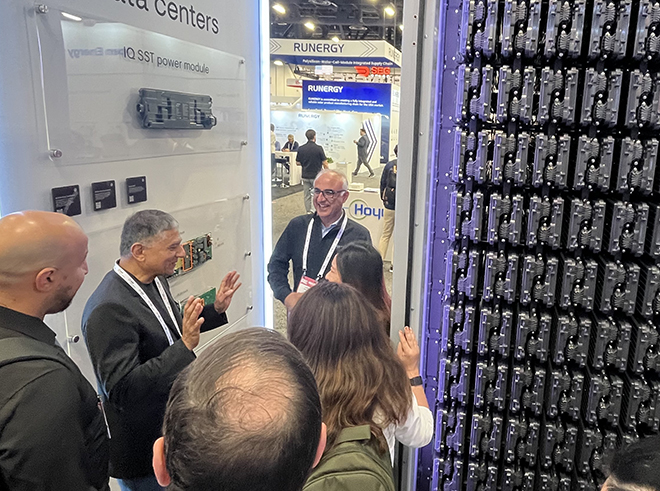
| Enphase chief products officer Raghu Belur, center, speaks on Nov. 18, 2026, at the RE+ clean energy conference in Las Vegas, where the company displayed its IQ Solid-State Transformer technology for data centers. |
Solar energy and battery storage companies are raising their bets on the next generation of AI data centers, with the topic dominating conversations at the recent RE+ trade show in Las Vegas.
"You're always looking to see whether you can leverage your technology to address a problem in a different industry, and that's exactly what we're doing," said Raghu Belur, chief products officer and co-founder of Enphase Energy Inc., standing before a display of the equipment supplier's solid-state transformer (SST) for data centers.
Enphase was one of hundreds of exhibitors showcasing their products and services to AI data center developers or displaying AI-enhanced offerings at RE+, the largest US clean energy conference, held Nov. 16-19. The event highlighted the deepening relationship between the clean energy and tech sectors, which is evolving even as hyperscale cloud computing giants and other digital infrastructure companies spur greater demand for fossil fuels.
Enphase's distributed power conversion platform, called IQ Solid-State Transformer (IQ SST), is scheduled for pilot projects in 2027 and volume shipments in 2028. It is based on the company's widely deployed microinverters used in home solar arrays and battery systems.
"We're not inventing a whole new power conversion technology; we're leveraging 90 million of these that we have shipped," Belur told Platts, part of S&P Global Energy. "We have to make some tweaks ... but 85% of the supply chain is the same as [microinverters for] solar and batteries."
IQ SST is designed to meet the demands of higher-power AI data centers, with multiplying server rack power densities and an expanding need for big on-site battery storage systems to help manage intense load spikes.
Enphase executives said their innovation can save data center operators significant capital with a more efficient way to electrify upsized facilities based on 800-volt direct current power distribution and 1-megawatt server racks — effectively quadrupling power density in just a few years.
"For a gigawatt data center, this is $400 million cheaper," said Zack Freedman, the company's head of investor relations. "At the end of the day, it's the hyperscalers and the global AI technology companies, the chip designers, who are driving this," he added, citing Open Compute Project and NVIDIA Corp. white papers that outlined the need for SSTs to enable a revolution in rack densities by late 2027 or early 2028.
"What has happened since is the hyperscalers who are most aggressive about their desire to deploy SSTs have quickly realized ... they need to find savings wherever they can," Freedman said.
Tesla joins SST frenzy
In addition to realizing upfront savings of $400 million per gigawatt, efficiency gains for IQ SST could add another $500 million in savings over 10 years of operation, analysts at Jefferies said in a Nov. 23 note.
But the field of companies developing SSTs "is getting crowded" and Enphase's lead "is only valuable if it converts quickly," they added.
Tesla announced its SST during RE+, complementing its booming battery storage business that is seeing "extreme demand" from data centers, including those operated by Space Exploration Technologies Corp., or SpaceX. The two companies, both led by Elon Musk, are exploring a potential merger.
Tesla's "unexpected" SST launch, planned for 2027, "could make it difficult for others to grab a slice of the market," analysts at Mizuho Securities USA said in a Nov. 18 note. But they "remain cautious on SST roll out pre-2029 as the balance of system is not 800V DC ready yet."
Jefferies analysts view the development of standards as the "gating item" for mass rollout rather than the technology.
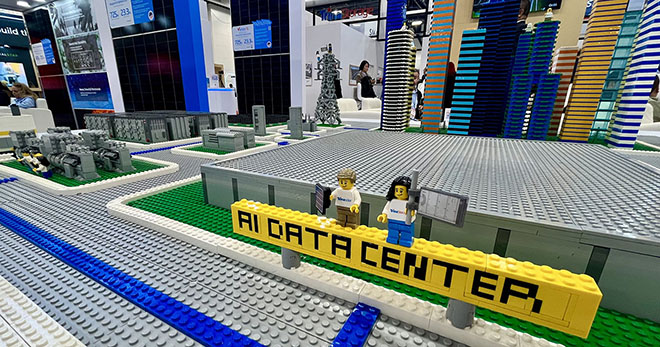
| Artist Mariann Asanuma built a Lego model of an AI data center, displayed at Trina Solar's booth at the RE+ conference in Las Vegas. Source: S&P Global Energy. |
Several SST developers are making strong inroads ahead of mass deployment.
Heron, led by CEO and founder Drew Baglino, a former long-time engineer and executive at Tesla, unveiled several deals for its Heron Link SST product for solar, storage and data center projects leading up to RE+.
Independent power producer Intersect Power LLC, which Google LLC acquired in March, reserved 1.5 GW of Heron Link manufacturing capacity for solar farms, the companies announced Nov. 12, weeks after digital infrastructure company Vantage Data Centers Management Co. LLC secured 1 GW for data centers.
RWE Americas, an affiliate of German energy company RWE AG with a substantial portfolio of renewable energy and battery storage assets in the US, is also working with Heron, initially on a pilot project in 2027 at a battery storage system in Texas, the companies said in September.
If successful, the pilot could pave the way to another big reservation of capacity at Heron's planned 40-GW plant in Morgan Hill, California, intended to start mass production in late 2027.
In addition, Heron is collaborating with LG Energy Solution Vertech Inc., the US-based energy system integration arm of South Korean lithium-ion battery giant LG Energy Solution Ltd., which has a fleet of battery factories in the US.
At RE+, LG Energy Solution displayed its products to serve AI data centers, including a new approach that combines SST technology with sodium-ion batteries.
The company is "ready to support responsible data center development" and to create "truly reliable" power infrastructure, Tristan Doherty, chief product officer at LG Energy Solution Vertech, said in a Nov. 17 presentation at the company's booth.
Post-midterm uncertainties
"There is tremendous demand growth in data centers," Ingmar Ritzenhofen, chief commercial officer at RWE Americas, said in an interview at the event.
But meeting the needs of data center customers can be complex, with multiple avenues for increasingly large on-site and front-of-the-meter projects, as well as tightening timelines to meet aggressive tech industry targets.
"I think with everything that's happening, we'll see a lot of dynamics on the data center side," said Ritzenhofen, who will assume the role of interim CEO in January 2027. "Now people are looking more and more at, OK, what are actually the prerequisites that we want to have?"
Companies must adapt to a new political environment, with Democrats set to take over Congress following midterm elections that featured widespread opposition to AI and data centers, exacerbating uncertainties over power demand.
"The question is, post-new Congress, what happens to the data center activities?" Kevin Smith, CEO of Cypress Creek Energy, told Platts, adding that Democrats and governors in states like Texas could "put in place some real rules and guidelines for new data centers."
But whether rising opposition to data centers and changes in political leadership affect power demand remains uncertain.
"I think we're going to continue to see strong demand, maybe not at the levels that everybody was forecasting," Smith said.
Cypress Creek is building one of the largest solar-plus-storage projects in the US, its Steel River Energy Center in Arkansas, largely under contract with Google. It will connect to the Entergy Arkansas LLC grid about 30 miles north of where the Alphabet Inc. subsidiary is building a $4 billion hyperscale data center in West Memphis, Arkansas.
"The key is, how do you find areas on the grid where they can support load supply to those data centers?" Smith said.
Given the heightened community concerns around data centers, improved tech industry outreach is a critical imperative, according to Justin Johnson, CEO of solar and storage developer Arevon Energy Inc.
"It's mostly a development problem that needs to be fixed," Johnson said. "The whole Silicon Valley culture of move fast and break things ... development doesn't work like that because you have to win the hearts and minds of all the people in the communities where you are building these projects."