05 Nov, 2026
Handelsbanken, DNB continue to lag large Nordic peers in lending income in Q3
By Adrian Jimenea and Marissa Ramos
For the second quarter in a row, Sweden-based Svenska Handelsbanken AB (publ) and Norway-based DNB Bank ASA recorded a year-over-year drop in lending income amid sluggish loan growth, while other large Nordic banks registered an increase.
Handelsbanken's net interest income (NII) declined 5.0% year over year in the third quarter, while DNB's decreased by 3.0%, S&P Global Market Intelligence data shows. The four other banks in the sample — Nordea Bank Abp, Danske Bank A/S, Skandinaviska Enskilda Banken AB (publ) and Swedbank AB (publ) — reported NII growth of between 1.4% and 6.9%.
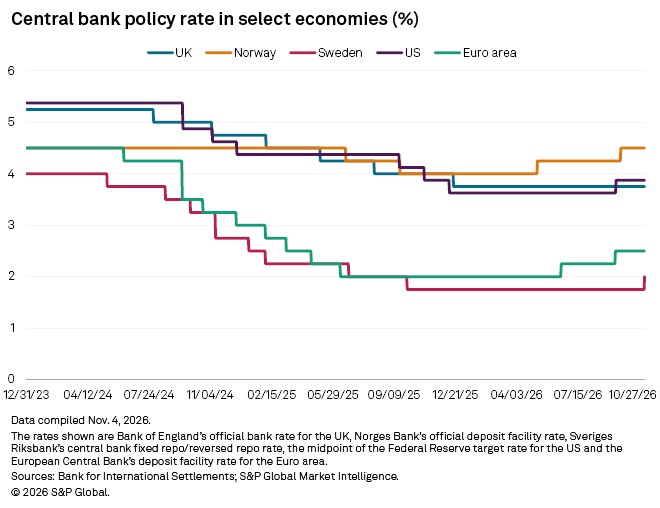
Of the three Swedish banks in the sample, Handelsbanken is the most susceptible to changes to central bank benchmark policy rates. SEB has a larger book of corporate loans, which typically carry fixed rates, and Swedbank is balanced by its sizeable business in the Baltic region, which is under the purview of ECB monetary policy.
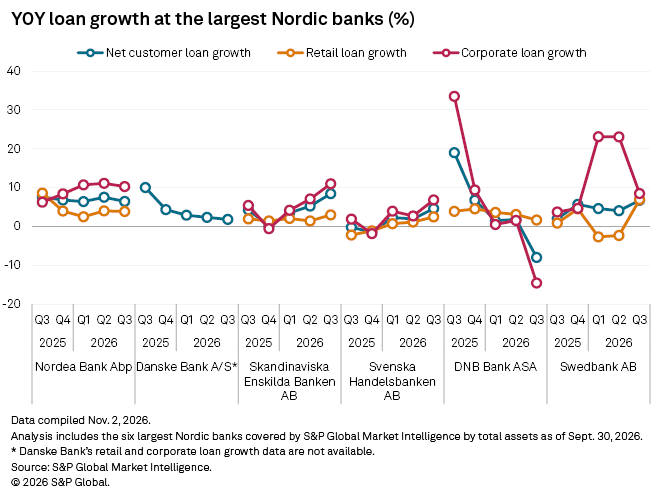
SEB, whose total lending book is 57% corporate loans, saw an 11% growth in corporate lending, while Swedbank reported a 8.5% increase. Finland-headquartered Nordea Bank, which still counts Sweden as its largest market, reported 10.3% growth in corporate lending.
Sweden's central bank held its benchmark interest rate steady in the first 10 months of 2026, and increased it on Nov. 4, the effect of which will take some time to reflect in banks' NII. Norway's central bank and the ECB have each made two 25-basis-point rate hikes so far in 2026.
DNB received some relief from loan repricing following rate hikes by the Norwegian central bank, CFO Rasmus Figenschou said. Another repricing based on the central bank's September rate cut will take effect toward the end of November, which should help boost NII in the fourth quarter.
While NII was a mixed bag for the banks, their ancillary income provided a more reliable cushion. Third-quarter fee income at the six banks rose year over year by an average of 12.03%, according to Market Intelligence data, with Danske Bank reporting the strongest growth at 16.3%.
Asset management and investment banking activities boosted fee income at both Danske Bank and DNB, with net inflows at DNB reaching an all-time high. Nordea also said its assets under management rose to another record high at the end of September.
Danske Bank recorded the biggest increase in net profit among the banks in the same analysis, with its third-quarter result increasing 15.7% year over year and beating Visible Alpha consensus estimates by 6.0%.
"The fee story at Danske is increasingly the highlight," Citi Research analysts said in a note following Danske's earnings announcement on Oct. 29.
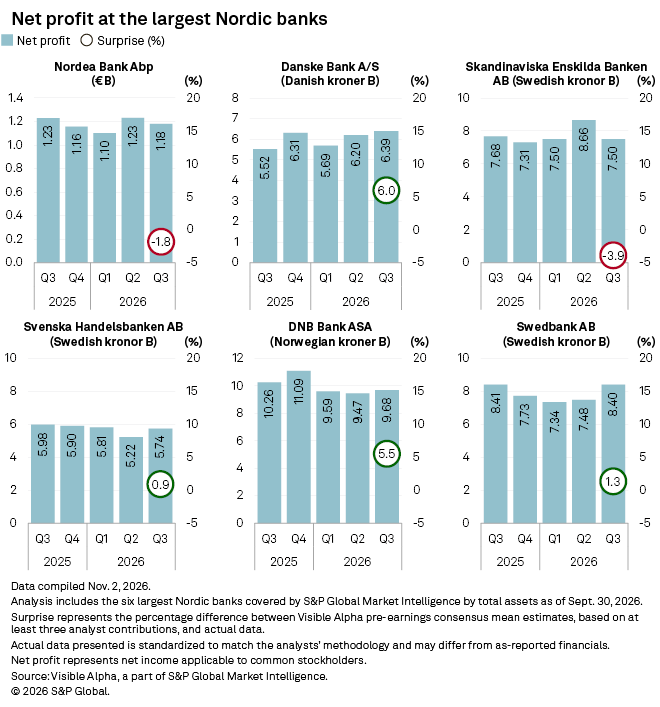
DNB's net profit also beat consensus estimates by 5.5%. It reported the second-highest fee income growth, at 14.7%, boosted by asset management and the performance of its Carnegie investment banking arm.
Danske upgraded its 2026 net profit guidance and now expects full-year net profit of between 24 billion Danish kroner ($3.60 billion) and 25 billion kroner, revising its previous guidance of at least 23 billion kroner.
|
Visible Alpha is an S&P Global company.