20 Nov, 2026
Deposit costs climb as banks brace for tougher competition
By Claire Lawson and Ayesha Shahbaz
US banks' deposit costs rose in the third quarter, already grappling with fierce funding competition and now staring down higher-for-longer rates.
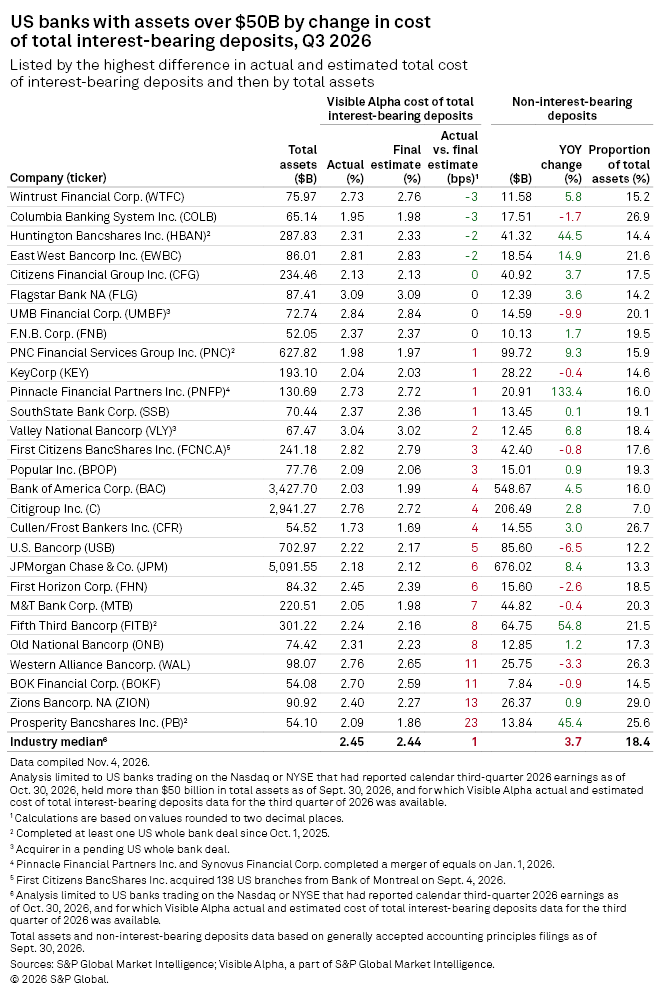
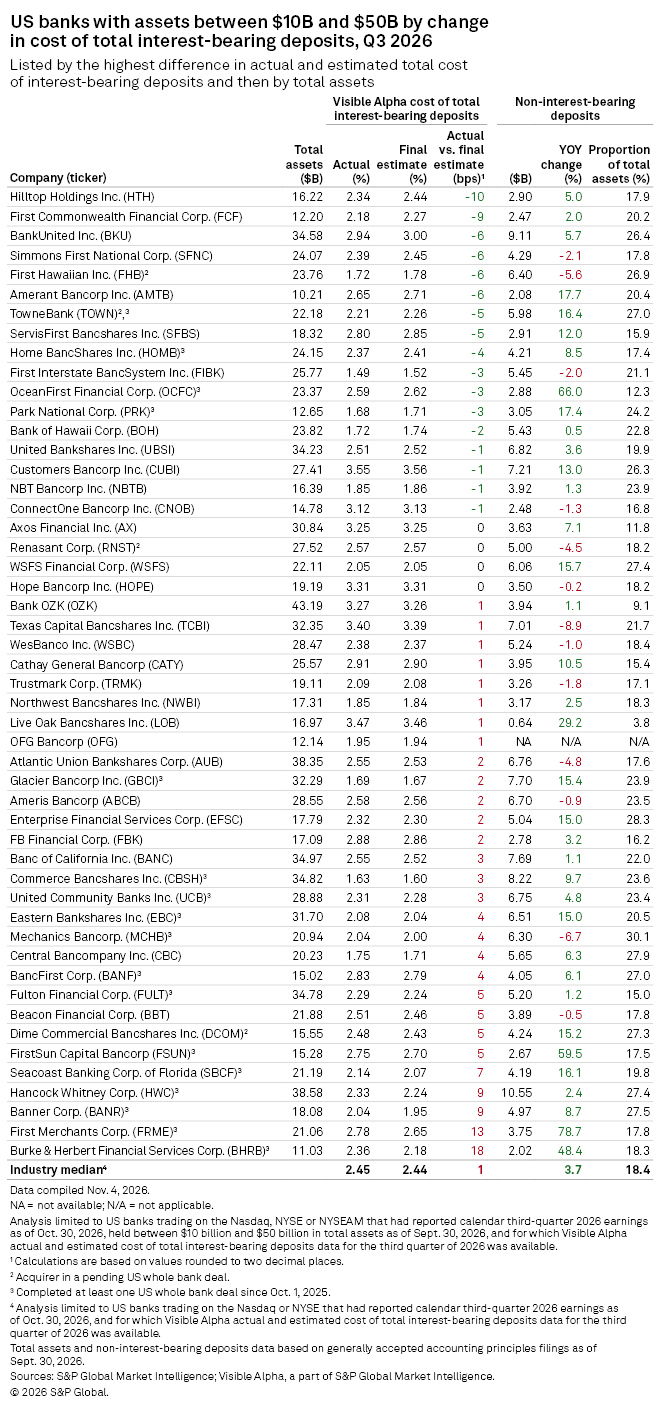
The US banking industry's median interest-bearing cost of deposits ticked up 3 basis points quarter over quarter to 2.45%, 1 basis point above consensus estimates. At the same time, the industry's proportion of non-interest-bearing deposits to total assets dropped to 18.4% from 18.9% the prior quarter.
Of 78 banks with assets over $10 billion in an S&P Global Market Intelligence analysis to report third-quarter results as of Oct. 30, 49 posted a higher actual cost of interest-bearing deposits than final Visible Alpha estimates, with just 21 banks beating estimates.
Larger banks performed slightly worse, with actual interest-bearing deposit costs missing consensus for 20 of 28 banks with assets over $50 billion and 29 of 50 banks with assets between $10 billion and $50 billion falling short of consensus.
While quarterly costs rose, non-interest-bearing deposits grew year over year for most of the banks analyzed, with 55 reporting increases.
|
Competition heating up
While many bank executives referred to deposit competition as rational during the third quarter, many leaders predicted it to increase in a rising-rate environment.
Hilltop Holdings Inc. CFO Will Furr said that third-quarter deposit competition was moderate during an earnings call, aside from new market entrants offering promos. But he expects that to change in coming quarters.
"As short-term rates start to move higher, we do expect there'll be intense competition for deposits, and that will drive overall interest-bearing deposit costs likely higher," he said.
The bank recorded the best beat in the analysis with its interest-bearing deposit cost 10 basis points below consensus estimates at 2.34%.
First Commonwealth Financial Corp.'s total cost of interest-bearing deposits was 2.18% for the third quarter, 9 basis points lower than consensus estimates and the second-best beat in the analysis. Like Hilltop, the company expects that cost to increase, citing rate hikes.
"We do see deposit competition heating up," CFO Jim Reske said during an earnings call. To keep deposit growth in line with loan growth, the company will pay market rates on deposits while costs rise, he said.
Bankers broadly anticipate the funding cost arena to become more contested in the coming months, with 88% of executives surveyed for IntraFi's third-quarter bank executive business outlook survey expecting rising funding costs over the next 12 months and 99% predicting deposit competition will increase or remain the same.
To protect their core deposits, several banks are focusing on relationship-driven accounts to attract more deposits and reduce reliance on higher-cost funds.
"How we price deposits is dependent on all the various pieces that we earn from the customer. So some of that is just good old-fashioned blocking and tackling and telling customers, 'Hey, this is what you need to have with us so that we can maintain this level of pricing so that we can all continue to win and be profitable,'" Torran Nixon, co-president of Columbia Banking System Inc.'s bank subsidiary Columbia Bank, said during the company's third-quarter earnings call.
Among the largest banks, Zions Bancorp. NA's cost of interest-bearing deposits in the quarter was 2.40%, a 13-basis-point consensus miss and up 15 basis points from the prior quarter. The increase was mostly due to repricing, CFO Ryan Richards said during an earnings call, and the deposit growth allowed the bank to reduce its reliance on wholesale funding.
"We've moved a lot of money back on the balance sheet for customers that we chased away a few years ago, when everybody was awash with liquidity. And so bringing that back on, our goal was really just bringing down our total cost of funding. A lot of the growth was higher-cost deposits and certainly lower cost than our marginal cost of funding," Chairman and CEO Harris Simmons said during the call.
And future deposit growth could continue to be pricey as the bank executes on that strategy.
"We would rather be reaching out to our clients and serving them and even these higher-cost products when they bring net new balances to us, than paying away to a broker or some other wholesale funder," he said.