19 Nov, 2026
AI investments face scrutiny as funding, buildout risks mount - S&P webinar

➤ Only five out of the 1500 companies in the S&P Composite 1500 index have publicly disclosed specific dollar returns from AI investments so far in 2026.
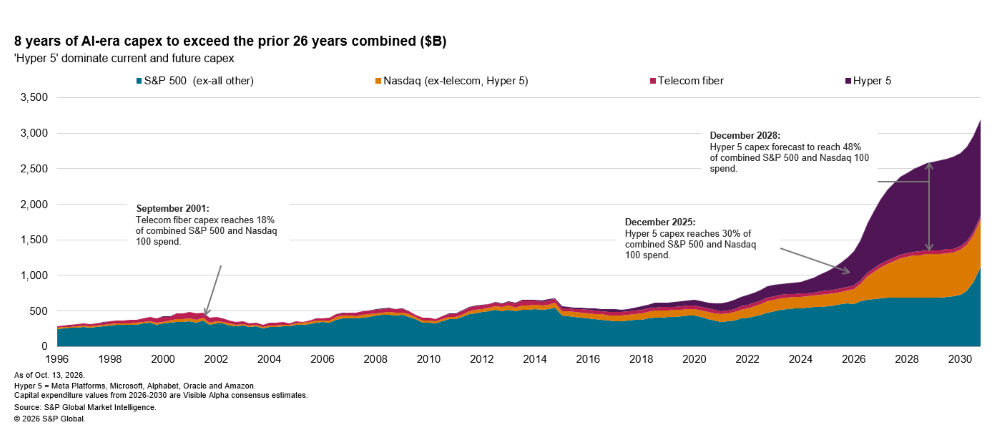
➤ Capital expenditures by five major hyperscalers have surpassed $1 trillion, with more than $5 trillion in additional expenditures expected by 2030.
➤ Technology companies have transformed the global dividend landscape, with Nvidia hiking its dividend by 25-fold in 2026.
Measuring returns on AI investments remains challenging despite widespread adoption, according to industry experts speaking at S&P Global Market Intelligence's "Big Picture 2027 Outlook: AI's Next Test" webinar.
About 80% of S&P 1500 companies have discussed the technology during earnings calls this year. However, just five disclosed specific dollar returns on their investments, said Sean Longoria, head of the Central Insights News and Data team at S&P Global Market Intelligence.
"That's a tiny fraction," Longoria said.
Companies usually cite productivity gains and efficiency improvements when it comes to AI adoption, though some have reported specific revenue gains, S&P Global Market Intelligence Purchasing Managers' Index survey data shows. Market performance has provided another measure of the technology's effects, with the Visible Alpha AI Monitor tracking about 50 AI-related companies generally outperforming the broader S&P 500 throughout most of 2026.
- Access a replay of the webinar
- Read all seven of the "Big Picture 2027 Outlook: AI's Next Test" reports
Funding mechanisms
The AI build-out has driven record-breaking activity in the capital markets in 2026. Through the third quarter of this year, convertible bond issuance reached 142% of the previous full-year record, while equity secondary offerings hit 105% of the all-time record, said Chris Fenske, head of capital markets research at Market Intelligence. Corporate bond issuance approached a record of $2.4 trillion.
"The AI build-out, no question, has injected adrenaline into the US capital markets," Fenske said.
Companies including CoreWeave Inc. have raised capital through multiple channels, including IPOs, follow-on equity offerings and convertible bond offerings. However, borrowing costs are rising significantly. For instance, Oracle Corp.'s bond spreads increased from 90 basis points over Treasurys in April to 160 basis points in early November, while spreads on another offering jumped from 145 basis points in February to 310 basis points in November.
Dividend transformation
Technology companies have fundamentally altered the global dividend landscape as AI leaders mature into profitable businesses with reliable cash generation models, said Juan Pablo Albornoz, US head of dividend forecasting at Market Intelligence.
"Technology is not usually the first sector that comes to mind when we analyze dividend factors," Albornoz said. "Historically, technology was viewed as a low-income, high-growth sector and the big picture here is that perception has changed."
NVIDIA Corp. exemplified this shift by increasing its dividend by 25x in 2026, quickly moving into the global top 10 dividend payers.
"Although it started from a very low payout base, Nvidia completely transformed the global dividend landscape in 2026," said Albornoz.
Cash flow and risks
Major hyperscalers are expected to report negative cash flow in 2026 and 2027 before turning positive in 2028, said Sarah James, TMT news lead at Market Intelligence. Negative cash flow is projected to reach $94 billion in 2027, then flip to a positive $40 billion in 2028. The five major hyperscalers are projected to hit positive cash flow of $294 billion in 2029 and $554 billion in 2030.
Global data center power demand is expected to more than double from 2020 to 2026 and continue rising through 2030. Because grid interconnection can take four to six years, hyperscalers are increasingly prioritizing speed to power, sometimes using behind-the-meter generation.
Natural gas tends to be the temporary solution of choice because it can be deployed quickly and provide reliable, continuous electricity. However, behind-the-meter power is significantly more expensive than grid electricity, so hyperscalers are expected to return to the grid over time while using a broader mix of renewables, batteries and nuclear power.
Data center projects face significant challenges, including power constraints and community opposition. Additional concerns include the potential adoption of cheaper open-weight AI models and high correlation among AI stocks, which could amplify volatility.
|
This content may be AI-assisted and is composed, reviewed, edited and approved by a human at S&P Global. S&P Global uses generative AI to create content in accordance with our Terms of Use.