12 Oct, 2026
UBS' US investment banking business to suffer most from tougher Swiss rules

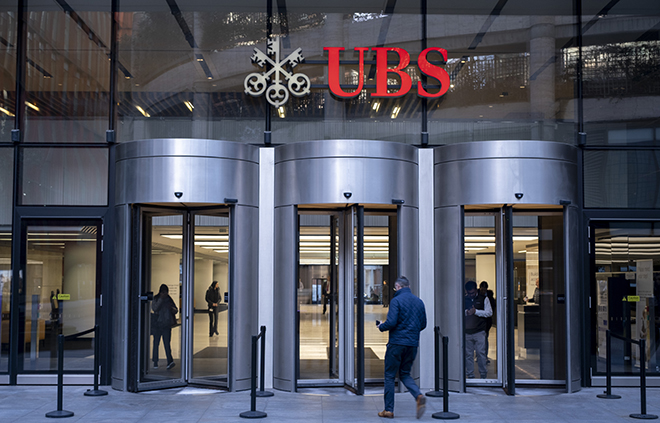
| UBS may have to pull back on some capital-intensive activities in light of the new Swiss rules, analysts said. Source: Mike Kemp/InPictures via Getty Images Europe. |
UBS Group AG stands to lose ground primarily to big US investment banks under a more stringent Swiss capital regime, analysts said.
New reforms, the bulk of which are still being voted in parliament, may require UBS to hold about $18 billion in additional common equity Tier 1 (CET1) capital to be raised over a period of at least seven years. The bank has called the reforms "extreme" and is lobbying to have them eased.
As the new rules target material foreign subsidiaries, they will affect mainly UBS' operations in the US and the EU. Analysts consider the potential impact of increased requirements manageable for UBS, but warn that maintaining a higher CET1 ratio than peers could constrain its global competitiveness, especially in US investment banking.
Unlike in wealth management, where pricing is not driven by balance sheet capital consumption, capital is priced into every trade and underwriting commitment in investment banking, said Johann Scholtz, banking equity analyst at Morningstar DBRS. This means a higher effective capital charge on business booked through UBS's US-based broker/dealer raises the cost of doing business against US peers who face no equivalent charge, Scholtz said.
UBS can offset some of this by booking business through other avenues, "but US securities business has to sit in a US-regulated entity, so the mitigation is partial," Scholtz said.
Still, the exposure is limited by the smaller size of UBS' investment bank unit, with the US business accounting for only a fraction, Scholtz said. UBS constrains the capital usage in its investment bank by capping the unit's risk-weighted assets (RWA) to about a quarter of the group's total. Lower RWAs allow UBS to support the same or similar exposures with less regulatory capital.
The higher requirements may force UBS to partially withdraw from certain global product segments, such as debt capital markets underwriting and trading in rates and credit securities, the analysts said.
Based on the subsidiary accounts, divisional and product mix, these business model changes could result in about 5% to 10% earnings attrition for UBS, the Citi analysts estimated. If the latest proposal, under which UBS must capitalize foreign units with 90% CET1 capital, is introduced, the group will have to raise its CET1 ratio to about 15.6% compared to its current target of about 14%, the analysts said.
Increasing capital levels materially will put UBS at a disadvantage, particularly to large US banks, which benefit from a more favorable regulatory capital framework, said Maria Rivas, senior credit analyst and sector lead European financial institution ratings at Morningstar DBRS.
"As UBS adapts to the new requirements, it may need to be more selective in growing capital intensive businesses, notably investment banking and other activities with relatively high risk-weighted assets," Rivas said.
UBS is forecast to have the second-highest CET1 ratio in 2026 among listed global systemically important banks (G-SIBs) after Morgan Stanley, Visible Alpha data shows.
Group-wide impact marginal
Nevertheless, UBS is one of the largest players across key businesses in wealth management, where it is expected "to further consolidate its global market position irrespective of the final calibration of the capital requirements," Rivas said.
About 60% of UBS' pre-provision profit comes from global wealth and asset management activities, "which are capital-light and would not be impacted that much by higher capital requirements," said Jesse Norcross, senior financial sector strategist at ING.
While parts of UBS could become less competitive, a well-capitalized bank is considered favorable in the bond markets, which could also continue to support its cost of funding, Norcross said. Given that UBS' cost of funding is generally lower than that of its peers, this could also be seen as a competitive advantage, according to Norcross.
The fact that UBS has achieved better earnings and lower costs since the integration of Credit Suisse, even with higher capital requirements over that period, suggests that the group should be able to absorb a further increase in requirements "relatively well," Norcross said.
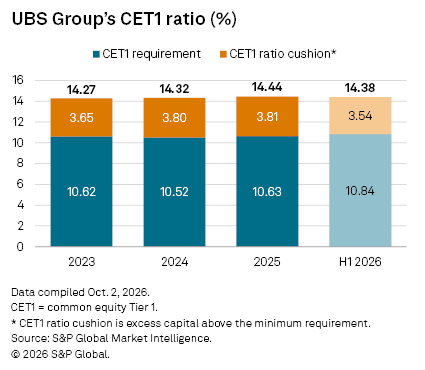
UBS' minimum capital requirements have increased since its acquisition of Credit Suisse in 2023, but the bank has managed to maintain a CET1 ratio cushion above requirements of over 300 basis points since then, S&P Global Market Intelligence data shows.
The group's CET1 ratio is projected to rise to about 15.5% by 2029 from about 14.5% expected in 2026, according to the latest sell-side analyst consensus estimates compiled by Visible Alpha.
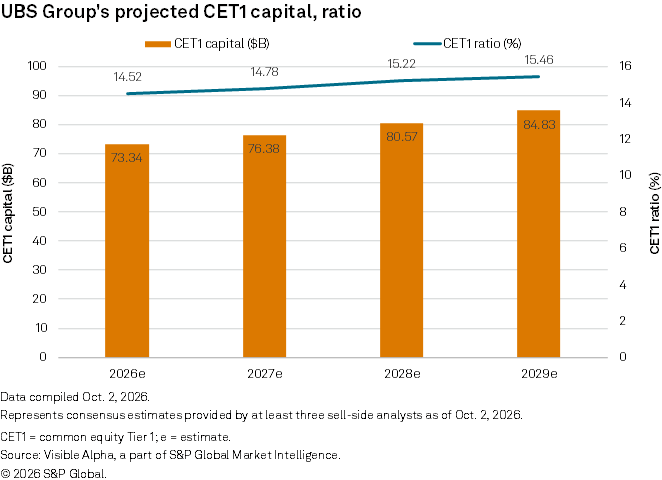
The new capital rules are not seen as a constraint to UBS' capital distributions over the next few years given that current CET1 ratio consensus estimates include about $5 billion to $6 billion of share buybacks per year, the Citi analysts said. In their own model, the Citi analysts estimate the CET1 ratio to increase to 15.5% by the end of 2028, with a progressive dividend and $6 billion of buybacks per year.
Even with the proposed higher additional capital requirements, the implied change in UBS' stock valuation is not significant, Ausano Cajrati Crivelli, equity analyst at Zürcher Kantonalbank, said in a Sept. 25 note. Zurcher Kantonalbank rates UBS at "market perform."
Compared with other listed G-SIBs, UBS has a midrange price-to-book ratio and dividend yield, according to Visible Alpha data.
While UBS will have to raise additional equity and incur extra annual costs for holding an overall larger amount of CET1 capital, the impact of that would not be immediate given the planned phase-in period of about seven years, Zurcher Kantonalbank's Crivelli said. The full impact would be visible around 2034, which would reduce the per-share impact, the analyst said.
If the recently approved proposal is accepted as final, UBS expects annual costs of about $2.5 billion to hold CET1 capital required under existing and new reforms, it said in a statement.
The upper house of parliament's decision has triggered renewed chatter about UBS' potential exit from Switzerland or even a merger with another bank. Yet analysts consider a compromise scenario on the new Swiss capital regime as the most likely outcome for UBS.
A new compromise proposal for a potential 75% CET1 capital backing of foreign subsidiaries has already been floated in the lower house of parliament, according to a report by Swiss newspaper NZZ am Sonntag.
|
Visible Alpha is a part of S&P Global Market Intelligence.