27 Oct, 2026
Small listings dominate European IPO activity in Q3 amid choppy markets
Smaller stock market debuts dominated the third-quarter IPO activity of European companies as many businesses remain in a wait-and-see mode due to uncertain market conditions.
While significantly more European companies went public during the third quarter of 2026 compared to a year ago, the aggregate value of listings declined year over year, S&P Global Market Intelligence data shows.
Some 46 companies raised $2.75 billion from IPOs between July and September this year, compared to 26 companies raising $4.56 billion in the same period of 2025.
"Elevated energy prices feeding into inflation, the potential for further ECB rate increases and ongoing geopolitical tensions have added complexity to the macroeconomic backdrop," EY Global IPO Leader Karim Anani said via email. As a result, investors are scrutinizing valuations closely and remaining selective, favoring growth sectors such as defense, infrastructure, energy and AI, he said.
Selective market
Given the heightened investor cautiousness, many companies considering going public are "taking extra care over timing and valuation to execute successfully within narrow [IPO] windows," Anani said.
A swing factor for many sponsor-backed businesses is the valuation gap between private and public markets, while M&A remains a competitive alternative exit route, he said. "Many larger candidates are therefore pursuing dual-track processes to keep their options open," Anani said.
While global equity indices remained resilient, there was a notable increase in equity and bond market volatility over the third quarter, PwC said in its latest IPO report. This was driven by growing concerns over inflation and the global growth outlook amid the war in the Middle East, while fears over AI safety drove a repricing of technology sector valuations, PwC said.
Europe's share in global IPO activity, measured by total proceeds from new company listings, fell to 5.3% in the third quarter of 2026 from 8.7% a year earlier, Market Intelligence data shows.
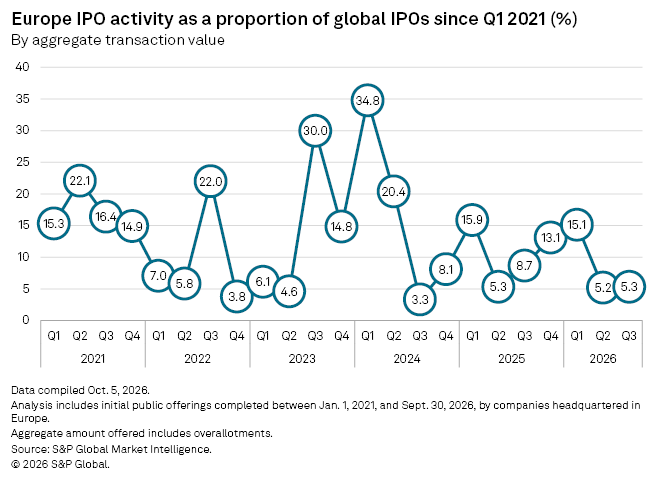
Although third-quarter listings were smaller on average and much of the larger pipeline remains on hold, the number of IPOs on European exchanges was higher than in any other quarter this year, EY's Anani said. Europe has been among the regions where overall IPO activity has picked up this year, he said.
DIGI Spain Telecom SA's July 16 debut was the largest European company IPO in the third quarter, raising $344.1 million.
This was followed by the $294.3 million listing of Swiss hospital and health care infrastructure operator Infracore SA in Zurich and the $147.8 million IPO of German military and defense antenna systems maker SMAG Mobile Antenna Masts AG, Market Intelligence data shows.
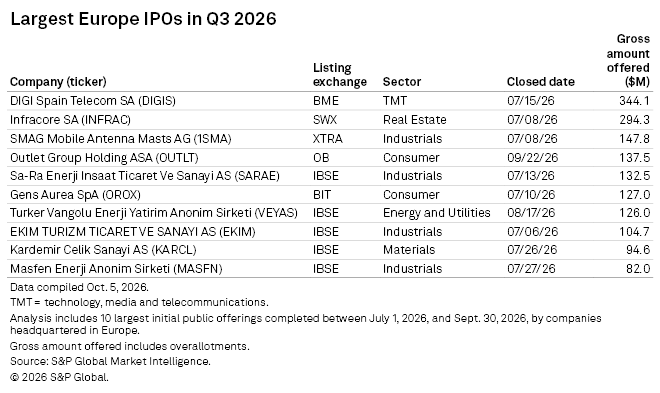
Most of the largest IPOs in the third quarter took place on Turkey's stock exchange, which also recorded the highest number of listings and second-highest aggregate amount offered in the first three quarters of 2026, the data shows.
Nordics active
Nordic listings venues, including the Oslo Stock Exchange, Nasdaq Stockholm, Nasdaq Copenhagen and Nasdaq Helsinki, were among the most active, recording a large number of listings and overall IPO proceeds, the data shows.
"The Nordic markets have stood out as one of Europe's more consistent sources of IPO activity," EY's Anani said. The activity has been underpinned by strong market liquidity, with trading turnover reaching record levels earlier this year, while "sponsor-backed exits have also become a meaningful source of [IPO] candidates," he said.
Other structural factors that have supported Nordic IPO activity include tiered market segments that allow companies to go public earlier in their development and sector diversity. "Technology and AI-adjacent issuers, including semiconductors and data centers, have listed alongside industrial, consumer and shipping companies," Anani said.
Yet, investor sentiment has started to soften across these markets based on the aftermarket performance of some of the larger Nordic listings over the past year, he noted. Third-quarter activity was concentrated in smaller deals and some candidates have put their IPO plans on hold since the end of September, Anani said.
"The timing of those transactions will depend largely on how sentiment develops in the months ahead," he said.
|
London still sluggish
IPO activity in London has remained weak in the first three quarters of this year, but industry observers see signs for optimism about future activity.
While there were no IPOs on the London Stock Exchange's (LSE's) main market segment in the third quarter, there was a new listing in the Alternative Investment Market (AIM) segment, that of oil and gas production company 1947 Oil & Gas PLC, PwC said.
Furthermore, Africa-focused fintech Airtel Mobile Commerce NV floated in London shortly after the end of the quarter at a roughly £5.3 billion valuation, making it one of the largest IPOs in recent years.
There has also been a "steady flow" of AIM-listed companies moving to the LSE's main market and strong secondary market activity, which "suggests recent market reforms are helping support confidence in London's public markets," Vhernie Manickavasagar, partner at PwC's UK capital markets team, said in the consultancy's report.
These trends provide a "solid footing" for the London issuance pipeline going into the fourth quarter of 2026 and 2027, Manickavasagar said.