23 Oct, 2026
Microinsurance can bridge Philippines' coverage gap — Re/Frame 2026

By RJ Dumaual
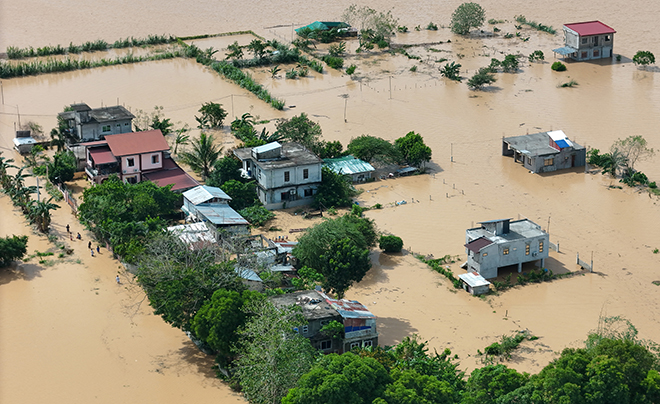
| An aerial view of submerged houses and farm lands with flood waters in Tuguegarao City, Cagayan province, north of Manila, on Nov. 11, 2025, as flood waters inundated homes due to heavy rains brought about by Super Typhoon Fung-wong. |
Private insurers in the Philippines need to develop more innovative solutions, such as microinsurance offerings, to bridge the country's insurance gap, according to RuralNet CEO Justin Arcenas.
Like most territories in Asia, the Philippines has a massive insurance gap, as evidenced by the limited insured losses expected from a 7.8-magnitude earthquake that struck off the southern coast of Mindanao, a Philippine island, earlier in 2026. Yet the Philippines is also one of the most advanced microinsurance markets in the world, Arcenas said during KRM Reinsurance Brokers Philippines Inc.'s Re/Frame regional forum on Oct. 16.
"Insurance is not something that is unfamiliar to the bottom of the pyramid," Arcenas said. "In the Philippines, there actually is quite a lot of adoption of insurance."
A large expense
Filipinos can access microinsurance through a variety of channels. The country's largest pawnshop chains, such as Cebuana Lhuillier Services Corp., offer coverage through their branches and online. The Philippines also has two cooperative-owned insurers, 1 Cooperative Insurance System of the Philippines Life and General Insurance and CLIMBS Life and General Insurance Cooperative, providing life and non-life coverage, including for natural catastrophes.
Microfinance institutions typically offer various insurance products, either directly or in partnership with mutual benefit associations. According to Insurance Commission data as of the end of 2023, mutual benefit associations insured over 28 million people.
Still, insurance is a large expense for low-income families, particularly farmers and those engaged in the fishing industry, for which about 98% of catastrophe losses are uninsured, Arenas said. The state-owned The Philippine Crop Insurance Corp. is stretched near capacity, the RuralNet executive said. RuralNet designs microinsurance solutions and provides cover through its CashKO microinsurance subsidiary.
Panelists also discussed how to strengthen the distribution of microinsurance by improving access and value.
Adriel Maniego, founder and CEO of Buhay Platforms, said lenders can embed insurance into more of their products and work with insurers on data and standardization to enhance underwriting.
Rodirick Takiang, senior vice president and chief actuary at Pioneer Life Inc., advocated designing an insurance product to meet the realities of underserved customers, including by simplifying contracts and paying claims promptly.
Technology such as the GCash app can play an important role, said Michael Rellosa, executive director of the Philippine Insurers and Reinsurers Association. The GCash e-wallet app facilitates microinsurance sales, offering cover such as comprehensive vehicle insurance, third-party liability, health, home, fire and pet, with plans to roll out specialized products like farmers' insurance and Islamic insurance. GCash is used by millions of people, which helps reduce the cost of distributing insurance, Rellosa said.