27 Oct, 2026
HDFC Bank's new CEO faces test of restoring investor confidence

By Yuvraj Singh
Anup Bagchi takes charge as HDFC Bank Ltd.'s CEO at a time when faster deposit growth and stabilizing margins suggest the worst of the lender's post-merger strain may be over. Bagchi's challenge will be to turn that financial recovery into renewed investor confidence.
The bank's stock price has fallen by about 8% since it announced its merger with its parent, mortgage lender HDFC Ltd., in April 2022, underperforming the more than 50% gain in the Nifty Bank index, a benchmark comprising the most liquid large-cap Indian lenders.
Bagchi took over as the bank's new CEO on Oct. 27, succeeding Sashidhar Jagdishan, who had led the bank since 2020.
"His main task will be to attract more low-cost deposits, reduce funding costs and, in turn, restore margins," Siddharth Rajpurohit, a banking analyst at Systematix Equities, told S&P Global Market Intelligence in a telephone interview on Oct. 22. "It is not an issue of brand or reach; it is the bank's liability profile that needs attention."
The bank's loan-to-deposit ratio is expected to improve to 94.24% by the end of the fiscal year ending March 2027, from about 104.4% three years ago, according to estimates from Visible Alpha, a part of S&P Global Market Intelligence. Its net interest margin is expected to improve after bottoming out at 3.23% in the current fiscal year.
Recovering from the merger's aftereffects
The bank's funding pressures stemmed largely from its merger with parent mortgage lender HDFC Ltd., completed on July 1, 2023. HDFC Bank absorbed HDFC Ltd.'s balance sheet, including a portfolio of long-term, lower-yielding housing loans totaling 5.26 trillion Indian rupees and high-cost borrowings, without a corresponding pool of deposits.
That pushed the combined entity's loan-to-deposit ratio above 100% in the fiscal year ended March 2024, according to Market Intelligence data. The bank was forced to accelerate retail deposit growth, reduce reliance on borrowings and strengthen its funding profile.
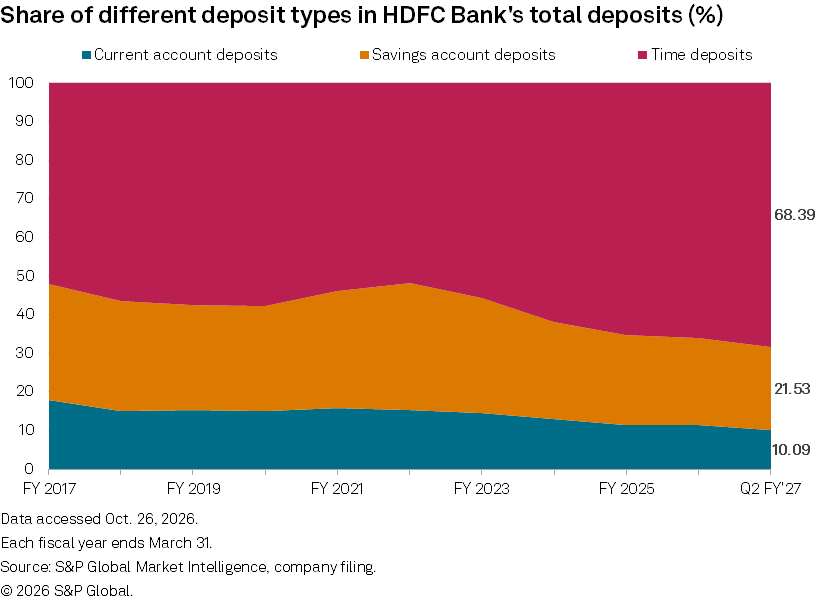
"In banking, the liability profile is extremely important. Before the merger, HDFC Bank had one of the best liability profiles, with a low cost of funds and a strong current account and savings account ratio of more than 40%," Rajpurohit said.
The bank filled part of the deposit gap with term deposits, which are more expensive than money held in current accounts and savings accounts (CASA). As a result, the share of these lower-cost deposits fell to 31.6% by September from the mid-40% range before the merger.
"For a bank as large as HDFC Bank, it is difficult to generate CASA deposits at a level significantly higher than term deposits," Rajpurohit said. "Deposit growth must exceed advances growth. This is the key factor that needs to improve."
Higher funding costs weigh on earnings
The high cost of borrowings inherited from HDFC Ltd.'s legacy balance sheet, along with expensive term deposits, dragged on the bank's earnings. Its return on average equity fell to about 14% in fiscal 2026 from a pre-merger high of about 17%, according to Market Intelligence data.
The bank has also tempered its loan growth to maintain the loan-to-deposit ratio. "Instead of focusing primarily on growth, the bank was forced to focus on its financials rather than simply pursuing growth," Rajpurohit said. "This put it at a disadvantage compared with peer banks, which were able to grow more freely in their respective markets and gain market share."
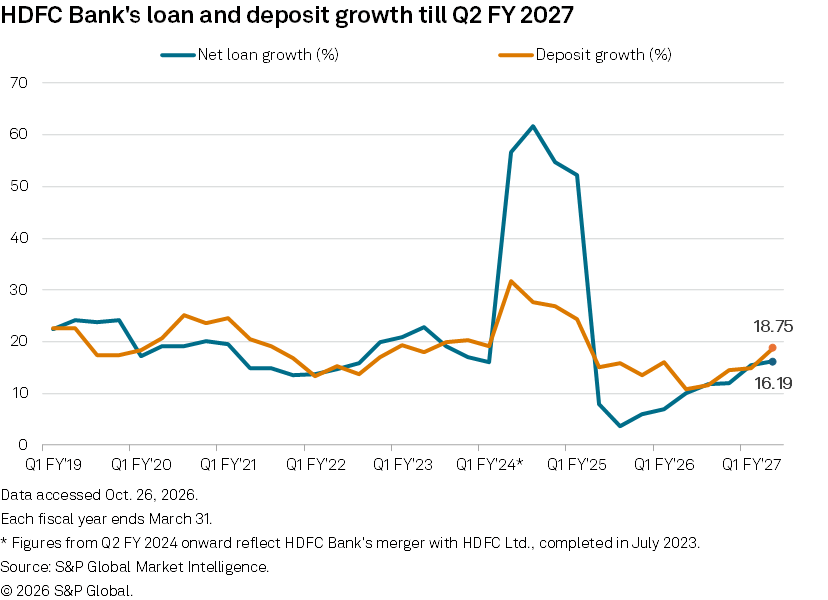
Although loan growth picked up to 16.19% year over year in the September quarter, HDFC Bank's credit growth remains below that of peers such as ICICI Bank Ltd., which grew its loan book by 30%, and Axis Bank Ltd., which reported 23% growth in net advances.
Loan growth also fell short of management's post-merger expectations. Once the balance-sheet integration was complete, the bank said it expected to grow broadly in line with the banking system in fiscal 2026 and eventually outpace the industry.
Profitability and governance issues hurt sentiment
A series of governance concerns added to investor unease. A group of retail investors accused the bank of misselling high-risk Credit Suisse Group AG AT1 bonds to nonresident Indian clients through its overseas branches in Dubai and Bahrain. After Credit Suisse collapsed and was acquired by UBS Group AG in March 2023, the bonds were written down to zero, resulting in total losses for investors.
The Dubai Financial Services Authority barred the bank's Dubai branch from onboarding new clients or offering new financial services, starting September 2025, citing compliance and governance lapses. The bank terminated three senior executives and imposed penalties on others.
Investor concerns deepened in March when part-time Chairman Atanu Chakraborty resigned, citing practices he said were inconsistent with his values. Chakraborty did not elaborate, and an external legal review commissioned afterward found no evidence supporting the concerns he raised.
"HDFC Bank has gone through a tough phase in the recent period amid concerns about governance and subdued operating performance after its merger with HDFC Ltd.," said Nitin Aggarwal, an equity analyst at Motilal Oswal. "While the bank has addressed most of the issues, they have taken a toll on its positioning and resulted in attrition among key leadership roles."
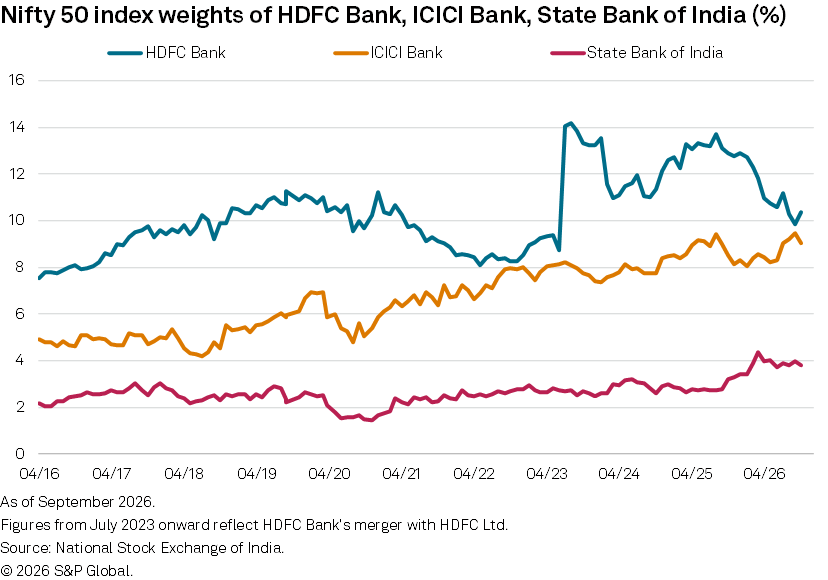
The bank's weight in the benchmark Nifty 50 index, which tracks the 50 largest stocks listed on the National Stock Exchange of India Ltd., fell from about 14% in August 2023, after the merger, to 10.38% in September 2026. The weights of peers ICICI Bank and State Bank of India increased during the same period.
Improving conditions offer hope
The first signs of balance-sheet normalization are now visible. Deposits grew 18.75% in the September quarter, outpacing the 16.19% expansion in loans. A part of that improvement came from foreign-currency deposits raised from Indians living abroad under a central bank program to attract Foreign Currency Non-Resident (Bank) accounts (FCNR(B).
Those deposits are relatively expensive and have initially weighed on margins, though the effect is expected to be temporary. HDFC's net interest margin declined by 8 basis points in the quarter ended Sept. 30.
The margin trend should improve from here, the lender said. The bank indicated that the second quarter likely marked the bottom and that margins should move "upward from the next quarter onwards" as the impact of rate increases passes through.
|
The Reserve Bank of India raised its benchmark policy rate by 25 bps in October and shifted to a "calibrated tightening" stance. Analysts expect two more rate increases in the coming months.
"While the recent rate hike is expected to support margins, the full-quarter impact of FCNR(B) funding is likely to offset part of the benefit, keeping margins broadly stable in the third quarter," said Avinash Singh, an analyst at Emkay Global.
Most analysts have recommended a buy or overweight rating on the bank. An Oct. 14 Market Intelligence report suggested that HDFC Bank's stock could deliver more than 38% upside from its current price over the next 12 months, the highest potential upside among major Asia-Pacific banks.
"We believe the appointment of a new CEO should resolve the prolonged succession overhang and help restore customer and investor confidence," Singh said. "Following the stock's sustained underperformance, valuations have turned attractive, offering scope for a sustained re-rating as the new leadership makes progress on key priorities."
As of Oct. 27, US$1 was equivalent to 94.99 Indian rupees.