14 Oct, 2026
Global battery storage failures fall as installations soar: EPRI

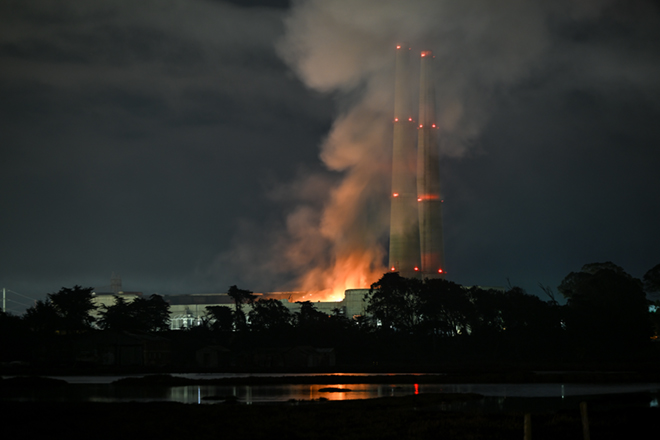
| Vistra's Moss Landing battery storage system burns in January 2025. Battery fires have become less frequent, according to a new report. |
Failures at lithium-ion battery storage systems that triggered fires, explosions and other safety hazards declined in recent years as global installations surged, according to a new analysis highlighting the technology's comparatively low and improving risk profile.
The Electric Power Research Institute (EPRI) found that the rate of battery failures at utility-scale, commercial and industrial sites plunged 98% between 2018 and 2025, based on gigawatt-hours installed.
The independent nonprofit research group also calculated an annual failure rate for battery system container units, with failures estimated to occur in one of every 714 to 2,500 units deployed per year. That is roughly on par with the failure rate for large oil-filled transformers, according to EPRI, marking a favorable comparison for an industry that has encountered significant growing pains associated with safety issues.
"When we went into this exercise, [this] was not actually what we expected," Lakshmi Srinivasan, a senior technical leader within EPRI's energy storage program, said in an interview following the report's Oct. 5 release. "I expected the battery failure rate to be higher as a newer technology that's doing this continuous improvement and growth."
Given the limited operating history of battery systems, Srinivasan cautioned against using EPRI's estimated failure rate to make predictions. But it is "a very positive result that it is comparable [to transformers] and expected to continue to improve," the report co-author said.
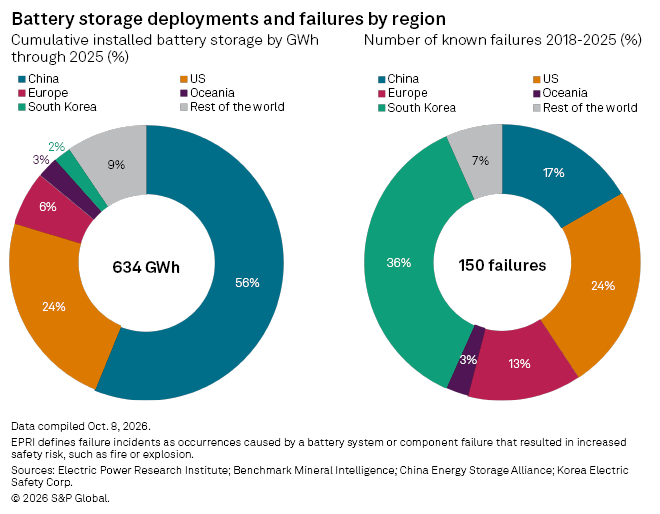
EPRI identified 150 public and nonpublic incidents between 2018 and 2025 in which battery systems or components malfunctioned and resulted in a hazard. Those peaked in 2023 with 30 episodes, before falling to 26 in 2024 and to 24 in 2025 despite rapidly expanding installations.
The research group attributed the falling rate of battery storage failures to lessons learned that have resulted in improved products, manufacturing and operating practices and have helped to enhance codes, standards and system designs.
"We're seeing year-over-year reductions in failure rate," Srinivasan said. "In the past three or four years, the deployment has basically doubled every year. It's that exponential curve, and you're not seeing that same number of battery failures, at least that we are capturing in our database."
EPRI began its online battery failure database in 2021 following a series of fires in South Korea and an explosion in Surprise, Arizona, that injured a crew of firefighters.
Regionally, South Korea has experienced the most failures, with 55, accounting for 36% of the 150 incidents EPRI identified. About half of those occurred in 2018 and 2019 during the country's initial rollout of the technology at commercial and industrial sites.
China, the world's largest battery storage market, experienced just 25 known failures between 2018 and 2025, according to EPRI, while the US, the second-largest market, had 36 failures.
An impactful 'outlier'
Of the 150 battery storage failures EPRI identified in previous years, 11 incidents led to 24 injuries and four fatalities, mainly involving first responders.
"The primary danger is from the buildup of flammable gas or arc-flash events resulting in explosions," the EPRI report said.
No member of the public has died or experienced an acute injury due to a battery fire or explosion in the research group's database.
But such incidents have sparked widespread community concerns, resulting in 113 active and 13 pending energy storage moratoriums across the US as of September, according to Carina Energy, which monitors moratoriums and helps developers with permitting.
By far the biggest failure to date occurred in January 2025 at Vistra Corp.'s Moss Landing Battery Storage Facility on the shores of California's Monterey Bay, which was one of the biggest battery projects in the world before it was largely destroyed by a fire lasting several days.
The cause of the incident remains unknown, according to Vistra. The plant previously experienced overheating events in September 2021 and February 2022 that temporarily forced the facility offline. A new fire erupted at the out-of-service project Sept. 18 when some of the remaining batteries ignited during site cleanup, which is being overseen by the US Environmental Protection Agency.
The blaze damaged 55% of the 1,200 megawatt-hours of capacity at the first phase of the Moss Landing complex, which was housed inside a refurbished building that once held natural gas turbines.
Moss Landing is often cited in opposition to proposed battery systems and in deliberations over moratoriums.
The 2025 fire, however, is an "outlier" in terms of its duration and scale, and the indoor design of the system is atypical and outdated, according to EPRI.
"An indoor architecture is more susceptible to more damage, and the more damage you have ... the more incident response you need," Srinivasan said.
Containerized, outdoor approaches, which are much more common, "are able to take advantage of the modular [battery energy storage system] design to mitigate the risk of fire propagation and limit equipment damage, mainly through spacing," EPRI said in the report.
A careful return
One such outdoor array is the 182.5-megawatt/730-MWh Elkhorn system, which sits next to Vistra's Moss Landing facility. The Elkhorn project, owned by Pacific Gas and Electric Co. (PG&E) and using Tesla Inc. Megapack containers, experienced its own fire in September 2022. The incident damaged only one container, accounting for 0.4% of plant capacity, according to EPRI.
The Elkhorn facility subsequently returned to service but went offline again in January 2025 when its infrared detection system sensed flames from the Vistra fire. It remains offline. The PG&E Corp. operating arm delayed the project's planned restart after discovering a clamp failure and coolant leak in one of Elkhorn's 256 Megapacks during testing.
Tesla, which maintains the plant for PG&E, "has evaluated the clamp that failed, developed an inspection and repair plan, and is working to remediate the issue," PG&E spokesperson Paul Doherty told Platts, part of S&P Global Energy. There were "no injuries, power outages, smoke, or fire" associated with the problems, Doherty added.
PG&E's best estimate for Elkhorn to return to service is July 2027, Doherty said, reflecting the utility's "decision to complete inspections and repairs across the entire system in alignment with evolving statewide battery safety standards and broader coordination with local stakeholders."
In the meantime, the project's lithium-ion batteries are being maintained above a minimum state of charge "to prevent degradation and ensure long-term system integrity," the spokesperson added. "Events across the industry have reinforced the importance of continuously improving battery safety standards, emergency planning, and coordination with first responders."
Coolant leaks have happened before. An investigation of a Tesla battery fire in July 2021 at the 300-MW/450-MWh Victorian Big Battery Storage Power Plant in Australia cited a coolant leak as the likely cause. The fire started in one Megapack and extended to another while damaging two additional units, according to EPRI.
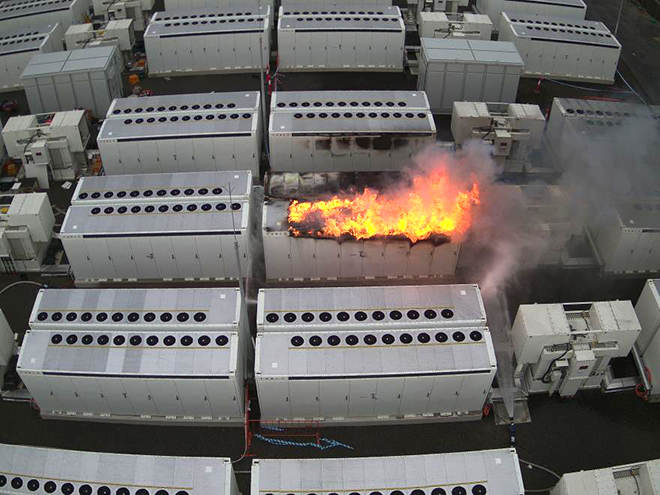
| A Tesla Megapack on fire in July 2021 at the Victorian Big Battery project in Australia. The root cause was likely a coolant leak, an investigation found. |
Call for transparency
In a 2024 root cause analysis of battery failure incidents, EPRI flagged balance of plant and controls as the most common failed components, rather than battery cells and modules.
Since that time, new information on the root causes of battery failures has been sparse.
Of the 150 incidents identified between 2018 and 2025, EPRI has root cause details for 26, Srinivasan said during a Sept. 24 panel discussion at the American Clean Power Association's RECHARGE energy storage summit in Aurora, Colorado. That is unchanged from the 2024 report.
She called on industry members to "fix that problem" by being more transparent, noting the far-reaching benefits of lessons learned "as long as they're shared."
Srinivasan also assumed EPRI's overall database is incomplete, though she and her colleagues have worked to validate and add to their data by reaching out to industry groups in the US and globally. That included forming ties with the China Energy Storage Alliance, which shared information on failure incidents in the world's biggest battery market.
EPRI also collaborated with product testing and certification firm UL Solutions Inc., which maintains its own database of lithium-ion battery incidents. UL tracks a wide range of products, from consumer electronics and electric vehicles to large-scale storage projects and home battery systems. Based on UL's database, which is not publicly available, EPRI added five incidents to its own database focused on utility-scale, commercial and industrial sites.
"We worked with a lot of different experts across the industry and asked ... if they couldn't share information about incidents," Srinivasan said. "And across the board everyone said, 'You're missing four or five incidents.' Not 50."