


15 Jan, 2026
Indonesia finalizing reduced nickel ore output target for 2026
By Karl Decena and Anita Nugraha
Indonesia may set its 2026 nickel ore production target at about 250 million–260 million metric tons, down from about 379 MMt in 2025, to align output with domestic smelter capacity, a senior government official said Jan. 14.
The government is still finalizing the output target, Tri Winarno, director general of minerals and coal at the Energy and Mineral Resources Ministry, told reporters.
Indonesia is cutting production to help boost nickel prices, which have been slumping due to oversupply. The nation produced 59.7% of the world's nickel in 2024, based on S&P Global Market Intelligence data.
The London Metal Exchange nickel cash price spiked 5.8% in one day to close at $18,495.24 per metric ton on Jan. 14, eclipsing a recent high of $18,348.65/t recorded Jan. 6.
"The immediate price response in the LME indicates that Indonesia has shifted from being a price taker to a price influencer in the global nickel market," said Ahmad Zuhdi Dwi Kusuma, an associate principal at the Energy Shift Institute think tank.
"Policy risk in Indonesia has become a key price driver for the global nickel market," Zuhdi told Platts, part of S&P Global Energy.
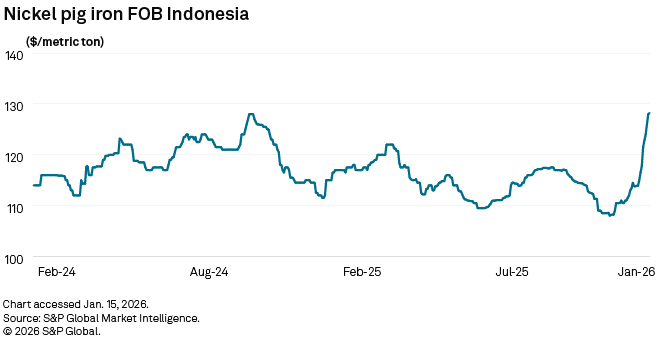
Platts assessed Indonesian nickel pig iron with 10% nickel content at $128.20/t on Jan. 15. The price was essentially flat day over day but represented a record high since the assessment was launched in February 2024, after reaching $124.00/t in August of that year. The price has risen 12.6% in 2026 since Jan. 2.
Tri also said the ministry has yet to approve 2026 work and budget plans, known in Indonesia as RKAB, for some miners. Discussions over production adjustments are ongoing, the official said.
The government has allowed mining companies to produce up to 25% of their three-year RKAB allocation for the first three months of 2026 while the approval process is ongoing, Tri said.
PT Vale Indonesia Tbk had suspended operations due to the delayed approval of its RKAB. The company announced Jan. 15 that it had secured RKAB approval and it is now working to restart its mines. Vale Indonesia's assets include the Sorowako mine and processing operations.
French-based miner Eramet SA, which owns a 38.7% stake in the Weda Bay nickel joint venture, said it continues to monitor the situation. Tsingshan Holding Group Co. Ltd. has a 51.3% interest in Weda Bay, with PT Aneka Tambang Tbk, or Antam, holding the remaining 10%.
"As a minority shareholder in Weda Bay Nickel, Eramet understands that the approval process for Weda Bay Nickel's 2026 RKAB is ongoing, with Weda Bay Nickel continuing to coordinate with and comply with directives from the Energy and Mineral Resources Ministry regarding the sustainability of its production activities," Nedjma Amrani, Eramet's press relations officer, told Platts.
Canada-headquartered Nusa Nickel Corp., which operates in Central Sulawesi province, said the company will "continue to operate within established production frameworks" amid the RKAB changes.
"Nusa Nickel views the Indonesian government's approach to RKAB approvals and interim production allowances as a measured and pragmatic step that balances supply discipline with operational continuity across the nickel value chain," Brandon Colwell, CEO of Nusa Nickel, told Platts.