


15 Jan, 2026
Building electrification is roadblock in Black Hills Colorado clean heat plan

Colorado regulators tabled a decision on approving Black Hills Colorado Gas Inc.'s revised clean heat plan, saying they need more time to resolve issues raised in public comments.
In their Jan. 14 meeting, members of the Colorado Public Utilities Commission largely agreed with comments from the Southwest Energy Efficiency Project (SWEEP) opposing the second proposed settlement of the clean heat plan. SWEEP, a regional energy efficiency advocate, said in a November 2025 filing that the second settlement "repackages and repeats the terms of the first one."
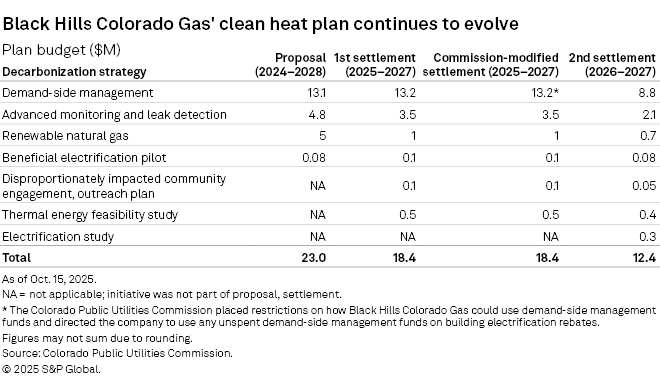
Under the revised settlement, released in October 2025, Black Hills Corp. subsidiary Black Hills Colorado would limit building electrification initiatives to a single pilot project and a study. The agreement left out regulators' modifications to the prior settlement, which had significantly expanded electrification's role in the clean heat plan (23A-0633G).
SWEEP said the settlement would burden ratepayers with costly and high-risk clean heat resources that do not make a large difference in Black Hills' emissions.
The nonprofit organization favors beneficial electrification (BE) to reduce greenhouse gas emissions. "Beneficial electrification" is the targeted replacement of natural gas or other fossil fuels with electricity in applications that could save consumers money as well as reduce emissions. SWEEP said the electrification study and Rocky Ford Beneficial Electrification Pilot efforts would not do enough to meet statewide emissions reduction goals. SWEEP's proposed portfolio for Black Hills would dedicate $14.1 million to beneficial electrification in 2027.
Commissioners set expectations
While the PUC commissioners said they do not approve of SWEEP's high budget and would prefer the clean heat plan to stay under the statutory 2.5% cost cap, they said Black Hills could take more steps toward electrification beyond the study proposed in the revised settlement. The utility anticipates spending $300,000 "to understand the potential costs and opportunities" of beneficial electrification.
"If you're going to do a study on electrification, there's a presumption that you can do electrification," Commissioner Tom Plant said.
The commissioners did not rule out the study, but they said the current outline is vague and they have questions about its scope. They also recommended that the study should be administered by a third party, rather than by the utility.
Regulators also agreed with SWEEP's comments opposing the deployment of an advanced monitoring and leak detection (AMLD) program and using renewable natural gas as a clean heat resource, which SWEEP said is a "high cost" resource. Commissioners said the utility should seek cost recovery through regular channels rather than using AMLD and RNG.
Settling parties in agreement
Commission staff, the state's Utility Consumer Advocate and the Colorado Energy Office (CEO) submitted comments urging the commissioners to approve the second settlement. They said the addition of the electrification study played a large part in their endorsements.
Parties also agreed to shorten the clean heat plan time frame to 2026–2027. The initial portfolio outlined a timeframe for the inaugural clean heat plan of 2024–2028. The shorter plan would adjust the budget to $12.4 million, while giving the company the discretion to shift the budget up by 15%.
Following the inaugural plan, Black Hills said it plans to file a combined demand-side management and clean heat plan application in 2027 for the 2028–2032 action period.
The modified clean heat plan portfolio can reduce greenhouse gas emissions by approximately 8% more over two years compared to the initial portfolio, the settlement said.
Black Hills said it also plans to conduct a feasibility study to investigate a thermal energy pilot program for $380,000, a reduction from the initial estimate of $455,000.
In annual reports to show progress toward clean heat targets, Black Hills said it will provide planned and actual clean heat plan expenditures and its CO2 equivalent emissions.
PUC staff said the settlement applied guidance from Atmos Energy Corp.'s approved inaugural clean heat plan, while recognizing the different circumstances of Black Hills. The electrification study would be similar to the beneficial electrification analysis the commission ordered for Atmos. The staff doubted Black Hills could administer a successful large-scale beneficial electrification program given the utility's strong opposition to the approach.
"There is simply no way to ensure that Black Hills will implement a satisfactory or successful BE program, even assuming the commission exercises the authority to order such implementation in the absence of any incentive for the company to succeed in implementing a large-scale BE program," PUC staff said.
Black Hills said its next clean heat plan will include 2015 emissions baseline attainment by 2030 and 2025 emissions target attainment by 2030.