01 Sep, 2025
US steps up to investor role: Trump inserts gov't in metals, mining sector

President Donald Trump is increasing the US government's stakes in the private sector, a trend experts say may be necessary to strengthen domestic supply chains for metals and mining.
During Trump's second term, the US government acquired a "golden share" as part of Japanese steelmaker Nippon Steel Corp.'s acquisition of U.S. Steel Corp. It also acquired a 15% stake in rare earths miner MP Materials Corp., a 10% equity stake in Intel Corp. and a revenue-sharing agreement with NVIDIA Corp. and Advanced Micro Devices Inc. from chip sales in China.
The president has also imposed country-specific tariffs on imports from dozens of trading partners — including a 50% tariff on steel, aluminum and copper — and the government has negotiated several trade deals with investment commitments.
Metal companies need such government support if the US wants to compete in the sector, experts told Platts, part of S&P Global Commodity Insights.
"Trying to stand up supply chains in the US is inherently extremely difficult, and so in order to break that hold that China has on the market, we do need government support to stand up players," said Ashley Zumwalt-Forbes, principal at critical minerals advisory firm Smoketree Resources.
Government stakes boost metals companies
The US government can de-risk projects by investing equity, serving as a catalyst for private capital, said Gracelin Baskaran, director of the Critical Minerals Security Program at the Center for Strategic and International Studies.
Baskaran referenced the MP Materials deal, where the Defense Department purchased $400 million of preferred stock, which has significantly increased in share prices since the announcement of the partnership. MP Materials operates the only rare earths mine in the US, the Mountain Pass mine in California.
"It is more economically and fiscally sustainable in that way that you continue to get a return as a shareholder," Baskaran told Platts.
When the government has "skin in the game," it provides incentives to address certain barriers to metals and mining projects, such as permitting and licensing, Baskaran said.
China is the world's largest producer of rare earths. It supplied 72% of US rare earths imports between 2019 and 2022, according to the US Geological Survey.
Grants and tax credits alone are no longer enough to ensure competition with countries like China, which controls and dominates many of these industries, Zumwalt-Forbes said.
For niche critical minerals like rare earths, antimony, gallium and germanium, Zumwalt-Forbes believes that government intervention is the only way to maintain supply chains. Free markets require a level playing field and being able to compete head-to-head with a counterparty, Zumwalt-Forbes added.
Stockpiles, permitting as other options
Experts told Platts that the US government has other tools at its disposal, like stockpiling materials and permitting reform, to boost the metals and mining sector without having to acquire equity in private companies.
Thomas Danjczek, former president of the Steel Manufacturers' Association and a steel industry adviser, does not think government equity stakes are the only solution to strengthen the steel supply chain. While the government can serve as a backstop, there are other options, such as permitting assistance, environmental subsidies, or even providing funding for training.
The metals and mining industry, specifically producers of niche critical materials for defense, requires a boost from government intervention to increase capacity, Zumwalt-Forbes said.
"The competitive advantage of this administration [is that it] does seem to be capital-market-savvy in understanding that to get projects off the ground and enable them to succeed going forward, these companies need the US government to pull multiple different levers of support and of funding," Zumwalt-Forbes said.
Harmful to competitors
Some, however, believe that government involvement could have a significant impact on the competitors of private companies receiving support.
"If you have four gas stations on a corner, you don't want one of them subsidized by the government," Danjczek said.
Danjczek pointed to the U.S. Steel-Nippon Steel deal, where the US government received a single preferred share in the company, known as a "golden share," that gave it wide authority over certain company decisions. Danjczek said the deal benefited foreign investment in the country.
In other countries such as Italy, Venezuela and the UK, governments are commonly involved in local steel companies. Only once in US history did the government seize control of the steel industry: in 1952 under President Harry Truman during the Korean War. The government control lasted for two months and ended when the Supreme Court declared the seizure unconstitutional.
While government equity can have anti-competitive effects, there is only limited capital available, leading the government to identify projects most aligned with its security interests, Baskaran said.
One area where government equity could be helpful is in the construction of copper smelters, Baskaran said. Other commodities that may benefit from an equity arrangement include those that China has restricted exports of, such as tungsten, germanium and gallium.
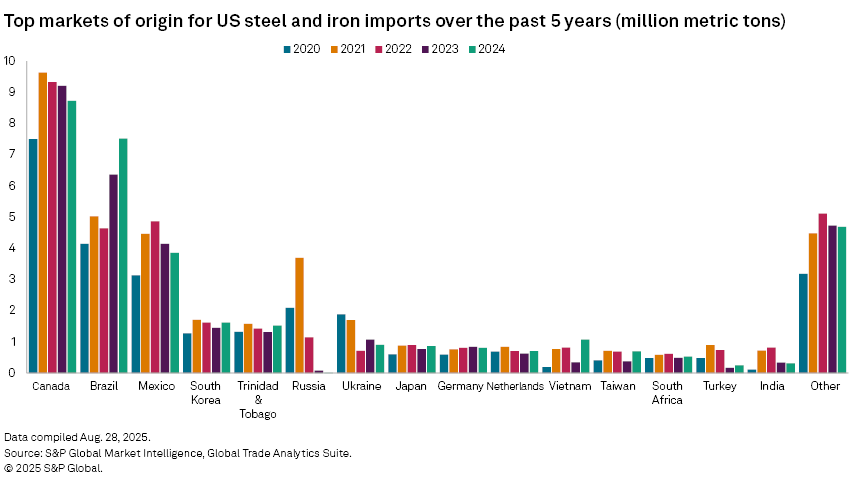
'Unprecedented' level of government involvement
Aaron Bartnick, global fellow at Columbia University and former White House economic security official, said the Trump administration has been using a variety of economic tools that are less common and "quite unprecedented" in an economy like the US.
"These are all economic tools that you would expect to see out of an emerging market that can't attract capital on its own and that can't compete on global markets, and so it needs to protect its own industries," Bartnick said.
Trump has expressed interest in further increasing government involvement in private companies. "We do a lot of deals like that. I'll do more of them," Trump told reporters on Aug. 22 when asked about the Intel deal.
The US government historically has treated state-owned enterprises as being akin to governments themselves, said Scott Lincicome, vice president of general economics at the Cato Institute's trade policy center. However, after similar moves by the US government, Lincicome sees the US on a path resembling China's economic model, which involves government control of major enterprises.
"Now, under the United States' own standards, will other governments look at US exports and say, 'These contain subsidized Intel chips or MP Materials products or U.S. Steel,'" Lincicome said. "It's not certain to happen, but I think these are new uncertainties, they're new risks that could have real commercial implications in the medium term."