


26 Sep, 2025
Texas law could be model for large load integration across US – panel

By Nushin Huq
A new Texas state law aimed at managing large customers within the Electric Reliability Council of Texas Inc. service territory could be a model for other parts of the country, according to panelists at a CPower Inc. webinar.
Texas Senate Bill 6, which went into effect Sept. 1, requires new loads over 75 MW connecting to the ERCOT grid to be flexible and participate in demand response. At a time when the power grid faces critical challenges from forecasts of massive load growth from artificial intelligence applications and data centers outpacing the development of new generation, demand response could be an essential short-term solution to bridge the gap between rising demand and available supply, panelists said during the Sept. 25 webinar.
"S.B. 6 is at the forefront, but it's part of trends we're increasingly seeing across the country by legislators and regulators asking large loads not only to pay their own way, but also to actively shoulder a portion of the grid's resilience and environmental responsibilities," said Claire Swingle, senior legal and policy analyst at CPower, a virtual power plant platform owned by LS Power Development LLC.
The webinar included analysis of S.B. 6 and its implications for data centers, particularly assets serving artificial intelligence applications.
"We expected S.B. 6 to migrate a bit, and it did get picked up," said Jim McDonald, founder and director of ENP Consultants, part of Miratech Corp.
A similar program was launched in the PJM Interconnection LLC when the grid operator introduced its non-capacity program. Unlike the Texas law, which requires participation, the PJM program is voluntary. If a large load customer agrees to come off the grid, it can avoid capacity charges, McDonald said.
"PJM doesn't have to account for your load in their capacity auction," McDonald said. "It actually will reduce prices for everyone involved."
There are five active dockets at the Public Utility Commission of Texas to implement the new law, covering forecasting, net metering, interconnection, new demand response programs and a review of transmission cost methodology. Most of those rules are expected to be adopted by July 2026.
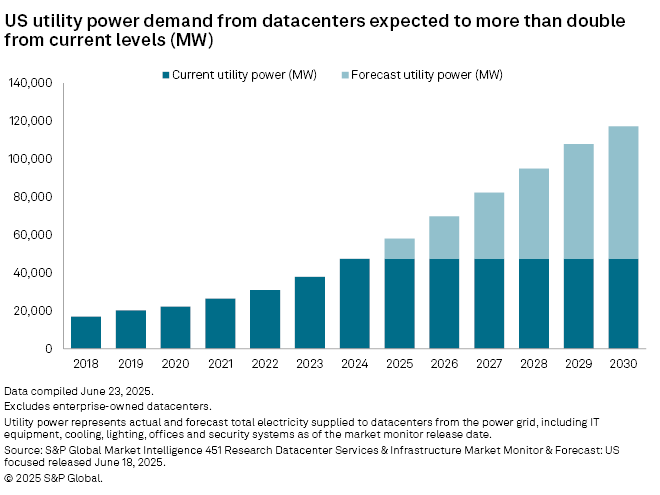
With US utility power demand from data centers expected to more than double by 2030, according to S&P Global Market Intelligence data, demand response will be a critical, immediate solution, said David Chernis, a specialist in digital assets at CPower. These programs could be used to prevent the need to build expensive and less efficient peaker plants. Natural gas turbines are backordered for several years, pushing the cost up for on-site natural gas generation to be even with battery storage, Chernis said.
Data centers can provide that flexibility without harming their computing performance by leveraging backup generators, incrementally adjusting graphics processing unit workloads and utilizing thermal cooling systems. A 0.25% to 1% flexibility for large loads could free up 90 GW of capacity on the grid, Chernis said, citing a research paper by Duke University.
Under S.B. 6, large loads may be asked to curtail their demand significantly at times, if not altogether, requiring them to install backup generation, McDonald said. This presents opportunities for large loads to install cleaner generation than what is on the grid and also allows loads to test backup generation ahead of time and have it ready before a curtailment event.
"The beauty of entering into these programs is you are going to be able to, while the grid is still available, do a smooth transition to the backup generator and make sure there's no hiccups along the way," McDonald said. "The biggest concern of any data center is going to be uptime. That's always been their number one thing ... doing it this way and having advanced notice is something that's going to really work to their benefit."
Another advantage of entering into a demand response program is that it gives participants additional insight into the power provider.
"[S.B. 6] is going to be mandatory, but I think what they're going to come to realize is that you get a peek behind the curtain when you're in a demand response program," McDonald said. "You get a sense of the health of the utility at all times. You're not watching the lights flicker and wondering what's happening over there on the other side of the substation. Now you're going to know 24 hours in advance, 'Hey wait a minute, this plant came down for maintenance. It was unplanned.'"