


11 Sep, 2025
German state banks see geopolitical uncertainty as key risk to 2025 profits

German state banks expect the uncertain geopolitical climate to be a key threat to 2025 profits because it can dampen economic growth and trigger market volatility.
The country's landesbanken — state-run lenders acting as central institutions for the German savings bank sector, namely Bayerische Landesbank (BayernLB), Landesbank Baden-Württemberg (LBBW), Landesbank Hessen-Thüringen Girozentrale (Helaba) and Norddeutsche Landesbank Girozentrale (NordLB) — released their latest earnings results in the second half of August. All except NordLB expect their 2025 profits to be flat or lower than a year ago.
Net profits at LBBW, Helaba and NordLB remained largely stable in the first half of 2025 compared to the same period of 2024, while BayernLB recorded a year-over-year profit decline, S&P Global Market Intelligence data shows. BayernLB also booked a more notable decline in both net interest income (NII) and net fee and commission income (NFCI), compared to the other banks.
Profit outlook
BayernLB was the most bearish in its 2025 outlook, reiterating a full-year pretax profit target of €1 billion to €1.3 billion, versus the €1.58 billion recorded in 2024. "This forecast remains fraught with significant uncertainty due to the highly unpredictable geopolitical climate and the inflation and interest rate situation," BayernLB said in its Aug. 14 earnings release.
Apart from lower NII amid ongoing central bank rate cuts, €100 million of risk provisions in its corporate mobility and commercial real estate portfolios weight down the Bavarian group's first-half profit.
"Persistent geopolitical tensions and uncertainties surrounding US trade policy are likely to influence markets in the months ahead," CEO Thomas Groß said in Helaba's Aug. 28 earnings release. The bank anticipates its full-year pretax profit to come in "slightly below" the 2024 result of €767 million.
Germany is among the EU economies most exposed to US tariffs due to its high export volumes to the country. It had by far the highest trade surplus with the US compared to other EU countries in 2024, at more than €92 billion, meaning the value of their net exports to the US is greater than the value of their imports, Eurostat data shows.
The economic environment remains volatile, creating uncertainty for both real GDP growth and the financial markets, LBBW CEO Rainer Neske said in its Aug. 27 earnings statement. The group confirmed its full-year guidance for a pretax profit of more than €1 billion, in line with €1.23 billion booked in 2024.
NordLB was more positive, saying it expects 2025 pretax profit "to moderately improve" year over year despite the persisting macroeconomic headwinds.
Helaba's Groß signaled a more optimistic note looking beyond the next few months, saying "tentative signs" of German economic recovery, coupled with fiscal stimulus measures, should drive investment activity, while "the more favorable interest rate environment should provide tailwinds for capital and real estate markets." This should help Helaba reach its medium-term goal of generating annual pretax profit exceeding €1 billion.
– Compare banks using the Peer Analysis template on the S&P Capital IQ Pro platform.
– Access aggregate financial highlights for banks in Germany on Capital IQ Pro.
– Explore the individual financial performance of LBBW, Helaba, BayernLB and NordLB on Capital IQ Pro.

Costs & asset quality
NordLB was the only of the landesbanken to lower its cost-to-income ratio year over year. Helaba's ratio remained largely stable, while LBBW and BayernLB booked ratio increases of 81 basis points and 704 basis points, respectively.
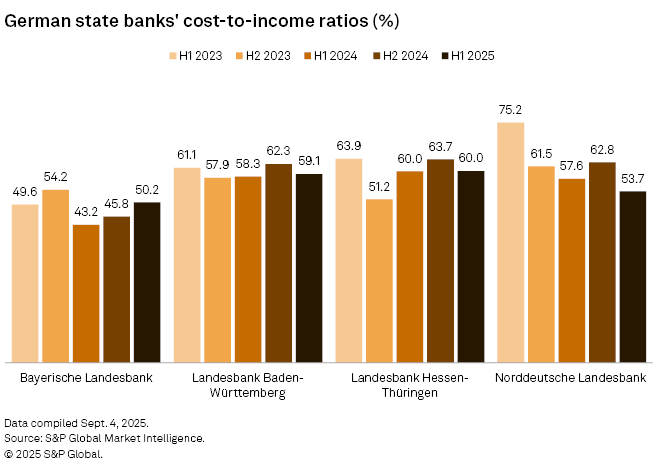
A new collective wage agreement, increased headcount, and investments in IT infrastructure and portfolio build-up over the first half of 2025 pushed up costs at BayernLB, the lender said.
NordLB said it was maintaining "strict cost discipline," showing positive operating jaws with 8% revenue growth versus a 1% increase in expenses in the first half of 2025 versus a year ago.
The banks, apart from BayernLB, recorded an increase in the share of problem loans in their books. Helaba, which has the highest problem loan ratio among the four banks, said new defaults largely offset the reduction of existing NPLs over the period.
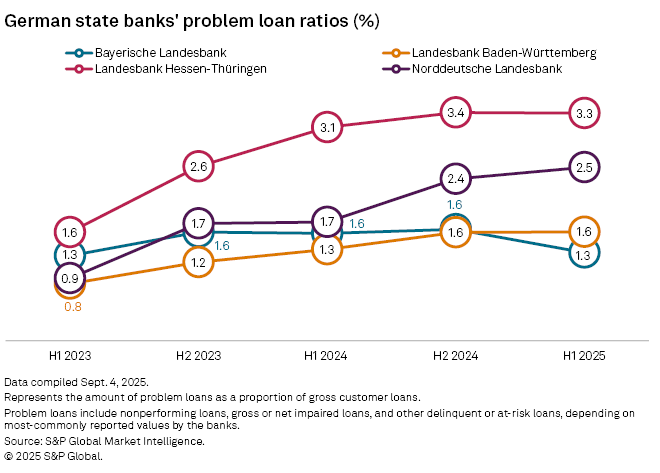
BayernLB said its improved problem loan ratio in the first half was partly thanks to the "initial effects of recovery in the real estate portfolio." State banks are key lenders to the commercial real estate market and have been affected by the sector's downturn in Europe and the US in recent years.
Strong capitalization
All banks strengthened their core capitalization over the first half of 2025, posting year-over-year increases in their common equity Tier 1 ratios of 200 basis points or more, Market Intelligence data shows.
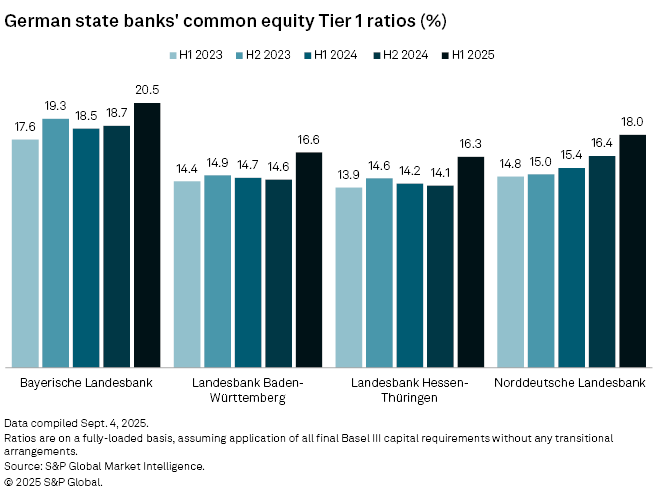
NordLB booked the strongest increase of 260 basis points, attributing this mainly to the first-time application of new rules under the final Basel III capital requirements, "which led to a noticeable reduction in risk-weighted assets."
German state banks showed some of the highest CET1 ratio depletion rates in the European Banking Authority's 2025 EU-wide stress test. Yet, the banks were confident they would stay resilient in a downturn, noting test does not take into account any measures they would take to offset the impact of the adverse scenario.