12 Sep, 2025
Gas industry pulls back the veil on early data center negotiations

|
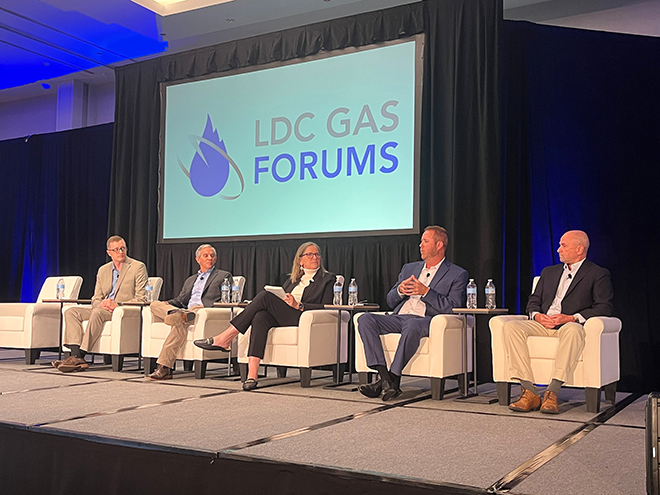
The LDC Gas Forums Mid-Continent event in Chicago convened a panel to discuss the gas industry's path to serving the complex energy needs of data centers. |
Data center developers seeking to expedite their projects by securing natural gas for on-site power generation are finding that even this shortcut has its fair share of speed bumps.
A panel representing companies across the gas value chain agreed that the fuel can help these developers achieve speed to market. However, they said the gas industry faces numerous challenges in serving the data center sector, where many players are still developing an understanding of complex energy systems, the panelists said.
Additionally, the highly secretive nature of commercial discussions around data center projects can create hurdles for the segmented gas industry. During a Sept. 9 panel at the LDC Gas Forums Mid-Continent event in Chicago, gas industry insiders pulled back the veil on some of those dealings.
With data center power demand forecast to grow exponentially, the panel focused on the obstacles that the gas industry faces in meeting that demand. The wide-ranging conversation touched on the challenge of lining up data centers' various resource needs during project siting, the facilities' sustainability considerations, and gas transmission and storage constraints in regions like the PJM Interconnection LLC.
But panelists kept returning to the overarching issue of accommodating a rapid data center buildout within the highly regulated gas industry.
Bridging power demand — but for how long?
Long waits to connect to the power grid have led many data center developers to explore on-site generation or colocating at existing or repowered plants. Recent regulatory and legislative developments that seek to protect other customers from data centers' massive energy consumption have also "forced the conversation between behind-the-meter and front-of-the-meter" approaches, said Rock Graham, manager for gas origination at NRG Energy Inc.
A key question is whether behind-the-meter generation assets will provide long-term power or simply bridge data centers' needs until they secure a grid connection.
This bridge-to-power solution is becoming a bigger issue as data center demand grows and developers envision larger facilities, according to Rob Cashell, director of asset management at microgrid and distributed energy service provider Enchanted Rock LLC. Securing gas capacity for power generation typically requires a 20-year contractual commitment, but data centers may only need to bridge their energy needs for five years, he said. In that scenario, developers will likely need to put together an asset management arrangement, which would allow them to release their capacity for the remaining 15 years to an asset manager.
"That's where this breaks," Cashell said. "In my mind, that's the biggest disconnect."
Data center developers that have approached Aspire Energy Express LLC about behind-the-meter solutions typically expect on-site gas-fired generation to provide primary power for 10-15 years, said Kyle Moore, general manager at the Ohio intrastate pipeline operator. But developers could decide it is better to stay behind the meter, he said.
"What I'm seeing timeline-wise is 10-15 years — and we'll see from there," Moore said.
'Bumpy' road to streamlining data center interconnection
Speed to market is the chief concern for many data center developers, panelists agreed.
Aspire Energy recently inked a deal to build a pipeline to a data center with on-site fuel cells in Central Ohio. Its intrastate system was appealing to the developer because Aspire can typically secure permitting faster from Ohio than pipeline developers working with the Federal Energy Regulatory Commission, which oversees interstate pipelines, Moore said.
There is also an imperative to revisit and streamline interconnection processes and tariffs to accommodate data centers, panelists said. They stressed that data center developers are typically scouting multiple locations, and delays can disadvantage competitors.
"They don't want to hear that it's a six-month process to determine whether or not we have sufficient capacity for you," Moore said.
Utility regulators and gas distributors are working on evolving tariffs to serve data centers, Southern Co. Gas Chair, President and CEO Jim Kerr said during a keynote following the panel.
However, Kerr stressed that negotiations with data centers are commercial conversations occurring within the context of a regulatory structure designed to guard against stranded assets and to protect the general customer base. It could take several years to build a library of contracts and push through tariff changes, he said.
"You want to meet the demand, but how do you do it in a way that is appropriate from a public policy standpoint?" Kerr said. "We will figure it out. It will be bumpy, I suspect, and it won't always work out perfectly. But I'm pretty confident that we'll figure it out."
More transparency needed in data center talks
The secrecy around data center projects, which developers often enforce through non-disclosure agreements, can also cause delays, panelists said. That culture creates challenges to communicating across industry segments, they said.
"I sell transportation — I don't sell the molecules," Aspire Energy's Moore said. "I think the way our processes work are so isolated, it can be very challenging for [data center developers] to put everything together as fast as necessary."
Being able to share more information among project participants, while staying within the bounds of the law and protecting business interests, would speed things along, panelists said. "If everyone holds their cards close to the vest, the conversation is so convoluted, there's never enough clarity — often not enough clarity — to land the plane," Enchanted Rock's Cashell said.
For Graham, the NRG originator, more transparency is key because creating reliable, affordable solutions to meet data center energy demands will require collaboration across the gas value chain.
"It's going to take a conglomerate of companies like this on the stage and all of you out there to solve these issues for this important part of the grid," Graham said.