09 Sep, 2025
'Complex continuity' in Norway spells difficult energy compromises post-election

|
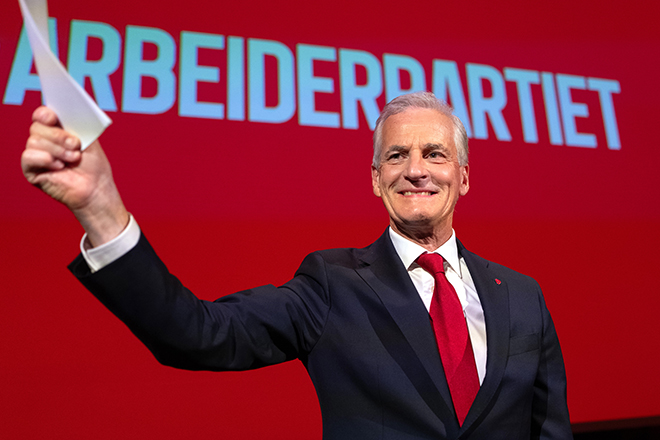
Norwegian Prime Minister Jonas Gahr Stø |
After winning the largest vote share in Norway's Sept. 8 general election, Prime Minister Jonas Gahr Støre's Labor Party will remain in power for the next four years. But the party faces difficult compromises on energy and climate issues with its collection of left-wing allies.
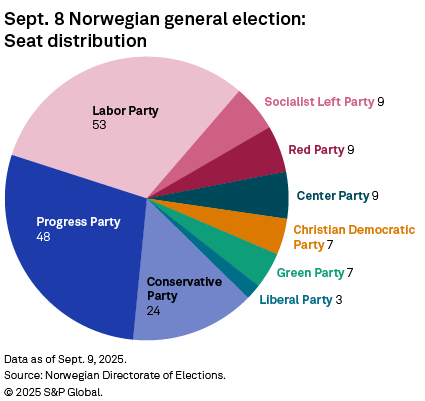
The Labor Party won 28.2% of the vote and is set to build a coalition government with partners such as the socialist Red Party and environmentalist Green Party, which secured 5.5% and 4.7% of the vote, respectively. All three parties built on their results from the 2021 general election.
The far-right Progress Party came second with 23.9% of the vote, improving its vote share by 12.3 percentage points since 2021. Meanwhile, the agrarian Center Party, a partner in the last coalition government, saw its support falter to 5.6% from 13.5%.
The election outcome can be described as "complex continuity," according to Jørgen Wettestad, a research professor with a focus on energy and climate policy at Norway's Fridtjof Nansen Institute.
"We avoided a government led by the Progress Party with climate policy dismantling high on its agenda. But it is easy to point out differing energy and climate positions in the new and even more complex red-green coalition," Wettestad said in a Sept. 9 email.
While the Green Party strongly supports further wind power development and aligning Norway closely with the green transition in the EU, the Red Party is more skeptical on both issues, Wettestad said.
 |
"So we are in for some very interesting debates in the years ahead," the academic added.
Labor's energy policies
The Labor Party ran on a platform of capped electricity prices and restrictions on power exports to Central European markets as a response to rising energy costs for consumers and industry.
A net electricity exporter, Norway has interconnections with Denmark, Germany and the Netherlands to the south, Sweden and Finland to the east, and the UK to the west.
The Labor Party pledged not to allow any new export cables during the upcoming legislative period, writing in its election manifesto that Norway is independent in its decision on future interconnector projects.
From Oct. 1, power prices will be fixed at 40 Norwegian øre per kilowatt-hour for primary residences and holiday homes, in a policy known as the "Norway Price."
Grid taxes will also be reduced from Oct. 1, the Labor Party said, with a total annual relief of 3 billion Norwegian kroner across households and businesses.
Green pushback on oil, gas
The Labor Party continues to support oil and gas licensing rounds and new production and frames the sector as central to Norway's economic security. However, the Green Party advocates for a stepwise exit from fossil fuel production.
The Green Party wants to see oil fields with high emissions closed first and gas fields with lower emissions allowed to operate longer. The last fields should be closed in 2040, the party said in its manifesto.
Norway
"Oil and gas have brought Norway enormous wealth, but now stand in the way of other industries flourishing and providing us with long-term income," the Green Party said in its election pledge.
Oil Change International, a nongovernmental organization, welcomed the election outcome, which is likely to see Green Party involvement.
"This election gives Norway a chance to change course. The Labor Party is now dependent on support from a big green block in parliament. The government must seize this moment to end new oil and gas exploration and align with the Paris Agreement," Silje Lundberg, North Sea campaign manager at Oil Change International, said Sept. 8.
"Norway has the opportunity to lead by example — and the world is watching," Lundberg said.
As of Sept. 8, US$1 was equivalent to 10.00 Norwegian kroner.