26 Aug, 2025
Joblessness for Black women surges as US labor market broadly cools

By Brian Scheid
US government staffing cuts; the dismantling of corporate diversity, equity and inclusion efforts; and a widespread cooling in the larger job market have pushed hundreds of thousands of Black women out of work.
In July, fewer than 10.25 million Black or African American women aged 20 or older were employed, the lowest level since December 2022 and down 319,000 from a peak of 10.57 million in February 2025, according to the latest government data. The most recent high was an almost 4% jump from the pre-pandemic employment peak.
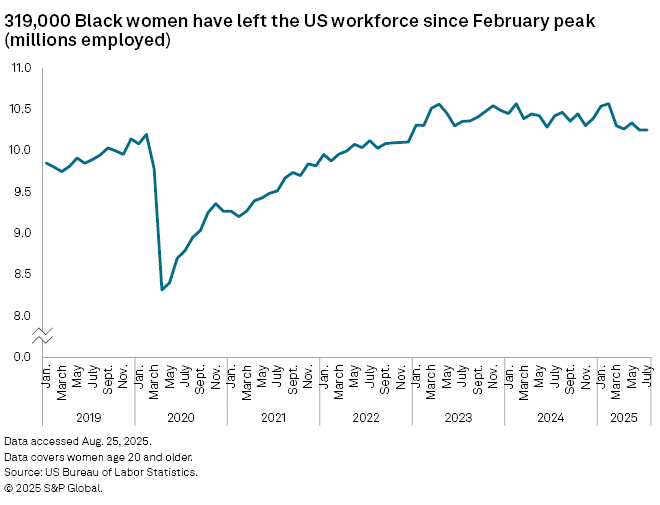
This sharp loss in jobs held by Black women, coupled with a corresponding rise in unemployment among this group and a fall in labor force participation, has been partly driven by cuts to the federal workforce that began shortly after President Donald Trump returned to the White House. Additionally, the end of many diversity, equity and inclusion programs in federal agencies and the private sector has triggered the decline in employment among Black women and a rise in joblessness, said Katica Roy, a gender economist and CEO and founder of Denver-based Pipeline, a company that uses AI to identify hiring and pay biases.
"When you combine institutional job cuts with shrinking access to inclusive hiring and promotion pathways, the result is structural displacement — not just unemployment, but a forced exit from the labor market altogether," Roy said.
Black women make up more than 12% of the federal workforce — roughly double their share of the overall domestic workforce — and comprise a large share of staff at the US Education Department and Department of Health and Human Services, which have seen some staffing levels cut in half.
Between August 2022 and July 2024, job postings mentioning diversity, equity and inclusion declined about 43%, Roy said.
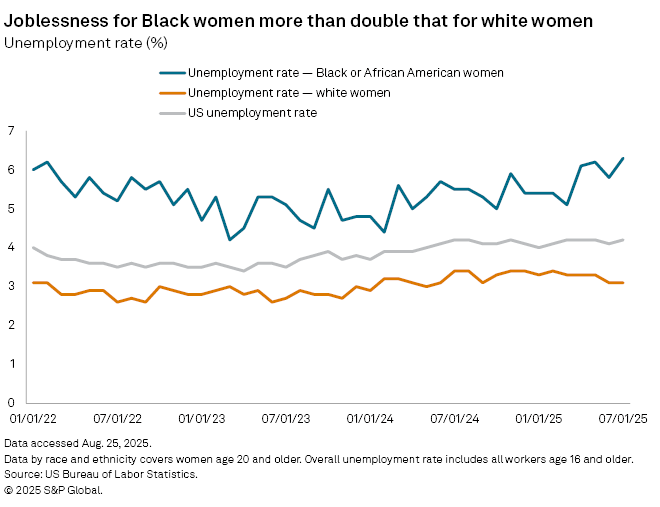
The unemployment rate for Black or African American women aged 20 or older surged to 6.3% in July, the highest rate since October 2021. The rate of joblessness among Black women is now more than twice that of white women aged 20 or older, a group that saw its unemployment rate drop to 3.1% in July. Unemployment for white women aged 20 or older has not been above 4% in nearly four years.
Overall, US unemployment has remained between 4% and 4.2% since May 2024, while joblessness among Black women is rising as job growth is stalling and hiring has slowed substantially.
"The hiring environment is really difficult," said Elizabeth Crofoot, senior economist and principal researcher with Lightcast. "Employers are not hiring, there are fewer jobs available. Job openings are down, hirings are down, it's a frozen labor market."
Crofoot said the fragile state of the job market is a particular challenge for Black women, who tend to face more barriers to entry. Black women are more likely to be single heads of household and primary caregivers, tend to work in jobs with lower pay and have few opportunities for advancement, Crofoot said. The loss of diversity, equity and inclusion programs, along with return-to-office mandates that scaled back many remote work opportunities, hit this group more significantly than others, Crofoot said.
"Those are all impacting Black women's ability to find a job or to stay in the labor market," Crofoot said.
The decline in Black women's employment and the potential for a prolonged state of joblessness for this group might have consequences that could last decades, said Brian Thompson, an economics professor at DePaul University.
"If there's a larger percentage of Black women that are single, head of household with no spouse, and they find themselves displaced without income, you can start to see a longer-term, generational effect," Thompson said.
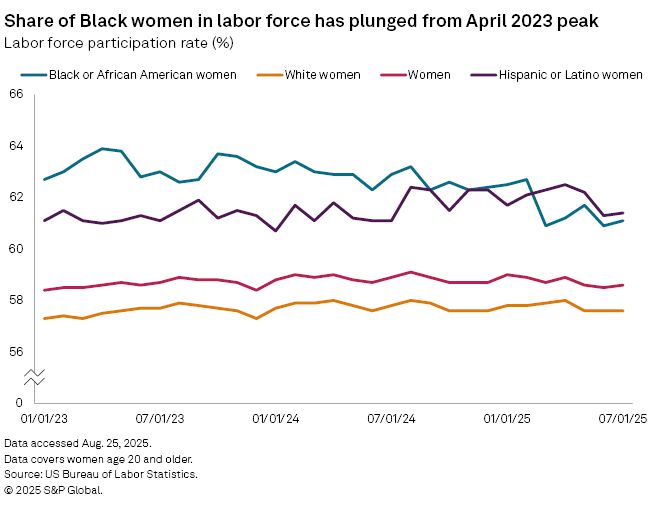
The labor force participation rate for Black women aged 20 or older dropped 280 basis points to 61.1% in July from its peak of 63.9% in April 2023.
Over that same stretch, the participation rate for all women aged 20 or older remained steady at 58.6%, while the rate for the same age group of white women increased 10 basis points and the rate for the same age group of Hispanic or Latino women increased 40 basis points.
The loss of Black women from the labor market will reverberate across the entire US economy, Roy with Pipeline said.
Labor force exits by Black women in 2025 are projected to cost the domestic economy nearly $36 billion in lost GDP, Roy said.
"Put simply: when Black women are pushed out of the labor force, we all lose," Roy said.