11 Aug, 2025
Japan's megabanks likely to cash in on higher rates to improve margins
By Yuzo Yamaguchi and Cheska Lozano
Japan's three megabanks are likely to benefit further from higher local interest rates amid preparations for a potential US economic slowdown.
Mitsubishi UFJ Financial Group Inc. (MUFG), Sumitomo Mitsui Financial Group Inc. (SMFG) and Mizuho Financial Group Inc. expect higher interest rates to boost their net interest margins (NIMs) and profitability. SMFG and Mizuho posted higher NIMs and net income in the April-to-June quarter, partly due to the Bank of Japan's exit from its experiment with negative interest rates in March 2024. MUFG, the largest Japanese banking group by assets, reported a slight decline in its net income to ¥546.07 billion in the fiscal first quarter ended June, down from ¥555.89 billion a year ago, data from S&P Global Market Intelligence show.
"The BOJ may push forward with rate hikes, helping their NIMs improve further," said Toyoki Sameshima, a senior analyst at SBI Securities. However, the three megabanks "may face a risk of higher credit costs as the prospects for the US economy are uncertain," Sameshima said.
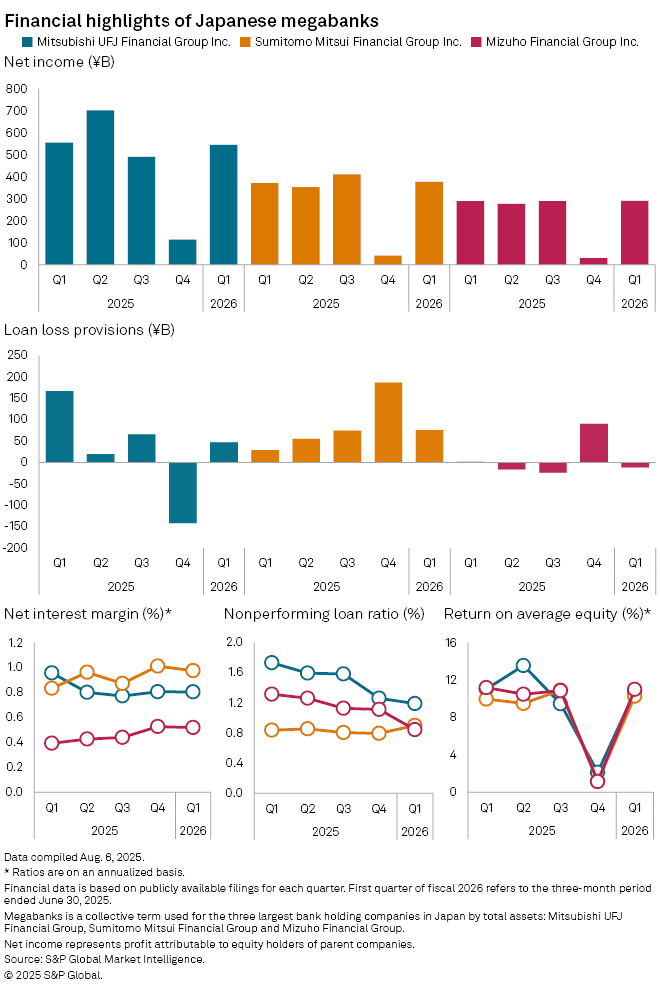
SMFG posted a 1.5% year-over-year gain in net income to ¥376.90 billion in the first quarter, supported by a 15 basis-point increase in its NIM to 0.98%. Mizuho's net income rose 0.4% to ¥290.52 billion, driven by a 13 basis-point increase in its NIM to 0.52%.
Policy normalization
Japan's central bank may gain greater leeway to resume its monetary policy normalization after a trade deal with the US was announced on July 22, which helped ease concerns about the economy. Meanwhile, US tariffs on imports from its key trading partners could cast a shadow over its own economy, potentially accelerating inflation and slowing consumer and corporate spending, economists said.
The US announced it will impose 15% reciprocal and auto tariffs on imports from Japan, lower than the 25% proposed by President Donald Trump in April. The US has also announced tariffs ranging from 15% to 25% on other Asian countries.
The tariffs could pull down the US economic growth by as much as 166 basis points to between 0.5% and 1.0% in 2025 and 2026, from 2.8% in 2024, Takahide Kiuchi, executive economist at Nomura Research Institute, said in a July 31 note.
"It would make sense [for the megabanks] to prepare for higher credit costs," Kiuchi said.
Higher margins
The three banks expect rising interest rates in Japan to boost their net interest income by a total of ¥535 billion for the current fiscal year ending in March of 2026, according to their statements. If the BOJ raises its policy interest rate to 0.75% from the current 0.5%, SMFG estimates an additional ¥100 billion in annual profits.
"Chances are higher" that the BOJ will take action to raise rates, said Hiroshi Minegishi, general manager at Mizuho's financial planning department, during an online earnings conference on July 31.
Michael Makdad, a senior analyst at Morningstar, forecasts domestic net interest margin to widen 16 basis points for MUFG, 10 basis points for SMFG and 12 basis points for Mizuho for the current fiscal year ending in March 2026. This forecast reflects the rate hikes that have already been implemented.
The BOJ maintained its policy rate at 0.5% for the fourth consecutive meeting on July 31. On the same day, the central bank raised its inflation outlook to 2.7% from the previous estimate of 2.2% in a quarterly report.
"We will focus on the risk of higher prices," said BOJ Governor Kazuo Ueda during a press conference after the policy meeting. Regarding the bank's baseline scenario of sustainably achieving its 2% inflation target, Ueda said, "I believe the certainty of the forecast coming true has increased a little."
The central bank will monitor the impact of tariffs on exports, production and US employment, Ueda said.
Two of the three Japanese megabanks raised their loan-loss provisions for the fiscal year ending in March 2026, reflecting concerns about the global economic outlook. MUFG set its loan-loss provision at ¥350 billion for the fiscal year, more than triple the ¥108.7 billion from the previous year, while Mizuho nearly doubled its credit cost to ¥100 billion, up from ¥51.6 billion. SMFG allocated ¥300 billion, lower than the ¥344.5 billion allocated a year ago.
As of Aug. 11, US$1 was equivalent to ¥147.98.