11 Aug, 2025
Departing FERC chair warns of 'insiders' game,' calls for consumer advocate
By George Weykamp and Maya Weber
Mark Christie shared one major institutional concern about the future of the Federal Energy Regulatory Commission as he wrapped up his time as chairman — and it was not about potential risks to FERC's independence that have dominated recent headlines.
In an interview with Platts, part of S&P Global Commodity Insights, Christie said "regulatory capture" by lobbyists was a greater worry in his eyes. The agency could use a consumer advocate such as at state utility regulatory agencies to ensure the interests of ordinary customers are well represented, Christie said.
The chairman's comments came amid a push from the Trump administration to exert more control over independent agencies, including FERC. President Donald Trump signed an executive order in February that would require independent agencies to submit all major and draft rulemakings to the White House for review. The president has also fired members of several independent agencies, including the Nuclear Regulatory Commission, despite statutory protections from removal.
|
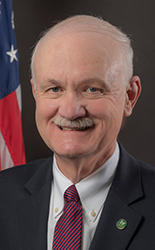
Federal Energy Regulatory Commission Chairman Mark Christie. |
Those actions have alarmed some energy sector stakeholders, who have said the erosion of FERC's independence could lead to less legally durable rulemaking and more dramatic political swings between presidential administrations.
In the interview, days before he officially left the commission on Aug. 8, Christie said an "insiders' game" within the commission's regulatory process is a bigger threat to consumers than the administration's erosion of FERC's independence.
"The problem of regulatory capture is real, and it has nothing to do with this administration. It is endemic to FERC," Christie said. "It's just the nature of what we do here is that the interest groups that have money at stake are going to buy the resources, and usually legal resources, to try to work the system, to try to get the best outcome."
In June, the president declined to renominate Christie, who was sworn in as a commissioner Jan. 4, 2021, at the end of the first Trump administration, and instead named industry attorney Laura Swett to fill Christie's seat.
Independence
Despite stakeholder concerns that a less independent FERC could undermine regulatory certainty and threaten long-term investments, Christie said the other side of the argument is that in a democratic system with accountability, there should be change following an election.
"If you're part of the insiders' game, you don't like the idea that somebody outside, whether it's a new administration or somebody else, is going to disrupt the insiders' game that you're pretty good at and that you're used to getting pretty much what you want.
"So, a lot of the complaints you're hearing about — what's going to cause chaos, it's going to cause disruption — are coming from the very insider groups that are benefiting from the insiders' game that takes place here and in other commissions," Christie said.
From Christie's perspective, the Virginia State Corporation Commission, which he previously chaired, is the "gold standard" in terms of how a regulatory commission should be established. The makeup is laid out in the Virginia constitution so that the governor does not appoint commissioners and cannot fire them. Rather, they are appointed to six-year terms by the legislature.
Christie said the Virginia SCC's structure allows the state commissioners to make decisions free from political and corporate influences. Virginia state commissioners are judges of courts of record and cannot discuss substantiative matters with the entities they regulate, Christie said. At FERC it is generally considered appropriate for commissioners to meet with outside interest groups in certain types of proceedings, although commissioners are barred from meeting with parties in contested rate or natural gas certificate proceedings.
Virginia state commissioners are "not subject to improper lobbying, and it serves the public interest in Virginia," Christie said. "But you're not going to have that at the federal level without a constitutional amendment."
"Virginia has done more to shield its regulatory commission from regulatory capture than many, many other regulatory agencies," he said.
Christie noted that FERC's independence was different because the agency was created by statute and not enshrined in the US Constitution.
"Independence at FERC ultimately is going to come down to whether the Supreme Court rules on whether the president can fire commissioners," Christie said.
Consumer advocacy
The outgoing chairman said FERC needs a consumer advocate to speak on behalf of ratepayers and balance out the influence of companies and organizations.
"If you look at the history of FERC over the last 30 years, what you had at FERC is regulations that — have they served consumers? I don't think so," Christie said. "It tends to be an insiders' game here, and that's one of the problems. We don't have a consumer advocate. So when [former commissioners] talk about stability ... stability in whose interest? Consumer interest has not been represented here."
He highlighted commission orders dealing with distributed energy and transmission planning — specifically orders 2222, 1920 and 1000 — among the major FERC actions in this period.
"It was because FERC got lobbied by various interest groups that wanted to get money out of the capacity market. That's where 2222 came from."
Christie was often viewed during his tenure on the commission as a pragmatist who advocated for ratepayers and forged compromises that ultimately cut back on split decisions over gas projects. Throughout his nearly five years on the commission, he often criticized electric transmission rate incentives — which he nicknamed "FERC candy" — and other policies he saw as having an adverse impact on consumers.
"My principle that has guided me from Day 1 as a utility regulator is that the purpose of utility regulation, energy regulation more broadly, is to provide the consumer with reliable power at the least cost," the chairman said.
Christie was known to make deals with Democratic colleagues on the commission, including working out key provisions to advocate for state planning authority in Order 1920-A — the commission's long-term transmission planning rule — and on natural gas infrastructure.
The chairman noted, however, that he was unable to garner enough support for some of his top priorities, such as reforming the commission's transmission incentive policies.
"To get anything done on a multi-member body, you have to get the votes," Christie said. "One of the things I would characterize as my approach is, you gotta play the cards in your hand. You gotta play the cards you were dealt, not the ones you wish were in your hand."