14 Jul, 2025
US teenage unemployment surges in sign of weakening labor market

By Brian Scheid
Joblessness among teenage workers in the US has surged to its highest levels since the early days of the COVID-19 pandemic as job openings shrink amid rising business uncertainty and questions about the state of the overall labor market.
Unemployment for Americans aged 16 through 19 rose to 14.4% in June, up from 13.4% a month earlier and 12.3% a year ago. Teen unemployment in June hit its highest mark since September 2020, when the market was still adjusting to the pandemic.
While employment data for the summer season, when school is out and teen hiring typically rises, is nascent, early numbers show teens fleeing the labor force, potentially to focus on school or work that falls outside of official government statistics. This is a troubling indicator for the broader US economy, economists said.
"Teen unemployment is a leading indicator for what will happen in the job market more broadly," said Alicia Sasser Modestino, an economics professor at Northeastern University. "This is because teens are the least experienced workers, so they are the last to be hired and the first to be fired. So you can think of rising teen unemployment as the 'canary in the coal mine' warning of a softer job market ahead."
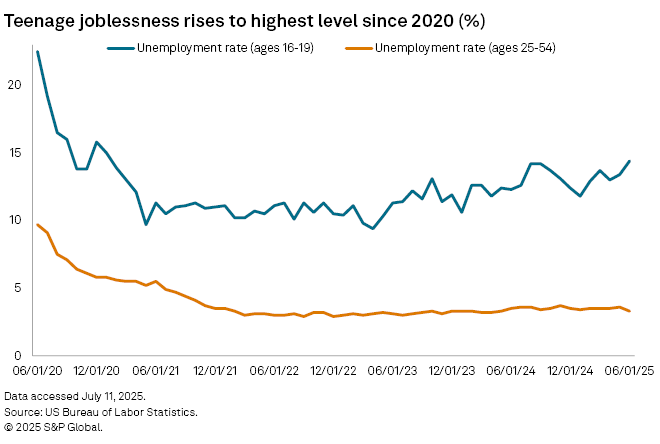
The rise in teen employment is particularly notable when contrasted with the relatively low unemployment rate for all workers, which fell to 4.1% in June, down from 4.2% a year earlier. The unemployment rate for all workers has not exceeded 4.2% since October 2021.
Meanwhile, unemployment for so-called prime-age workers, or those between the ages of 25 and 54, fell to 3.3% in June, down from 3.6% in May. This was the lowest level of prime-age worker unemployment since May 2024. Over the past year, unemployment for this group has averaged 3.5%.
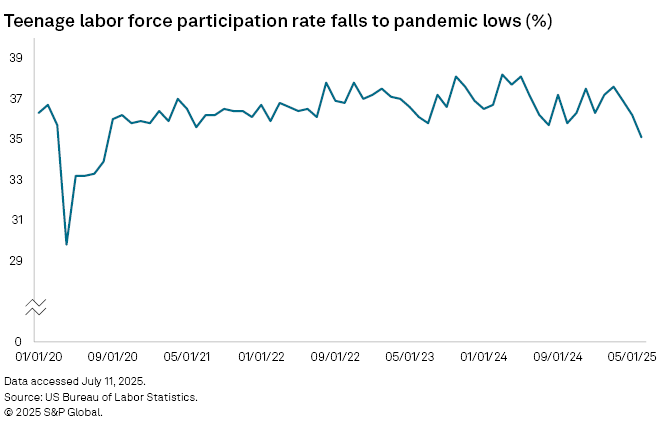
The labor force participation rate for teens, a measure of the percentage of the 16- through 19-year-old population either employed or actively seeking employment, fell to 35.1% in June, down from 36.2% a month earlier and the lowest participation rate for this age group since August 2020, the latest government data showed.
The decline in participation and the rise in unemployment among teens is a sign that the US labor market has a steep barrier to entry, said Allison Shrivastava, an economist with Indeed Hiring Lab.
"If you're in the labor force already, right now you're probably feeling nervous," Shrivastava said. "But, if you're trying to get into the labor force … that's where you're having a really difficult time."
Dubbed the "no hire/no fire" jobs market, US companies are not announcing waves of layoffs and remain reluctant to fire workers following the shortage of labor many struggled through as the country emerged from the pandemic. But rising uncertainty — driven by shifts in trade policy, uncertainty about inflation and interest rates, and fears of a potential recession — has slowed hiring, giving teens fewer employment opportunities than they may have had a year earlier.
"Teen employment is the first to drop off," Shrivastava said. "It's generally a concerning indicator because these are the first people to be overlooked for employment when the labor market starts loosening up."
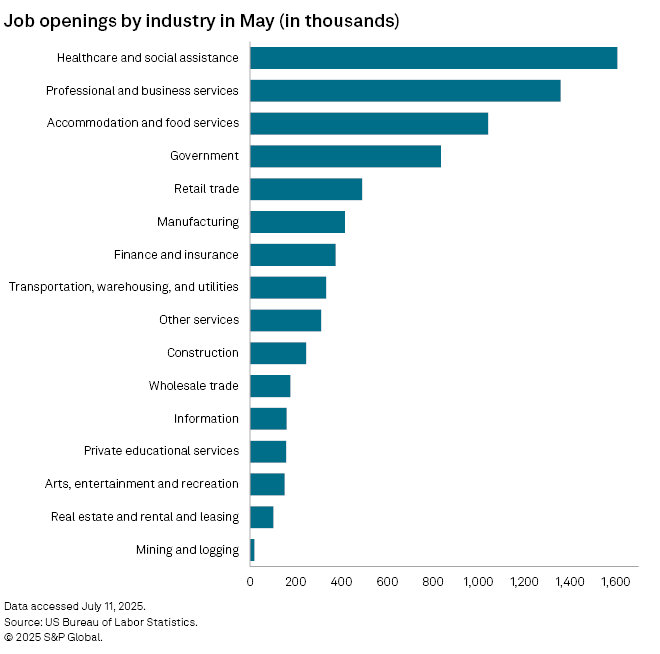
Employers are cutting back or eliminating some summer work positions typically filled by teens, and many of the jobs being added to the labor force are concentrated in healthcare or government, industries that do not typically hire younger workers.
"It's a pretty clean signal on the labor demand side," said Michael Madowitz, principal economist with the Roosevelt Institute.
A summer surge in hiring tends to take place during a hot labor market, where demand is outpacing supply. Slow teen hiring to start the summer indicates a weakening market, Madowitz said.
Cooling off
"Overall, I think that the white-hot labor market coming out of COVID has cooled off," said Northeastern professor
During the previous three summers, employers were desperate to fill entry-level jobs such as cashiers or dishwashers that adults no longer wanted when positions with better pay and potential advancement opened up, Modestino said.
"Now that we are seeing labor demand fall amid the uncertainty of the Trump administration's policies, teens are the lowest down on the list to be hired because they are the least experienced," Modestino said.
Additionally, while fewer companies are hiring teens, fewer teens may be seeking employment. As entry-level hourly wage growth in the service sector has slowed, some teens may be attending summer school instead of working, Modestino said, adding that stricter immigration enforcement could also be pushing some younger workers out of the labor market.